You already know which accounts are about to churn. You just do not know it yet.
The signals are there. Declining product usage, a support ticket that went unresolved for 12 days, an executive sponsor who stopped attending QBRs, a renewal date that crept up without a success plan in place. Without the right tooling, those signals exist in five separate systems, and nobody’s job is to synthesize.
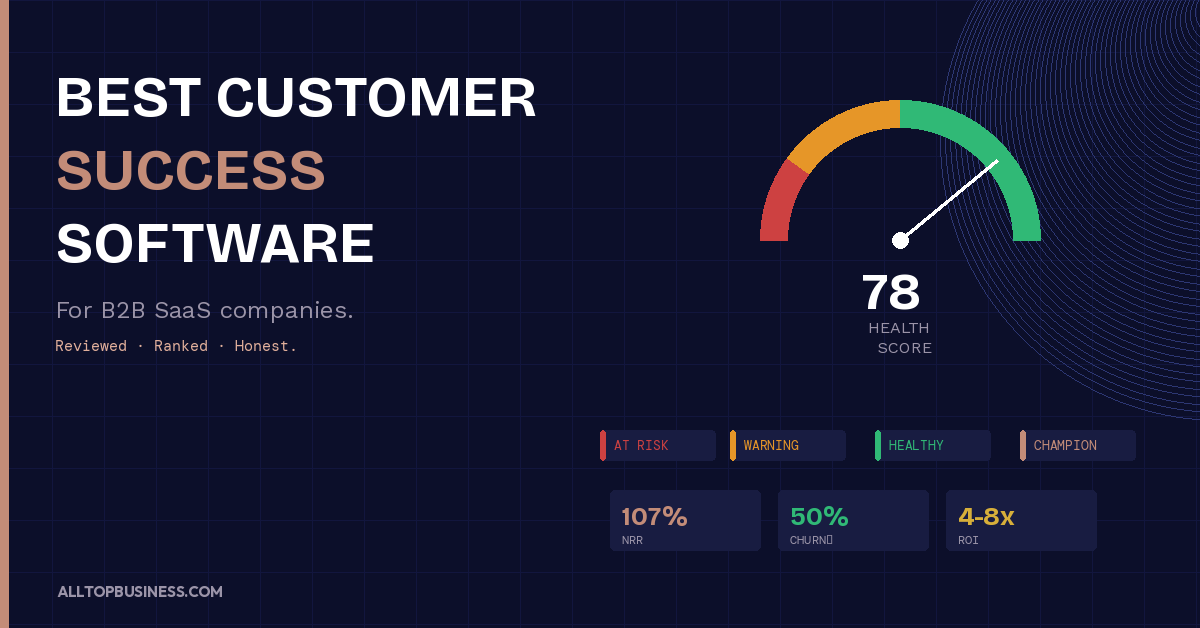
70% of B2B SaaS churn happens in the first 90 days. The customer success management market was valued at $2.68 billion in 2026 and is growing at a 21.67% CAGR, a rate that reflects how quickly subscription businesses are learning that retention is more profitable than acquisition.
Companies with strong customer success programs see 4 to 8 times ROI on their customer success investments. Customers with dedicated CSMs experience 50% lower churn rates. And top-quartile B2B SaaS companies achieve Net Revenue Retention between 115% and 120%, meaning expansion revenue from existing customers more than compensates for any churn.
Customer success software makes that possible at scale. This guide covers the best customer success software tools evaluated specifically for B2B SaaS companies, from early-stage tools to enterprise orchestration platforms. We assessed over 30 customer success software tools to arrive at this list. Every entry includes real 2026 pricing, honest limitations, and a stage-specific recommendation.
Best Customer Success Software Tools: Quick Picks
| Label | Pick |
|---|---|
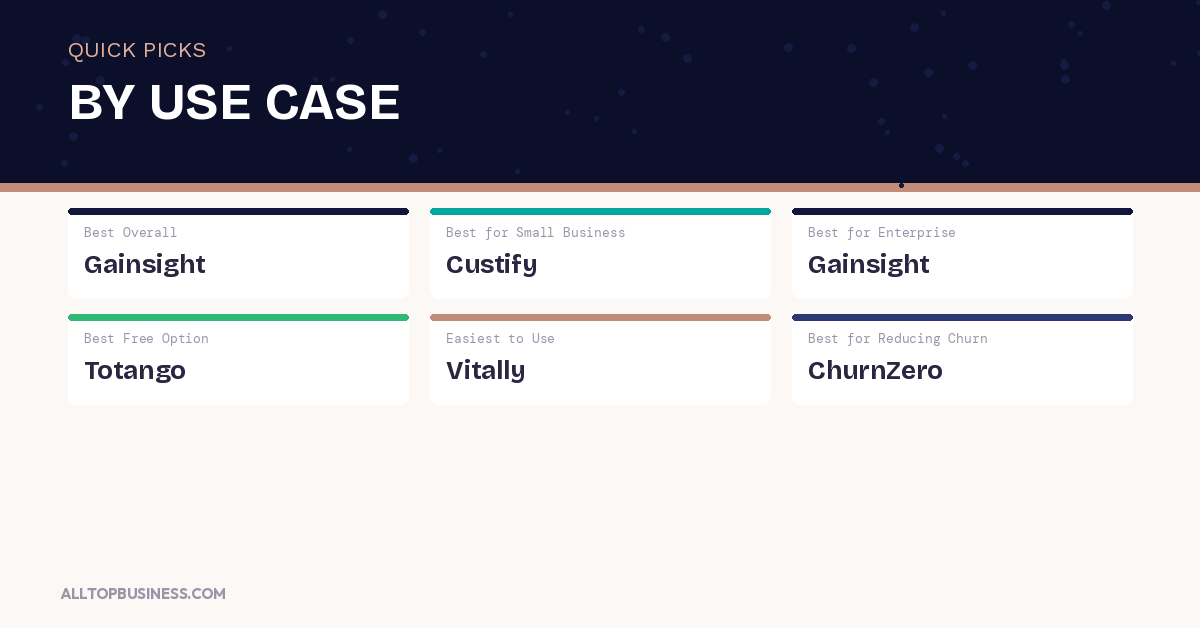
| Best Overall | Gainsight — the most complete enterprise CS platform for high-ARR SaaS teams with dedicated CSMs |
| Best for Small Business | Custify — the fastest path to essential CS automation for early-stage SaaS at accessible pricing |
| Best for Enterprise | Gainsight — unmatched depth in health scoring, journey orchestration, and AI-driven churn prediction |
| Best Free or Low-Cost Option | Totango — free tier with genuine health scoring and customer segmentation for teams under 100 customers |
| Best for Ease of Use | Vitally — the cleanest modern interface in the category with the fastest time to productive use |
| Best for Reducing Churn | ChurnZero — real-time churn alerts and lifecycle automation purpose-built for B2B SaaS retention |
How We Selected The Best Customer Success Software Tools
Every customer success software tool was evaluated against six criteria:
- Customer health scoring — depth and configurability of health score models
- Churn prediction and alerting — AI-driven risk identification before accounts reach a crisis point
- Playbook and workflow automation — lifecycle automation from onboarding through renewal
- Product usage integration — the ability to ingest and act on product telemetry data
- CSM workflow efficiency — account 360 views, task management, and QBR preparation tools
- Pricing accessibility — value delivered at each ARR stage from $1M through $100M+
Best Customer Success Software Tools: Comparison Table
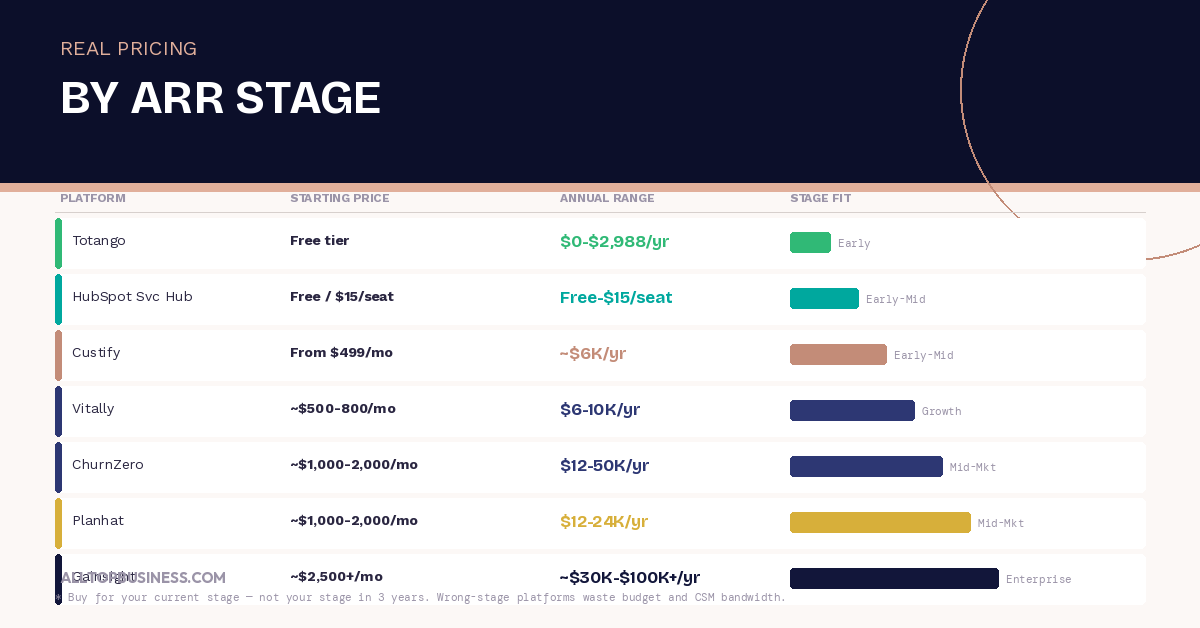
| Tool | Best For | Starting Price | Free Plan | Key Integration |
|---|---|---|---|---|
| Gainsight | Enterprise CS with large dedicated teams | ~$2,500/mo | No | Salesforce, HubSpot, Mixpanel |
| ChurnZero | Mid-market SaaS churn prevention | ~$1,500/mo | No | HubSpot, Salesforce, Stripe |
| Totango | Modular CS orchestration across large account bases | Free tier / $2,988/yr | Yes | Salesforce, HubSpot, Segment |
| Vitally | Modern interface for growth-stage B2B SaaS | ~$500-800/mo | No | HubSpot, Salesforce, Segment |
| Planhat | Revenue-led CS metrics for CRO-reporting teams | ~$1,000-2,000/mo | No | Salesforce, HubSpot, Stripe |
| ClientSuccess | Mid-market relationship-driven CS | Custom | No | Salesforce, HubSpot, Zendesk |
| Custify | Early-stage SaaS needing fast CS automation | From ~$499/mo | No | HubSpot, Stripe, Intercom |
| Userpilot | PLG teams needing in-app engagement and adoption | From $299/mo | No | Segment, Mixpanel, HubSpot |
| Intercom | Product-led growth support and CS workflows | From $29/seat/mo | No | Salesforce, Stripe, HubSpot |
| HubSpot Service Hub | HubSpot-native CS for companies already on HubSpot | Free / from $15/seat/mo | Yes | Native HubSpot ecosystem |
| Freshdesk / Freshsuccess | SMB and mid-market unified support and CS | Free / from $15/seat/mo | Yes | HubSpot, Salesforce, Stripe |
| Pylon | B2B SaaS support and CS in one tool | Custom | No | Slack, HubSpot, Salesforce |
| ZapScale | AI-powered CS for high-volume B2B account management | Custom | No | HubSpot, Salesforce, Mixpanel |
| Mixpanel | Product analytics feeding CS health scores | Free / from $28/mo | Yes | Segment, HubSpot, Salesforce |
| Amplitude | Enterprise product analytics for CS and growth teams | Free / from $49/mo | Yes | Segment, HubSpot, Salesforce |
| Staircase AI | AI-powered customer intelligence from communications | Custom | No | Gmail, Slack, Salesforce |
| Hook | AI churn prediction and revenue intelligence | Custom | No | Salesforce, HubSpot, Stripe |
1. Gainsight
The enterprise standard for customer success — built for high-ARR SaaS companies with dedicated CS teams
Gainsight is the category-defining customer success platform and the default choice for enterprise SaaS companies with mature customer success operations, large account portfolios, and dedicated customer success managers. Its health scoring engine is the most sophisticated available — configuring multi-dimensional health models that combine product usage, support ticket history, NPS scores, contract data, and executive engagement into a single account health view.
The platform’s Journey Orchestration module automates multi-step customer lifecycle workflows from onboarding through expansion and renewal. CSMs get automated task queues driven by health score changes and milestone triggers rather than manual reminders. AI-driven churn prediction identifies at-risk accounts weeks before renewal conversations would surface the problem through normal account review.
Gainsight typically costs around $30,000 per year on average, with advanced configurations crossing six figures annually. Implementation runs 8 to 12 weeks with meaningful professional services investment. The honest reality: this platform is not right for companies under $5M ARR or without at least two to three dedicated CSMs. Below that threshold, the complexity and cost exceed the problem being solved.
What it does well:
- The most sophisticated multi-dimensional health scoring engine in the category
- Journey Orchestration automates complex lifecycle workflows across the full customer lifecycle
- AI churn prediction identifies at-risk accounts weeks in advance
- Revenue Intelligence connects CS health data to expansion and renewal forecasting
- Largest CS platform ecosystem with 100+ integrations across the CS tech stack
Where it falls short:
- Average cost of ~$30,000/year with enterprise deployments exceeding six figures
- 8 to 12 week implementation with significant professional services requirement
- Overkill for companies under $5M ARR or without dedicated CS headcount
- Interface complexity creates adoption challenges for new CSMs without proper training
Pricing: From ~$2,500/month. Average reported cost ~$30,000/year. Enterprise configurations exceed $100,000 annually.
Best for: Enterprise and upper mid-market B2B SaaS companies with $10M+ ARR, 200+ customer accounts, and a dedicated customer success team of three or more CSMs that need the deepest available health scoring and automation.
2. ChurnZero
The best mid-market CS platform for B2B SaaS companies focused on real-time churn prevention
ChurnZero was built specifically for SaaS retention — and it shows. Its Journeys system maps the complete customer lifecycle from onboarding to renewal with native automations triggered by real product behavior within the application.
When a customer’s usage drops below a threshold, ChurnZero triggers an automated outreach sequence before the CSM even opens their task queue. When a renewal is 90 days out and the health score is yellow, a playbook initiates automatically.
The platform’s real-time analytics are its primary differentiator against Gainsight. Health score changes surface immediately rather than in daily batch updates, which matters for teams managing accounts where churn risk can escalate quickly. ChurnZero also provides granular analytics at both the account and CSM level — managers can see which CSMs are managing the highest-risk portfolios and where intervention is needed.
Mid-market tools like ChurnZero typically run $12,000 to $50,000 per year for a 10 to 15-person CS team. Implementation runs 4 to 6 weeks with a lower professional services burden than Gainsight.
What it does well:
- Real-time health score updates rather than daily batch processing
- Journeys lifecycle automation triggered by actual product behavior
- Granular CSM-level analytics for team performance management
- 62 integrations covering CRM, product analytics, support, and billing tools
- Better functionality-to-price ratio than Gainsight for mid-market teams
Where it falls short:
- Less depth in AI predictive analytics versus Gainsight at enterprise scale
- The interface is functional but less modern than Vitally
- Less suitable for professional services or non-SaaS business models
Pricing: ~$1,000 to $2,000/month. Annual contracts typically range from $12,000 to $50,000 for 10 to 15-person CS teams.
Best for: Mid-market B2B SaaS companies with $3M to $30M ARR and 5 to 20 CSMs that need real-time churn prevention automation and lifecycle playbooks built specifically for the SaaS retention motion.
3. Totango
The best modular CS platform for companies wanting a free starting point and flexible orchestration
Totango offers the most accessible entry point in the enterprise CS category. Its free tier provides genuine health scoring and customer segmentation for early-stage teams. Paid plans start at $2,988 per year, which is significantly lower than Gainsight or ChurnZero at comparable functionality.
The platform’s SuccessBLOCS — modular, pre-built customer success programs covering onboarding, adoption, expansion, and renewal — let CS teams deploy proven playbooks without building from scratch. For companies that are formalizing their CS motion for the first time, this guided starting point reduces time to productive CS operations.
Totango’s primary limitation is performance at scale. The platform slows noticeably when loading large datasets, which becomes a daily friction point for teams with very large account portfolios. AI capabilities are also less mature than Gainsight and ChurnZero in 2026.
What it does well:
- Free tier with genuine health scoring — the most accessible entry point in the category
- SuccessBLOCS pre-built playbooks for onboarding, adoption, expansion, and renewal
- Transparent published pricing from $2,988/year
- Good account 360 view with clear tasks and health visibility
- Zoe AI chatbot provides customer summaries on demand via Slack
Where it falls short:
- Performance degrades with large datasets — notable friction for teams with 500+ accounts
- AI capabilities are behind Gainsight and ChurnZero in maturity
- Complex business models with multiple SKUs can be difficult to model in Totango’s data structure
Pricing: Free tier available. Starter from $2,988/year. Enterprise custom pricing. Note: Totango charges a 20% setup fee for new customers.
Best for: Early-stage to mid-market SaaS companies with $500K to $10M ARR that want a proven CS platform with a free starting point, modular pre-built playbooks, and transparent pricing.
4. Vitally
The best modern CS platform for growth-stage B2B SaaS teams
Vitally has earned a devoted following among growth-stage B2B SaaS companies by combining a genuinely modern interface, fast implementation, and strong health scoring in a platform that does not require an enterprise configuration project to start delivering value. Most teams are live and actively managing accounts within two weeks.
The platform’s NPS tracking, health score models, and CSM task management are well-integrated, and its Salesforce and HubSpot integrations bring CRM data into the health score model naturally. For CS teams that have been working from spreadsheets and want the fastest path to a professional CS workflow, Vitally delivers time-to-value faster than any other platform in the mid-market segment.
What it does well:
- The cleanest, most modern CS interface in the category — high CSM adoption from day one
- Fast implementation — typically operational within 2 weeks
- Strong health scoring model with Salesforce, HubSpot, and Segment integration
- Good playbook automation for onboarding, QBR preparation, and renewal workflows
- Competitive pricing at approximately $500 to $800/month for growth-stage teams
Where it falls short:
- Less depth in enterprise-grade reporting and AI analytics versus Gainsight
- Less suitable for very large enterprise deployments with thousands of accounts
- Reporting customization is more limited than ChurnZero at enterprise scale
Pricing: ~$500 to $800/month. Custom pricing for larger teams.
Best for: Growth-stage B2B SaaS companies with $1M to $15M ARR and 2 to 10 CSMs that want a modern, fast-to-implement CS platform with strong health scoring without enterprise platform overhead.
5. Planhat
The best CS platform for revenue-led teams reporting to a CRO
Planhat is designed specifically for customer success teams where the primary metric is Net Revenue Retention rather than NPS or health score. Its revenue intelligence features — expansion pipeline tracking, renewal forecasting, and commercial health scoring — are the most developed in the mid-market customer success category. For customer success teams that present to a CRO and need to demonstrate customer success contribution to revenue growth, Planhat’s reporting framework maps directly to those conversations.
The platform’s timeline view gives CSMs a chronological history of every customer interaction, contract change, and health event in a single scrollable feed — which reduces the QBR preparation time that consumes significant CSM hours in most platforms.
What it does well:
- Revenue-focused health scoring and expansion pipeline tracking
- Best NRR reporting in the mid-market CS category
- Clean timeline view reduces QBR preparation time significantly
- Flexible data model supports complex customer hierarchies
- Strong Salesforce, HubSpot, and Stripe integration
Where it falls short:
- Less depth in in-app engagement and product usage analytics versus ChurnZero
- Implementation requires more configuration than Vitally for fast deployment
- Pricing at $1,000 to $2,000/month is at the higher end of the mid-market segment
Pricing: ~$1,000 to $2,000/month. Custom pricing for enterprise teams.
Best for: Mid-market B2B SaaS CS teams with 5 to 25 CSMs that report to a CRO and need strong NRR tracking, expansion pipeline visibility, and revenue-focused CS reporting.
6. ClientSuccess
The best relationship-driven CS platform for complex B2B sales cycles
ClientSuccess is a customer success tool built around the relationship management side of customer success — milestone tracking, executive stakeholder mapping, and structured success plan management alongside health scoring and renewal workflows. For B2B companies selling to enterprise accounts where relationship depth matters more than product usage signals, ClientSuccess provides the structured framework for managing those relationships at scale.
The platform covers health scores, success plans, playbooks, pulse surveys, and renewal management with a focus on keeping CSMs organized around the relationship milestones that determine renewal rather than just usage data.
What it does well:
- Strong success plan management connecting customer goals to customer success team activities
- Executive stakeholder mapping for multi-contact enterprise accounts
- Clean milestone and cadence tracking for high-touch customer success motions
- Good Salesforce, HubSpot, and Zendesk integration
- Well-suited for professional services, implementation, and complex B2B sale models
Where it falls short:
- Less depth in product usage analytics versus ChurnZero or Gainsight
- Custom pricing requires a sales conversation
- Less suitable for pure product-led growth motions where in-app data is the primary signal
Pricing: Custom pricing based on team size and accounts managed.
Best for: Mid-market B2B companies with complex enterprise sales cycles where relationship management and success plan execution are the primary CS levers, particularly professional services, implementation, and multi-stakeholder enterprise SaaS.
7. Custify
The fastest path to customer success automation for early-stage SaaS companies
Custify is built for B2B SaaS companies that need customer success automation without enterprise pricing or an 8-week implementation project. The platform can be configured and live in days, covers health scoring, lifecycle management, and task automation, and starts at approximately $499 per month.
For teams at the $1M to $5M ARR stage where CS is managed by one or two people wearing multiple hats, Custify provides the essential customer success infrastructure — automated health alerts, renewal reminders, and lifecycle playbooks — without the overhead of configuring a full enterprise platform.
What it does well:
- Industry-leading implementation speed — most teams live within days
- Health scoring, lifecycle automation, and NPS workflows at accessible pricing
- Clean interface appropriate for non-CS-specialist team members
- Good HubSpot, Stripe, and Intercom integration
- Pricing from ~$499/month — accessible without board approval
Where it falls short:
- Feature depth does not match Gainsight or ChurnZero for enterprise-scale requirements
- Reporting and analytics are lighter than mid-market platforms
- Less suitable for teams managing more than 300 to 400 accounts simultaneously
Pricing: From ~$499/month. Custom pricing for larger teams.
Best for: Early-stage B2B SaaS companies with $500K to $5M ARR and one to three people handling customer success alongside other roles, who need essential health scoring and lifecycle automation deployed in days.
8. Userpilot
The best in-app engagement platform for product-led growth SaaS teams
Userpilot is the strongest option for PLG teams that need to act on customer success at the product layer without engineering involvement. It delivers in-app onboarding tours, feature announcements, NPS surveys, and adoption analytics through a no-code editor that customer success and product teams control directly.
Where most customer success software tells you a customer is at risk based on usage decline, Userpilot lets you respond to that risk inside the product — triggering a contextual onboarding checklist, a feature discovery tooltip, or an in-app message from the CSM — without waiting for a support ticket or an email outreach sequence.
Pricing starts at $299 per month based on Monthly Active Users rather than CSM seats, which makes it a fundamentally different cost model from traditional customer success platforms.
What it does well:
- No-code in-app onboarding tours, feature announcements, and adoption flows
- In-app NPS and CSAT surveys with segmented targeting
- Product analytics for tracking feature adoption and user journey completion
- MAU-based pricing reduces cost for teams with small customer success headcount but large user bases
- Strong Segment, Mixpanel, and HubSpot integration
Where it falls short:
- Not a full CS platform — does not replace health scoring or renewal management
- Less suitable for high-touch enterprise customer success motions where relationship management dominates
- MAU-based pricing can escalate quickly for products with large user bases
Pricing: From $299/month. Scales by Monthly Active Users rather than CSM seats.
Best for: PLG B2B SaaS companies with $1M to $20M ARR that need to improve onboarding completion rates, feature adoption, and in-app engagement without engineering resources or development cycles.
9. Intercom
The best unified support and customer success platform for product-led SaaS companies
Intercom is the most widely adopted customer messaging and support platform for SaaS companies. For customer success teams that handle both reactive support and proactive customer success, Intercom’s unified inbox, automated workflows, and customer data platform reduce the context-switching between separate tools.
The platform’s AI agent Fin handles routine support queries autonomously, which frees the customer success team time for proactive, high-value customer work. For PLG SaaS companies where the customer success and support functions overlap significantly, Intercom provides a single platform rather than two separate subscriptions.
What it does well:
- Fin AI handles routine support queries autonomously — significant customer success team time savings
- Unified inbox combining support tickets, chat, and proactive outreach
- In-app messaging and onboarding flows alongside support workflows
- Strong product usage-based segmentation for proactive outreach targeting
- Widely integrated with the SaaS tool stack
Where it falls short:
- Not a dedicated customer success platform — health scoring and renewal management are lighter than purpose-built CS tools
- Can be expensive for large teams when Fin AI usage is included in higher tiers
- Less suitable for high-touch enterprise customer success motions managing complex account portfolios
Pricing: Starter from $29/seat/month. Pro from $85/seat/month. Enterprise custom pricing.
Best for: PLG and low-to-mid-touch B2B SaaS companies where support and customer success overlap significantly, and a unified customer messaging platform is more valuable than separate best-of-breed tools for each function.
10. HubSpot Service Hub
The best customer success software for B2B SaaS companies already on HubSpot CRM
HubSpot Service Hub is the natural customer success extension for companies already running HubSpot CRM and Marketing Hub. Every customer interaction, health event, and support ticket lives in the same contact and company records that sales and marketing already use, which eliminates the data silos that plague customer success teams working in separate platforms.
The platform covers help desk, knowledge base, customer portal, NPS surveys, and basic health scoring — with the free tier offering meaningful functionality for early-stage teams. For companies that want to avoid a separate customer success platform subscription while already paying for HubSpot, Service Hub delivers most of the essential customer success workflow within the existing investment.
What it does well:
- Native integration with HubSpot CRM eliminates data silos between sales and customer success
- Free tier with genuine ticketing, knowledge base, and basic health scoring
- Breeze AI features for ticket summarization and suggested responses
- Customer portal for self-service ticket tracking and knowledge base access
- Easy cross-sell and expansion tracking connected to HubSpot deals
Where it falls short:
- Health scoring and CS automation are less deep than dedicated customer success platforms
- Less suitable for high-ARR enterprise customer success motions requiring sophisticated health models
- Best value for HubSpot-native companies — less compelling as a standalone customer success platform
Pricing: Free tier available. Starter from $15/seat/month. Professional from $90/seat/month. Enterprise from $130/seat/month.
Best for: B2B SaaS companies already running HubSpot CRM that want to extend into customer success workflows without adding a separate platform vendor and subscription.
11. Freshdesk / Freshsuccess
The best SMB-friendly unified support and CS option
Freshdesk is Freshworks’ support platform, and FreshSuccess (formerly Natero) is its CS-specific module for mid-market SaaS teams. Together, they provide a unified support and customer success experience for SMB and mid-market teams that want health scoring, lifecycle automation, and help desk capability from a single vendor at competitive pricing.
The free Freshdesk plan is genuine, covering unlimited agents for basic ticketing. Paid tiers add automation, health scoring, and deeper customer success workflows. For teams that are managing support and customer success from the same small team, Freshworks’ unified platform reduces tool fragmentation effectively.
What it does well:
- Free Freshdesk tier with unlimited agent access for basic support
- Unified support and customer success workflows for teams that cover both functions
- Competitive pricing relative to Gainsight and ChurnZero at equivalent CS functionality
- Good HubSpot, Salesforce, and Stripe integration
- Freddy AI for automated ticket resolution and customer success health alerts
Where it falls short:
- FreshSuccess is less widely known and less proven than ChurnZero or Vitally
- Health scoring depth is lighter than that of dedicated customer success platforms
- Less suitable for enterprise-scale customer success with hundreds of accounts and complex automation
Pricing: Free Freshdesk tier. Growth from $15/seat/month. Enterprise custom pricing.
Best for: SMB and lower mid-market B2B SaaS companies that need both support and CS functionality from a single vendor at accessible pricing.
12. Pylon
The best tool for B2B SaaS teams where support and customer success are the same function
Pylon takes the position that support and customer success should not live in separate tools for B2B teams. The platform combines ticket management with health scoring and proactive outreach, built specifically for B2B SaaS companies where the customer success team handles reactive support issues and proactive success activities simultaneously.
Its Slack-based support ticketing — where B2B customers submit and track support requests through shared Slack channels rather than email — is its most distinctive feature. For modern SaaS companies whose enterprise customers prefer Slack over email ticketing, Pylon provides a native support experience alongside customer success health tracking.
What it does well:
- Native Slack-based ticketing for B2B customers that prefer channel-based support
- Unified support and customer success health visibility in one tool
- Strong HubSpot and Salesforce integration for CRM data enrichment
- Fast implementation for teams moving off legacy support tools
- Good fit for companies where the same people handle support and success
Where it falls short:
- Newer entrant with a smaller integration ecosystem than established platforms
- Less proven at enterprise scale compared to Gainsight or ChurnZero
- Less suitable for organizations with large dedicated support teams separate from CS
Pricing: Custom pricing based on team size.
Best for: B2B SaaS companies with $1M to $10M ARR where support and customer success are handled by the same team, and customers prefer Slack-based communication over traditional email ticketing.
13. ZapScale
The best AI-powered CS platform for teams managing high-volume B2B accounts
ZapScale is an AI-first customer success platform built specifically for B2B companies with large account volumes where manual CSM intervention on every account is not operationally feasible. Its AI layer handles health scoring across every account continuously, surfaces the highest-priority intervention opportunities automatically, and generates account summaries that reduce CSM preparation time for QBRs and renewal conversations.
The platform’s ready-made playbooks reduce configuration time significantly — teams can deploy proven customer success automation patterns without building workflows from scratch. For customer success teams that are stretched across more accounts than manual management allows, ZapScale’s automation-first approach scales customer success capacity without proportional headcount growth.
What it does well:
- AI-driven health scoring across high-volume account bases with minimal manual input
- Ready-made playbooks for rapid deployment without workflow configuration projects
- Strong churn prediction with early warning signals ahead of renewal windows
- Good HubSpot, Salesforce, and Mixpanel integration
- Faster implementation than enterprise platforms like Gainsight
Where it falls short:
- Less brand recognition than Gainsight, ChurnZero, or Vitally
- Custom pricing requires a sales conversation
- Less suitable for high-touch enterprise customer success motions where relationship depth is the primary retention lever
Pricing: Custom pricing based on account volume and team size.
Best for: Mid-market B2B SaaS companies managing 200+ accounts per CSM where AI-driven automation is the only way to maintain meaningful coverage across the full customer base.
14. Mixpanel
The best product analytics platform for building usage-based CS health scores
Mixpanel is not a customer success platform — it is a product analytics tool. It belongs on this list because product usage data is the most predictive signal for customer health, and the quality of that data determines how accurate any customer success platform’s health scoring will be.
70% of B2B SaaS churn happens in the first 90 days. The top three predictors of churn are product usage data, low engagement indicators, and health scores. Mixpanel provides the product usage layer that feeds those signals into platforms like Gainsight, ChurnZero, and Vitally.
For CS teams whose CS platform health scores are not reflecting reality, the problem is almost always upstream data quality rather than the CS platform itself.
What it does well:
- Deep behavioral analytics tracking exactly how customers use the product
- Funnel analysis for identifying where customers drop off during onboarding
- Cohort analysis for comparing retention across customer segments and acquisition periods
- Strong Segment, HubSpot, and Salesforce integration
- Free tier covering 20 million events per month — accessible for early-stage teams
Where it falls short:
- Not a CS platform — does not provide health scoring, playbooks, or renewal management
- Requires technical implementation to instrument product events correctly
- Full value is only realized when integrated with a dedicated CS platform
Pricing: Free for 20 million events/month. Growth from $28/month. Enterprise custom pricing.
Best for: B2B SaaS CS teams that want to improve health score accuracy by feeding high-quality product usage data into their CS platform rather than relying on proxy metrics.
15. Amplitude
The best enterprise product analytics platform for CS and growth teams
Amplitude is Mixpanel’s primary competitor in the product analytics category. For enterprise SaaS companies with complex product instrumentation requirements, large user bases, and sophisticated analytics needs, Amplitude’s more powerful query engine and better support for complex event taxonomies make it the preferred choice over Mixpanel.
Like Mixpanel, Amplitude belongs in a CS software guide because the quality of product analytics data directly determines the predictive accuracy of CS health scoring. The free tier covers up to 10 million events per month, and the Growth plan starts at $49/month.
What it does well:
- A more powerful query engine than Mixpanel for complex analytical requirements
- Strong behavioral cohorts for segmenting customers by usage pattern
- Amplitude AI for automated insight generation from product usage data
- Deep Segment integration for clean event data pipeline management
- Better enterprise governance and data management features than Mixpanel
Where it falls short:
- More complex to implement and maintain than Mixpanel for simpler analytics needs
- Not a CS platform — requires integration with a dedicated customer success tool
- Enterprise pricing can be significantly higher than Mixpanel for large event volumes
Pricing: Free for 10 million events/month. Plus from $49/month. Growth and Enterprise custom pricing.
Best for: Enterprise B2B SaaS companies with complex product analytics requirements that want deeper query capabilities and better data governance than Mixpanel provides.
16. Staircase AI
The best AI customer intelligence platform for CS teams drowning in communication data
Staircase AI analyzes every customer communication — emails, Slack messages, meeting notes, and support tickets — to extract relationship health signals that usage data and NPS surveys miss. It identifies sentiment shifts, executive sponsor disengagement, and relationship risk in conversations before those signals appear in product usage metrics.
For enterprise customer success teams managing complex accounts where relationship health is as important as product usage, Staircase AI surfaces the qualitative signals that quantitative platforms cannot capture. It integrates with CRM systems and customer success software as a complementary intelligence layer rather than a replacement.
What it does well:
- AI analysis of all customer communications for relationship health signals
- Executive sponsor engagement tracking across email and Slack
- Sentiment analysis identifies risk earlier than usage-based health scores alone
- CRM and CS platform integration — works alongside Gainsight and ChurnZero
- Reduces the manual relationship health assessment work that CSMs currently do intuitively
Where it falls short:
- Not a standalone customer success software — requires integration with a primary customer success tool
- Custom pricing requires a sales conversation
- Less suitable for high-volume, low-touch customer success motions where relationship data is thin
Pricing: Custom pricing based on team size and account volume.
Best for: Enterprise customer success teams managing complex, high-value accounts where relationship health signals from communications are as important as product usage data for predicting churn risk.
17. Hook
The best AI revenue intelligence platform for CS teams focused on expansion and upsell
Hook uses machine learning to predict which customers are ready to expand and which are at risk of churning, trained on product usage, billing data, and engagement signals. Where most customer success tools are defensive — built to prevent churn — Hook specifically focuses on the offensive opportunity: identifying expansion-ready accounts and surfacing them to customer success and sales teams before the customer expresses interest.
For customer success leaders who need to demonstrate revenue contribution to the board, Hook’s expansion prediction directly connects customer success activity to pipeline generation.
What it does well:
- Machine learning expansion prediction trained on multi-signal customer data
- Identifies expansion-ready accounts before customers self-identify as interested
- Churn risk scoring at the account and product line level
- Strong Salesforce, HubSpot, and Stripe integration
- CS-to-revenue attribution for demonstrating customer success contribution to NRR
Where it falls short:
- Not a full customer success workflow platform — no playbooks, health score configuration, or QBR tools
- Custom pricing requires a sales conversation
- Best value when combined with a primary customer success software rather than as a standalone tool
Pricing: Custom pricing based on account volume.
Best for: Mid-market to enterprise customer success teams that want AI-driven expansion revenue identification alongside churn risk scoring, and customer success leaders who need to demonstrate pipeline generation contribution from customer success activities.
How to Choose the Best Customer Success Software Tool
The biggest Customer Success Software mistake is buying a tool built for a different stage.
A $2M ARR company with two CSMs does not need Gainsight. A $50M ARR company with 20 CSMs cannot run on Custify. Stage fit is the first filter. Everything else is secondary.
Match the platform to your ARR and CS headcount
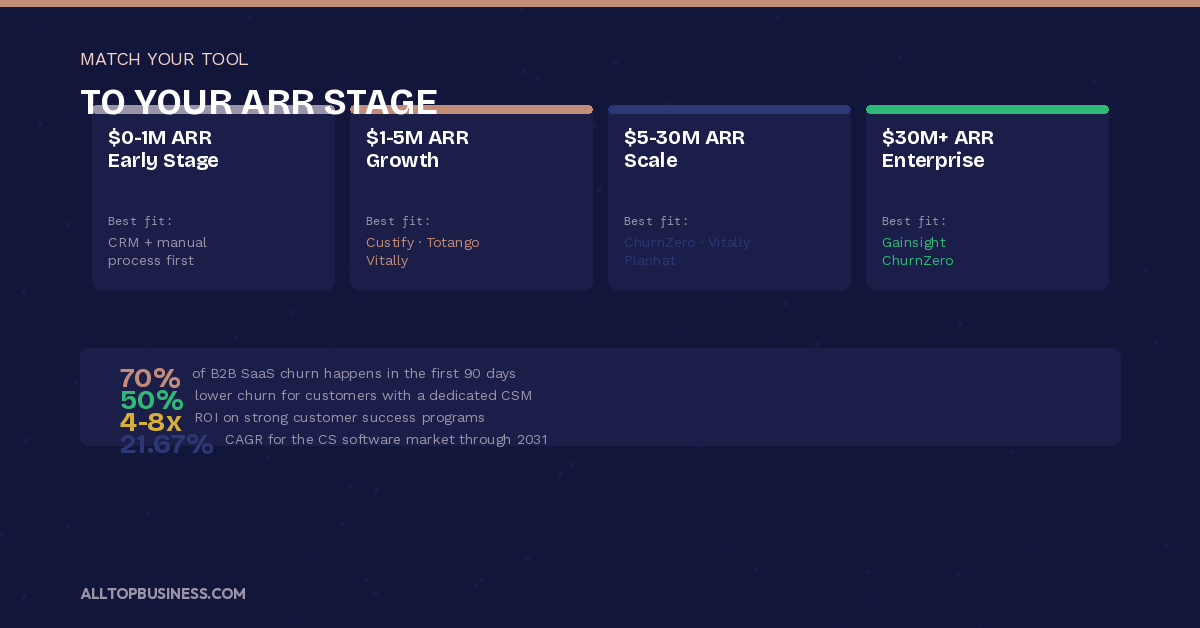
Under $1M ARR: do not buy a dedicated CS platform yet. Use your CRM with disciplined processes. At $1M to $5M ARR with one to two CSMs: Custify, Totango free tier, or Vitally.
At $5M to $30M ARR with 3 to 15 CSMs: ChurnZero, Vitally, or Planhat. Above $30M ARR with 15+ CSMs: Gainsight or ChurnZero at the high end. These are ranges, not exact thresholds, but the direction is clear.
Identify your primary retention lever
Product usage-driven churn? Prioritize platforms with strong product analytics integration — ChurnZero, Gainsight, or Userpilot for PLG teams. Relationship-driven churn at enterprise accounts? ClientSuccess, Staircase AI, or Gainsight.
Revenue expansion as the primary customer success goal? Planhat or Hook. Onboarding and early activation problems? Userpilot addresses this at the product layer before a customer success software tool is even needed.
Implementation capacity matters as much as features
ChurnZero deploys in 4 to 6 weeks. Vitally and Custify deploy in days to two weeks. Gainsight deploys in 8 to 12 weeks.
If your CS team cannot spare the bandwidth for a long implementation project, the fastest-deploying platform that covers your primary use case is always the better choice over a more capable platform that takes three months to configure.
Frequently Asked Questions
What is the best customer success software overall?
Gainsight is the enterprise standard for large SaaS companies with mature customer success operations. For mid-market teams, ChurnZero delivers the best functionality-to-price ratio for SaaS-specific churn prevention.
For growth-stage teams that want fast deployment and a modern interface, Vitally is the strongest starting point. The right answer always depends on ARR stage and customer success team size — not platform reputation alone.
When should a SaaS company invest in dedicated customer success software?
The practical threshold is 50+ customers, at least one dedicated CSM, and defined retention challenges you are trying to solve systematically.
Below that, your CRM with disciplined manual processes is usually more efficient than a customer success software tool that requires configuration investment. Above it, the customer success software tool pays for itself quickly through improved retention and CSM efficiency.
How much does customer success software cost?
Totango’s free tier is genuinely functional for small teams. Custify and Vitally start at approximately $500/month. ChurnZero runs $1,000 to $2,000/month.
Gainsight averages around $30,000/year, with enterprise deployments exceeding $100,000 annually. Implementation costs are additional for platforms requiring professional services engagement.
What is a customer health score?
A health score is a composite metric that aggregates multiple customer signals — product usage frequency, feature adoption depth, support ticket volume, NPS scores, contract value, and executive engagement — into a single score indicating how likely a customer is to renew or churn.
Health scores below 70% typically correlate with significantly higher churn risk. The quality of a health score depends entirely on the quality and completeness of the underlying data inputs.
What is Net Revenue Retention and why does it matter for customer success?
Net Revenue Retention measures the percentage of recurring revenue retained from existing customers over a period, including expansion revenue from upsells and cross-sells minus churn and downgrades. A 107% NRR means the existing customer base grew 7% through expansion alone, with no new customer acquisition needed.
Top-quartile B2B SaaS companies achieve NRR between 115% and 120%. Customer success software directly influences NRR by reducing churn and creating expansion opportunities.
What is the difference between customer success and customer support?
Customer support is reactive — it responds to problems customers surface. Customer success is proactive — it identifies and addresses risks before customers know they have a problem.
Support measures ticket resolution time and CSAT. Customer success measures health scores, NRR, time to value, and churn rate. Both functions matter, but conflating them leads to under-investing in the proactive retention activities that customer success software tools enable.
Final Verdict
Gainsight for enterprise SaaS with mature customer success operations and budget to match. ChurnZero for mid-market B2B SaaS where real-time churn prevention and playbook automation are the primary requirements. Vitally for growth-stage teams that want the fastest deployment and the cleanest modern interface.
Custify for early-stage teams that need to get essential customer success automation live this week rather than after an 8-week implementation. Totango for teams that want to start free and graduate to a paid plan as their customer success motion matures.
Userpilot, when the problem is activation and in-app adoption rather than post-activation churn management. Staircase AI or Hook as intelligence layers on top of your primary customer success software tool for teams that want qualitative relationship signals or expansion prediction alongside standard health scoring.
The most expensive customer success decision is not choosing the wrong platform. It is buying a platform that is too advanced for your current stage, spending months on configuration, and deploying it before your customer success processes are mature enough to use what it offers.
For related B2B SaaS operations reading, explore our guide on the best CRM software for B2B sales teams and browse all B2B software reviews on the AllTopBusiness blog. Have a specific customer success software question? Contact our team directly.

I’m Adeyemi Adetilewa, a Content Marketing and SEO Specialist, Digital Strategist, Entrepreneur, and the Editor of AllTopBusiness.com. With over 13 years of experience helping businesses scale through content-driven growth, I’m happy to share all the top business tools I have discovered with you here.