Marketing automation in 2026 means something fundamentally different from what it meant five years ago. Email drip campaigns and lead scoring, the original definition, are now table stakes.
The B2B companies generating the most pipeline are automating the full buyer experience: intent signals identifying in-market accounts, personalized content delivered across multiple channels simultaneously, sales and marketing sharing the same data in real time, and AI agents that can adapt messaging based on buyer behavior without human intervention.
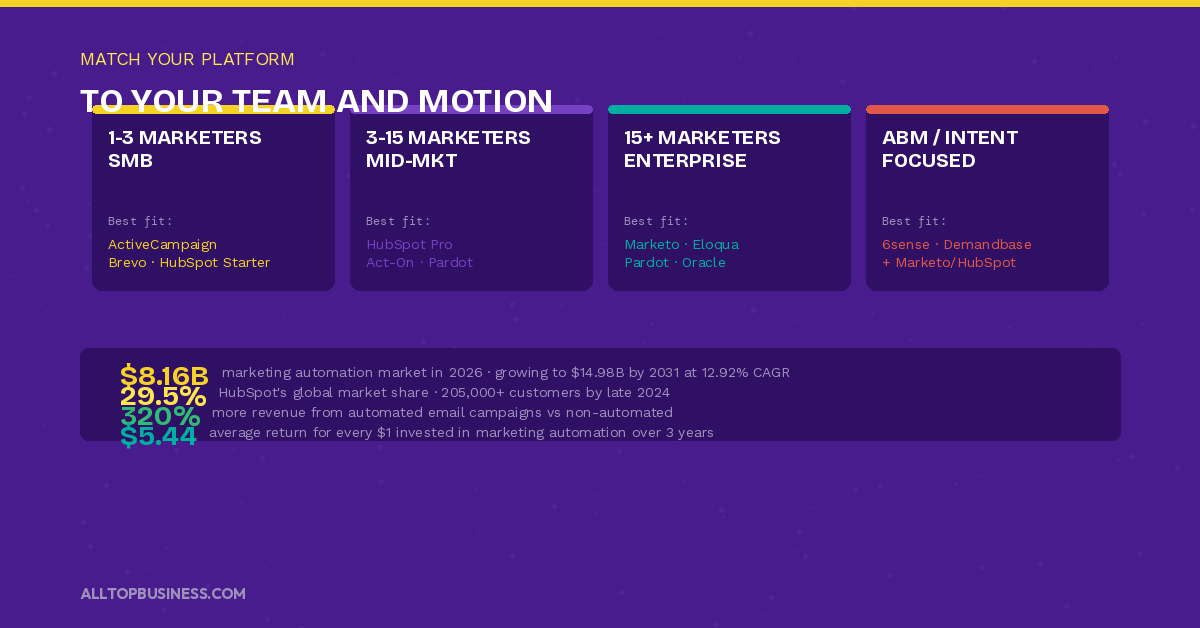
The global marketing automation software market is valued at $8.16 billion in 2026 and is projected to reach $14.98 billion by 2031 at a 12.92% CAGR.
HubSpot dominates market share at approximately 29.5% to 38%, with 205,000+ customers by late 2024. Automated email campaigns generate about 320% more revenue than non-automated campaigns. Companies earn an average return of $5.44 for every $1 invested in automation platforms over three years.
Yet 46% of B2B organizations report using marketing automation extensively, which means more than half are not. The gap between teams that automate intelligently and those that do not is widening every quarter.
This guide covers the best marketing automation software evaluated specifically for B2B companies. We assessed several B2B marketing automation software for small businesses to arrive at this list. Every entry includes real 2026 pricing, honest limitations, and a specific recommendation for who each tool actually fits.
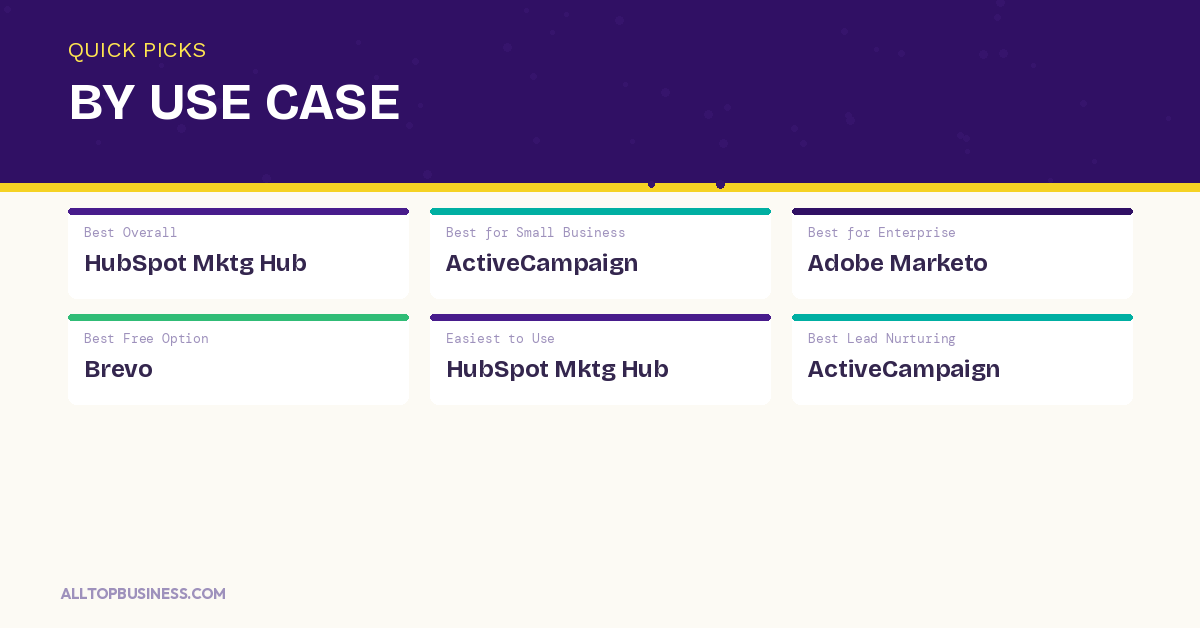
Best B2B Marketing Automation Software: Quick Picks
| Label | Pick |
|---|---|
| Best Overall | HubSpot Marketing Hub — the most complete all-in-one marketing automation and CRM platform for B2B teams of every size |
| Best for Small Business | ActiveCampaign — the most powerful email automation and CRM for small B2B teams at a fraction of HubSpot’s price |
| Best for Enterprise | Adobe Marketo Engage — the enterprise standard for complex B2B nurture programs, lead scoring, and account-based marketing |
| Best Free or Low-Cost Option | Brevo — free tier covering 300 emails per day with CRM, email, and SMS automation |
| Best for Ease of Use | HubSpot Marketing Hub — the fastest path from signup to running a campaign in the category |
| Best for Lead Nurturing | ActiveCampaign — the deepest email automation and behavioral triggers for long B2B buying cycles |
How We Selected The Best Marketing Automation Software
Every B2B marketing automation software was evaluated against six criteria:
- B2B-specific automation depth — lead scoring, multi-step nurture programs, and buying stage logic
- CRM and sales alignment — integration quality with Salesforce, HubSpot CRM, and sales engagement tools
- Multichannel capability — email, SMS, web personalization, social, and paid advertising automation
- AI capabilities — AI content generation, predictive scoring, behavioral triggers, and AI agents
- Pricing transparency — real cost data from public sources and verified market research
- Implementation complexity — realistic time to first campaign for teams without a dedicated marketing ops specialist
Best Marketing Automation Software: Comparison Table
| Tool | Best For | Starting Price | Free Plan | Key Integration |
|---|---|---|---|---|
| HubSpot Marketing Hub | All-in-one CRM + marketing for SMB and mid-market | Free / from $20/mo | Yes | Native CRM, Salesforce, Slack |
| Adobe Marketo Engage | Enterprise B2B complex nurture and ABM | ~$895-$3,195/mo | No | Salesforce, Microsoft Dynamics |
| Salesforce Marketing Cloud (Pardot) | Salesforce-native B2B marketing automation | From $1,250/mo | No | Native Salesforce ecosystem |
| ActiveCampaign | Affordable email automation and CRM for SMB | From $29/mo | No (trial) | Salesforce, HubSpot, Shopify |
| Brevo | Budget-conscious multichannel marketing | Free / from $9/mo | Yes | HubSpot, Salesforce, WooCommerce |
| Klaviyo | Email and SMS for product-led B2B and ecommerce | Free / from $45/mo | Yes | Shopify, WooCommerce, BigCommerce |
| Oracle Eloqua | Enterprise governance-heavy B2B nurture programs | Custom | No | Oracle CRM, Salesforce, Dynamics |
| Act-On | Mid-market full-featured marketing automation | From $900/mo | No | Salesforce, HubSpot, Dynamics |
| Mailchimp | SMB email marketing with basic automation | Free / from $13/mo | Yes | Shopify, Salesforce, QuickBooks |
| Keap | Small service-based business CRM + automation | From $299/mo | No (trial) | QuickBooks, Stripe, WooCommerce |
| 6sense | ABM intent platform for enterprise pipeline | Custom ($35K+/yr) | No | Salesforce, HubSpot, Outreach |
| Demandbase | ABM platform for enterprise B2B marketing | Custom ($18K+/yr) | No | Salesforce, HubSpot, Marketo |
| Customer.io | Behavioral messaging for B2B SaaS companies | From $100/mo | No (trial) | Segment, Twilio, Stripe |
| Klaviyo B2B | B2B variant of Klaviyo for product-led growth | Free / from $45/mo | Yes | HubSpot, Salesforce, Segment |
| Encharge | Behavior-based email automation for B2B SaaS | From $99/mo | No (trial) | HubSpot, Segment, Stripe |
| Constant Contact | Very small business email marketing | From $12/mo | No (trial) | Shopify, WooCommerce, Salesforce |
| Drip | E-commerce and B2B email automation | From $39/mo | No (trial) | Shopify, WooCommerce, HubSpot |
1. HubSpot Marketing Hub
The best all-in-one marketing automation and CRM platform for B2B SMB and mid-market teams
HubSpot Marketing Hub is the default choice for B2B teams that want marketing automation, CRM, and sales alignment from a single vendor without managing integrations between separate platforms. Its visual workflow builder, form and landing page tools, email automation, and SEO capabilities all share the same contact database as HubSpot CRM and Sales Hub — which means every marketing interaction is visible to sales in real time without a sync or API configuration.
HubSpot Breeze AI, now fully integrated across all tiers, handles content generation, email subject line optimization, contact enrichment, and workflow suggestions. The jump from Starter at $20/month to Professional at $890/month is significant and frequently cited as the primary pain point for growing teams — it is the steepest pricing cliff in the category.
HubSpot holds approximately 29.5% to 38% of the global marketing automation market, reflecting how broadly mid-market B2B teams have converged on it as the default stack anchor. For teams under 500 employees without an existing enterprise CRM commitment, HubSpot Professional is the most practical all-in-one starting point.
What it does well:
- All marketing, sales, and service data on one contact record — no cross-platform sync required
- Breeze AI across content generation, lead scoring, workflow automation, and email optimization
- Visual workflow builder accessible to non-technical marketers without a marketing ops specialist
- Comprehensive feature set covering email, landing pages, SEO, social, ads, and webinars
- Free CRM with unlimited contacts is the most accessible entry point in the all-in-one category
Where it falls short:
- The Starter to Professional pricing jump ($20 to $890/month) is the steepest cliff in the category
- Contact-based pricing means costs scale with database growth — significant for high-volume teams
- Very complex enterprise use cases sometimes require workarounds or custom integrations
- Advanced features like multi-touch attribution and custom reporting require Enterprise at $3,600+/month
Pricing: Free plan. Starter from $20/month. Professional from $890/month. Enterprise from $3,600/month. Contact-based pricing applies to Professional and Enterprise.
Best for: B2B SMB and mid-market companies with 5 to 500 employees that want marketing, CRM, and sales on a single platform without managing multiple vendor integrations.
2. Adobe Marketo Engage
The enterprise standard for complex B2B nurture programs and account-based marketing
Marketo Engage remains the benchmark for large B2B organizations running complex, multi-stage nurture programs with granular segmentation, sophisticated lead scoring, and account-based marketing at scale. Its lead scoring engine earned a 9.5/10 rating from expert reviewers in March 2026 for its depth — combining demographic data, behavioral signals, and predictive analytics to identify sales-ready leads with precision that HubSpot and ActiveCampaign cannot match at equivalent configuration.
Marketo pricing ranges from $895 to over $3,195 per month for typical enterprise configurations. The platform requires a dedicated Marketo administrator to configure and maintain — teams without specialized marketing operations expertise consistently underutilize it.
For mid-market companies without a dominant Adobe or Salesforce commitment, Marketo is frequently oversized. The consensus among marketing analysts in 2026 is clear: start with HubSpot; graduate to Marketo when your programs are genuinely complex enough to justify the operational overhead.
What it does well:
- The deepest lead scoring engine in the category — 9.5/10 expert rating in 2026 for predictive accuracy
- Complex multi-step nurture programs with conditional branching that outperform HubSpot at scale
- Granular segmentation across behavioral, firmographic, and intent data
- Native ABM capabilities alongside traditional demand generation programs
- Deep Salesforce and Microsoft Dynamics integration for enterprise CRM environments
Where it falls short:
- Requires a dedicated Marketo administrator — teams without one consistently underutilize the platform
- Pricing from $895 to $3,195+/month is inaccessible for most SMBs and lower mid-market companies
- Implementation takes 2 to 4 months with a significant professional services investment
- The interface is dated compared to HubSpot and ActiveCampaign for non-technical marketers
Pricing: Typically $895 to $3,195/month based on database size and features. Custom enterprise pricing.
Best for: Large B2B enterprises with dedicated marketing operations staff, complex multi-stage nurture programs, and Salesforce as the CRM of record that need the deepest available lead scoring and ABM capability.
3. Salesforce Marketing Cloud Account Engagement (Pardot)
The best marketing automation for B2B organizations is already deep in the Salesforce ecosystem
Salesforce Marketing Cloud Account Engagement — formerly Pardot — is the natural marketing automation choice for B2B organizations where Salesforce Sales Cloud is the system of record and avoiding cross-platform sync issues is a strategic priority. Every lead behavior, form submission, email open, and scoring change flows directly into Salesforce records in real time without middleware.
The platform covers email marketing, landing pages, lead scoring, nurture programs, and ROI reporting in a B2B-specific design that Salesforce Marketing Cloud (built for B2C) does not replicate as cleanly for long sales cycles. Einstein AI within the platform handles predictive lead scoring, send time optimization, and engagement scoring across the nurture program.
What it does well:
- Native Salesforce integration with real-time bidirectional sync — no middleware required
- B2B-specific design for long sales cycles with account-based lead scoring
- Einstein AI for predictive scoring and engagement analysis
- Comprehensive ROI and multi-touch attribution reporting for revenue marketing teams
- Agentforce integration for AI-driven campaign orchestration
Where it falls short:
- Best value only for organizations deeply committed to the Salesforce ecosystem
- The starting price of $1,250/month plus Salesforce licensing makes it expensive for SMBs
- The interface and workflow builder are less modern than HubSpot for non-technical marketers
- Implementation requires Salesforce expertise alongside Pardot-specific knowledge
Pricing: Growth from $1,250/month (up to 10,000 contacts). Plus from $2,500/month. Advanced from $4,000/month.
Best for: Mid-market to enterprise B2B organizations where Salesforce Sales Cloud is the definitive CRM of record and marketing-to-sales data alignment without cross-platform sync is the primary requirement.
4. ActiveCampaign
The best marketing automation platform for small B2B teams wanting enterprise-level email automation at SMB pricing
ActiveCampaign punches well above its price point. Its automation builder offers conditional branching, site tracking, behavioral triggers, and lead scoring at a level of sophistication that surprises most teams evaluating it against HubSpot. The Plus plan at $49/month (with CRM) covers the full automation feature set for most small B2B teams. The Professional plan at $149/month adds predictive sending, split testing on automations, and win probability scoring.
The CRM is basic by Salesforce or HubSpot standards — but for teams whose primary need is email nurture and lead scoring rather than pipeline management, the CRM coverage is sufficient. Contact-based pricing means costs grow with the database, which is a meaningful consideration for high-volume outbound B2B programs.
What it does well:
- The deepest email automation and behavioral trigger logic in the SMB category
- Pre-built automation “recipes” for common B2B nurture scenarios — faster setup than building from scratch
- Site tracking connects web behavior to email automation without a separate tool
- Competitive pricing versus HubSpot for teams that primarily need email automation with CRM
- Strong Salesforce, HubSpot, and Shopify integration for teams using other primary CRMs
Where it falls short:
- No visitor identification or ABM capabilities — not designed for account-based marketing
- CRM is basic — teams with complex pipeline management needs should look at HubSpot or Salesforce
- Contact-based pricing scales awkwardly for large databases
- The interface is less polished than HubSpot for non-technical marketing teams
Pricing: Lite from $29/month. Plus from $49/month (with CRM). Professional from $149/month. Enterprise custom pricing.
Best for: Small B2B teams of 1 to 10 marketers that want powerful email automation and lead scoring at a fraction of HubSpot Professional pricing, particularly service businesses and SaaS teams with clear nurture sequences.
5. Brevo
The best budget-conscious multichannel marketing automation platform
Brevo covers email, SMS, WhatsApp, chat, and push notifications in a single platform at pricing that makes it accessible for early-stage and budget-constrained B2B teams. The free plan covers 300 emails per day with no contact limit — genuinely useful for small teams getting started with marketing automation before committing to a paid platform.
Brevo integrates with HubSpot, Salesforce, and WooCommerce, covering the most common CRM and ecommerce connections without requiring custom setup. For B2B teams whose primary need is multichannel communication automation without enterprise ABM capabilities, Brevo delivers more channel coverage at lower cost than any alternative.
What it does well:
- Free plan with no contact limit — the most accessible entry point in the category
- Multichannel automation covering email, SMS, WhatsApp, chat, and push in one platform
- Transparent pricing from $9/month with no steep tier cliff
- Built-in CRM for basic contact and deal management
- Good HubSpot, Salesforce, and WooCommerce integration
Where it falls short:
- Advanced ABM, complex lead scoring, and enterprise governance require other tools
- Less depth in B2B-specific automation compared to HubSpot or ActiveCampaign
- Analytics and attribution are lighter than mid-market platforms
Pricing: Free (300 emails/day, unlimited contacts). Starter from $9/month. Business from $18/month. Enterprise custom pricing.
Best for: Early-stage B2B companies and budget-constrained teams that want multichannel marketing automation with no contact limit at the lowest possible monthly cost before upgrading to HubSpot or ActiveCampaign.
6. Klaviyo
The best email and SMS automation platform for product-led B2B and ecommerce-adjacent businesses
Klaviyo has built the strongest behavioral email and SMS automation platform in the market, with predictive analytics that identify which customers are likely to purchase, churn, or reach a lifetime value threshold. While best known for e-commerce, Klaviyo’s behavioral trigger capabilities make it relevant for product-led B2B SaaS companies where in-product behavior should drive marketing communication.
The free plan covers 500 contacts and 500 email sends per month — more limited than Brevo but with stronger analytics and predictive capabilities at the paid tiers.
What it does well:
- Best predictive analytics in the email/SMS category for behavioral segmentation
- Strong A/B testing and revenue attribution across email and SMS campaigns
- Free plan available for small contact databases
- Excellent Shopify, WooCommerce, and BigCommerce integration for ecommerce-adjacent B2B
- AI-powered product recommendations and send time optimization
Where it falls short:
- Less suitable for complex B2B nurture programs with long sales cycles
- B2B-specific features like lead scoring and ABM are limited compared to HubSpot or Marketo
- Pricing scales quickly with contact database growth
Pricing: Free up to 500 contacts. Paid plans from $45/month. Scales by contact count.
Best for: Product-led B2B SaaS companies and ecommerce-adjacent businesses that want behavioral email and SMS automation with strong predictive analytics and revenue attribution.
7. Oracle Eloqua
The best marketing automation platform for governance-heavy enterprise B2B programs
Oracle Eloqua is the platform of choice for large enterprises in regulated industries — healthcare, financial services, and government — where campaign audit trails, compliance controls, and integration with Oracle CRM or complex data warehouses are mandatory requirements. Its campaign canvas is the most structured in the category, enforcing governance standards that prevent the “spaghetti automation” that plagues poorly maintained Marketo instances.
Eloqua is not designed for speed or ease of use. Implementation takes months. It requires dedicated marketing operations expertise. And the pricing reflects the enterprise infrastructure that comes with it.
What it does well:
- The strongest governance and audit trail controls in the enterprise marketing automation category
- Campaign canvas enforces structured automation workflows that scale across large marketing teams
- Deep Oracle CRM and enterprise data warehouse integration
- Strong compliance support for regulated industries
- Scales to millions of contacts without performance degradation
Where it falls short:
- Implementation takes 3 to 6 months with a significant professional services requirement
- Interface is the least modern in the enterprise category — below HubSpot and Marketo
- Not suitable for companies below $100M in revenue, where governance overhead exceeds the benefit
Pricing: Custom enterprise pricing. Typically $2,000/month and above for mid-market entry configurations.
Best for: Large enterprises in regulated industries — healthcare, financial services, government — that need enterprise governance, audit trail controls, and Oracle ecosystem integration alongside full B2B marketing automation capability.
8. Act-On
The best marketing automation platform for mid-market teams wanting full features without enterprise complexity
Act-On occupies the mid-market gap between ActiveCampaign’s SMB positioning and Marketo’s enterprise requirements. It covers email marketing, lead scoring, multi-step nurture programs, landing pages, form building, social publishing, and ROI reporting in a platform designed for marketing teams of 2 to 15 people.
The platform’s Adaptive Sending feature uses AI to optimize email delivery timing per contact based on individual engagement history. Its Salesforce, HubSpot, and Microsoft Dynamics integration covers the most common mid-market CRM environments without requiring custom development.
What it does well:
- Full marketing automation feature set without enterprise implementation complexity
- Adaptive Sending AI optimizes email delivery per individual contact’s engagement patterns
- Strong Salesforce, HubSpot, and Microsoft Dynamics integration
- Better mid-market pricing than Marketo at comparable feature coverage
- Dedicated customer success support is included on all plans
Where it falls short:
- $900/month entry price is higher than HubSpot Starter or ActiveCampaign for equivalent database sizes
- Less brand recognition than HubSpot or Marketo for teams that benchmark against category leaders
- ABM capabilities are lighter than 6sense or Demandbase
Pricing: From $900/month. Custom pricing for larger deployments.
Best for: Mid-market B2B companies with $10M to $100M in revenue and 2 to 15 marketers that want full marketing automation capability without the enterprise implementation overhead of Marketo or Oracle Eloqua.
9. Mailchimp
The most widely adopted email marketing tool for very small B2B businesses
Mailchimp is the most recognizable name in email marketing, with over 11 million users globally. For very small B2B businesses that need professional email newsletters, basic automation sequences, and list management without marketing ops expertise, Mailchimp’s free plan and beginner-friendly interface are the lowest-friction entry point in the category.
The platform has expanded significantly beyond email into landing pages, social ads, and basic CRM functionality. However, for genuine B2B marketing automation with lead scoring, CRM integration, and behavioral triggers, Mailchimp’s feature depth does not match ActiveCampaign’s or HubSpot’s at comparable pricing tiers.
What it does well:
- The most recognizable brand in email marketing — strong support community and documentation
- Free plan covering 500 contacts and 1,000 emails per month
- User-friendly email builder with professional templates
- Basic automation sequences for welcome series, abandoned cart, and re-engagement
- Good Shopify, Salesforce, and QuickBooks integration
Where it falls short:
- Marketing automation depth is significantly below ActiveCampaign for B2B nurture programs
- Contact-based pricing can become expensive for growing lists relative to alternatives
- Lead scoring and CRM capabilities are basic compared to HubSpot or ActiveCampaign
- Better suited for B2C and newsletter marketing than complex B2B buying cycles
Pricing: Free (500 contacts, 1,000 emails/month). Essentials from $13/month. Standard from $20/month. Premium from $350/month.
Best for: Very small B2B businesses that primarily need professional email newsletters and basic automation sequences, and companies just starting with email marketing before graduating to a more B2B-specific platform.
10. Keap
The best CRM and marketing automation platform for small service-based B2B businesses
Keap is an all-in-one CRM and marketing automation platform built for small service businesses — consultants, agencies, coaches, and professional services firms with 1 to 25 employees. Its Advanced Automations builder creates multi-step nurture sequences, payment reminders, appointment follow-ups, and client onboarding workflows in a visual canvas designed for non-technical business owners.
At $299/month, Keap is significantly more expensive than ActiveCampaign for similar database sizes but includes CRM, invoicing, payment collection, and appointment scheduling alongside marketing automation.
What it does well:
- All-in-one platform covering CRM, marketing automation, invoicing, and appointment scheduling
- Advanced Automations builder handles complex multi-step business workflows without coding
- Strong payment collection and invoicing integration alongside email marketing
- Built for small service businesses rather than adapted from enterprise platforms
- Good Stripe, QuickBooks, and WooCommerce integration
Where it falls short:
- $299/month minimum is high relative to ActiveCampaign or Brevo for email-focused B2B teams
- Less suitable for product-based businesses or complex B2B enterprise marketing programs
- Marketing analytics are lighter than HubSpot for revenue attribution
Pricing: From $299/month. Max from $399/month. Ultimate from $599/month.
Best for: Small service-based B2B businesses — consultancies, agencies, coaches — with 1 to 25 employees that want CRM, marketing automation, invoicing, and appointment scheduling in a single platform designed for service workflows.
11. 6sense
The best account-based marketing and intent platform for enterprise B2B pipeline generation
6sense is the market leader in B2B intent data and account-based marketing, using AI to identify accounts that are actively researching solutions in your category before they ever submit a form or engage with outbound outreach. It monitors buying signals across the web, identifies the companies behind anonymous website visits, and routes those accounts to the right sales rep with context on what they are researching.
For enterprise B2B teams where identifying in-market accounts before competitors do is the primary growth lever, 6sense provides a capability that traditional marketing automation platforms cannot replicate. Annual pricing typically starts above $35,000 — an investment that only makes sense for organizations with meaningful pipeline targets and dedicated demand generation resources.
What it does well:
- AI identifies in-market accounts showing intent signals before they self-identify
- De-anonymizes anonymous website visitors and matches them to company records
- Orchestrates advertising, email, and sales engagement to target accounts simultaneously
- Revenue AI prioritizes accounts by buying stage and expected deal value
- Native integration with Salesforce, HubSpot, Outreach, and Salesloft
Where it falls short:
- Entry pricing above $35,000/year is inaccessible for SMBs and early mid-market companies
- Value depends on the quality of intent data coverage in your specific market category
- Requires a dedicated demand generation or ABM team to operationalize effectively
Pricing: Custom pricing. Typically $35,000+/year for enterprise teams.
Best for: Enterprise B2B marketing teams with $50M+ in pipeline targets that want AI-powered intent data to identify in-market accounts before competitors reach them and coordinate multi-channel ABM campaigns against those accounts.
12. Demandbase
The best ABM platform for enterprise B2B companies wanting account intelligence alongside marketing automation
Demandbase is 6sense’s primary competitor in the enterprise ABM category. Its differentiation from 6sense is in account intelligence depth — Demandbase’s proprietary B2B data layer covers firmographic, technographic, and relationship intelligence that many enterprise teams find more actionable than intent signals alone.
Annual pricing typically starts around $18,000 — lower than 6sense’s entry point, though full ABM capability configurations are comparable in cost. For enterprise B2B teams evaluating ABM platforms, the 6sense versus Demandbase decision often comes down to the quality of intent data coverage in the specific vertical rather than platform feature comparison.
What it does well:
- Deep account intelligence combining firmographic, technographic, and intent data
- Site personalization that adapts web content based on the visiting account’s profile
- Pipeline prediction connecting ABM activity to expected revenue outcomes
- Strong Salesforce, HubSpot, and Marketo integration for enterprise stacks
- Lower entry pricing than 6sense for comparable ABM capability
Where it falls short:
- Still requires significant ABM operational expertise to deploy effectively
- Intent data coverage varies by industry and company size
- Custom pricing requires an enterprise sales conversation
Pricing: Custom pricing. Typically starts around $18,000/year.
Best for: Enterprise B2B marketing teams that want account intelligence and ABM orchestration with a lower entry point than 6sense, particularly in industries where account firmographic and technographic data drives more reliable targeting than behavioral intent signals.
13. Customer.io
The best behavioral messaging platform for B2B SaaS companies
Customer.io is purpose-built for SaaS companies that need to send triggered, behavioral messages based on what users do (or do not do) inside the product. When a user completes onboarding, Customer.io sends a congratulatory email and unlocks the next feature introduction sequence. When a user does not log in for 14 days, Customer.io triggers a re-engagement campaign. When a trial user reaches the paywall, a targeted conversion sequence starts automatically.
The platform connects to Segment, Twilio, and major analytics tools to pull behavioral data into the messaging workflow. For B2B SaaS teams where the product is the primary growth channel, Customer.io provides a level of behavioral trigger sophistication that general marketing automation platforms cannot match.
What it does well:
- Behavioral trigger depth for SaaS product interactions — the strongest in the category
- Connects to Segment for clean event data pipeline management
- Supports email, push, SMS, and in-app messaging from a single workflow
- Data warehouse integrations for teams managing large behavioral datasets
- Developer-friendly with strong API documentation
Where it falls short:
- Requires technical implementation — not suitable for non-technical marketing teams
- Less depth in top-of-funnel demand generation and lead nurturing versus HubSpot
- B2B account-level scoring is less developed than Marketo or HubSpot for enterprise use cases
Pricing: Essentials from $100/month. Premium from $1,000/month. Enterprise custom pricing.
Best for: B2B SaaS companies where in-product behavioral triggers drive marketing communication and customer lifecycle management, particularly teams already using Segment for event data management.
14. Encharge
The best behavior-based email automation platform for early-stage B2B SaaS
Encharge is a flow-based marketing automation tool for B2B SaaS that sits between Customer.io’s developer-first complexity and HubSpot’s generalist positioning. It connects to Segment, Stripe, HubSpot, and major SaaS data sources and delivers behavioral email sequences based on product usage, trial status, billing events, and CRM data.
For early-stage SaaS teams that want behavioral email automation without Customer.io’s technical requirements or HubSpot Professional’s $890/month price tag, Encharge provides a practical middle ground starting at $99/month.
What it does well:
- Flow-based automation connecting product usage, billing, and CRM data to email sequences
- Pre-built templates for SaaS-specific scenarios — trial conversion, onboarding, and churn prevention
- More accessible than Customer.io for non-technical marketing teams
- Good HubSpot, Segment, and Stripe integration
- Competitive pricing at $99/month for early-stage teams
Where it falls short:
- Less established brand than HubSpot or ActiveCampaign
- Reporting and analytics are lighter than mid-market platforms
- Limited channel coverage beyond email
Pricing: From $99/month. Scales with contact count.
Best for: Early-stage B2B SaaS companies with $500K to $5M ARR that want behavior-based email automation triggered by product usage and billing events without Customer.io’s technical complexity or HubSpot’s Professional pricing.
15. Constant Contact
The best email marketing platform for very small B2B businesses new to digital marketing
Constant Contact is among the oldest email marketing platforms and remains the go-to for very small businesses — local service companies, professional practices, and small B2B teams — that need reliable email newsletters and basic automation without marketing operations expertise.
The platform covers email campaigns, basic automation (welcome series, anniversary emails, and abandoned cart), landing pages, event management, and social media scheduling in a clean interface designed for non-technical users. Marketing automation depth is limited compared to ActiveCampaign or HubSpot, but for businesses that primarily need to stay in touch with a contact list consistently, Constant Contact delivers reliably.
What it does well:
- The most beginner-friendly email marketing setup in the category
- Event management tools built into the platform — useful for B2B service businesses
- Good customer support by phone and chat — rare in the email marketing category
- Social media scheduling alongside email campaigns
- Extensive template library for professional email design without graphic design skills
Where it falls short:
- Marketing automation depth is significantly below ActiveCampaign or HubSpot for B2B nurture
- Less suitable for companies with complex lead scoring or CRM alignment requirements
- Pricing is less competitive than Brevo or Mailchimp for equivalent contact volumes
Pricing: Lite from $12/month. Standard from $35/month. Premium from $80/month. Contact-based pricing.
Best for: Very small B2B businesses — professional practices, local service companies — that primarily need reliable email newsletter delivery and basic automation with strong customer support.
16. Drip
The best email automation platform for B2B companies with e-commerce or hybrid revenue models
Drip combines email marketing automation, SMS, and behavioral segmentation in a platform designed for businesses at the intersection of B2B and e-commerce. For SaaS companies with self-serve purchasing, B2B software companies with product-led growth motions, and service businesses that also sell products online, Drip’s behavioral revenue tracking connects marketing activity to actual purchase data more cleanly than general B2B platforms.
What it does well:
- Strong revenue tracking connecting email engagement to purchase behavior
- Behavioral segmentation based on purchase history, web activity, and email interactions
- Solid A/B testing with revenue-based optimization
- Good Shopify, WooCommerce, and HubSpot integration
- Competitive pricing from $39/month
Where it falls short:
- Less depth in B2B-specific features like lead scoring and CRM alignment for long sales cycles
- Better suited for hybrid B2B/ecommerce models than pure enterprise B2B pipelines
- CRM capabilities are basic
Pricing: From $39/month. Scales by contact count.
Best for: B2B companies with e-commerce or product-led growth revenue models that want behavioral email automation with revenue tracking tied to purchase events alongside standard email marketing.
17. Mailchimp Transactional (Mandrill)
The best transactional email infrastructure for B2B SaaS companies
Mandrill is Mailchimp’s transactional email API, designed for sending product-triggered emails — password resets, invoice receipts, account notifications, and usage alerts — at scale. While not a marketing automation platform in the traditional sense, transactional email is a critical but often overlooked component of the B2B SaaS communication stack.
For B2B SaaS companies that have separate tools for marketing email and transactional product email, Mandrill handles the transactional layer with strong deliverability and developer-friendly API documentation.
What it does well:
- Reliable transactional email infrastructure with strong deliverability
- Developer-friendly API for product-triggered email at scale
- Good analytics on delivery, opens, and bounce rates per transactional email type
- Integrates with Mailchimp Marketing Hub for unified email reporting
- Cost-effective for high-volume transactional email sending
Where it falls short:
- Not a marketing automation platform — transactional email only
- Requires developer implementation — not a self-service marketing tool
- Best value when combined with a separate marketing automation platform
Pricing: From $20/month for 25,000 emails. Scales by email volume.
Best for: B2B SaaS companies that need reliable transactional email infrastructure for product notifications, receipts, and alerts alongside a separate marketing automation platform for campaign emails.
How to Choose the Best Marketing Automation Software
The marketing automation category is broad enough that choosing wrongly costs 6 to 12 months and $50,000 to $500,000 in sunk costs. Three questions cut through the complexity before evaluation begins.
What is your CRM of record?
Is Salesforce the CRM of record? Pardot is the lowest-friction choice. HubSpot is the CRM? HubSpot Marketing Hub is the logical extension.
No dominant CRM? Choose Marketing Hub or ActiveCampaign and let the CRM follow the marketing platform choice rather than the other way around. The marketing automation software you choose will define your data model. Align it to where your customer data actually lives.
What is your marketing team size and technical maturity?
Solo marketer or 1 to 3-person team? ActiveCampaign, Brevo, or HubSpot Starter. 2 to 15-person team with dedicated marketing ops? HubSpot Professional or Act-On. 15+ person team with enterprise programs? Marketo, Pardot, or Eloqua, depending on the CRM ecosystem.
Every software above has a sweet spot team size. Buying above or below it creates either underutilization or ceiling friction.
What is your primary marketing motion?
Email nurture for long B2B buying cycles? ActiveCampaign or HubSpot. ABM targeting enterprise accounts? 6sense or Demandbase. Product-led growth with behavioral triggers? Customer.io or Encharge. Budget-first multichannel? Brevo.
The biggest mistake in marketing automation selection is buying software built for a different motion than yours.
Frequently Asked Questions
What is the best B2B marketing automation software for small businesses overall?
HubSpot Marketing Hub is the strongest all-around choice for most B2B SMB and mid-market teams. It covers email automation, CRM, landing pages, SEO, and social in one platform with the most accessible implementation in the category.
For teams that only need email automation at a lower cost, ActiveCampaign delivers comparable nurture depth at significantly lower pricing. Enterprise teams should evaluate Marketo or Pardot based on the CRM ecosystem.
What is the difference between marketing automation and email marketing?
Email marketing covers creating and sending email campaigns. Marketing automation extends that to include behavioral triggers, lead scoring, multi-step nurture sequences, CRM integration, and cross-channel orchestration.
An email marketing tool sends newsletters. A marketing automation platform reacts to prospect behavior (a form submission, a page visit, a demo request) and automatically delivers the next right message at the right time.
How much does B2B marketing automation software cost?
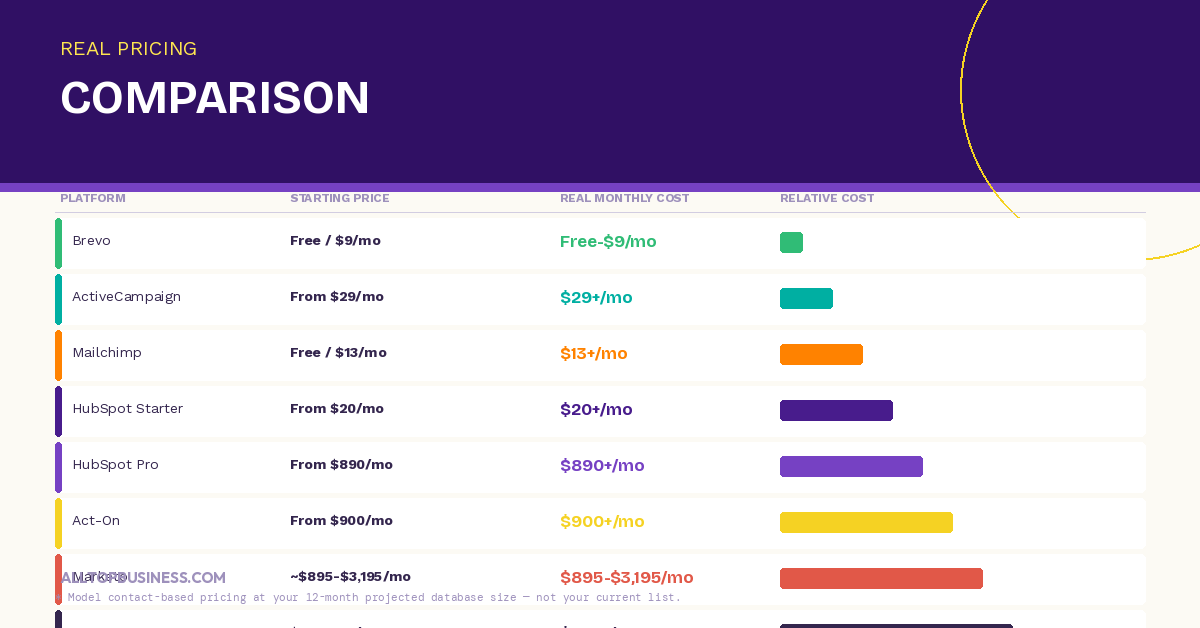
The range is wide. Brevo starts free. ActiveCampaign starts at $29/month. HubSpot Starter at $20/month. HubSpot Professional at $890/month. Marketo from $895/month. Act-On from $900/month. Pardot from $1,250/month. 6sense from $35,000/year.
Enterprise configurations of Marketo and Eloqua typically run $3,000 to $7,000+/month. Always model contact-based pricing at your projected database size in 12 months, not your current list.
When should a B2B company upgrade from email marketing to full marketing automation?
The practical triggers are: you have multiple customer segments requiring different nurture tracks, you need to score leads before passing to sales, your sales cycle is longer than 30 days and prospects go cold without structured follow-up, or your marketing team spends more than 5 hours per week on manual email campaign execution.
Below these thresholds, a simple email marketing tool is often more efficient than an automation platform that requires ongoing maintenance.
What is account-based marketing, and do I need ABM software?
Account-based marketing (ABM) is a strategy that focuses marketing and sales resources on a defined set of high-value target accounts rather than broad lead generation. ABM platforms like 6sense and Demandbase add intent data, anonymous visitor identification, and account-level orchestration on top of traditional marketing automation.
Most B2B companies under $20M in revenue do not need dedicated ABM software; HubSpot or ActiveCampaign with good CRM-level account tracking covers the ABM fundamentals at lower cost.
Final Verdict
HubSpot Marketing Hub is the starting point for most B2B marketing teams. It covers the widest range of use cases, benefits from Breeze AI across every workflow, and eliminates the integration overhead of managing separate marketing and CRM systems.
The Starter to Professional pricing cliff is real, but for teams whose marketing programs have genuine complexity, HubSpot Professional pays for itself in reduced tool fragmentation alone.
ActiveCampaign is the strongest alternative when email automation depth is the primary requirement, and $890/month for HubSpot Professional is not justified by current program complexity. The automation builder genuinely rivals HubSpot at roughly one-sixth of the price.
Marketo for enterprise teams with dedicated marketing ops, complex programs, and Salesforce as the system of record. Pardot for Salesforce-first organizations that want marketing-to-sales data alignment without middleware. 6sense when identifying in-market accounts before competitors is a strategic priority, and the pipeline scale justifies the investment.
For early-stage SaaS teams, Customer.io or Encharge deliver behavioral trigger depth that general marketing automation platforms cannot match for product-led growth motions. Brevo remains the most accessible multichannel starting point for budget-constrained teams.
For more B2B go-to-market tool reviews, explore our guides on the best CRM software for B2B sales teams and browse all B2B software reviews on the AllTopBusiness blog. Have a specific marketing automation question? Contact our team directly.

I’m Adeyemi Adetilewa, a Content Marketing and SEO Specialist, Digital Strategist, Entrepreneur, and the Editor of AllTopBusiness.com. With over 13 years of experience helping businesses scale through content-driven growth, I’m happy to share all the top business tools I have discovered with you here.