Your sales team is losing deals it should be winning. Not because the product is wrong or the pricing is off, but because the follow-up slipped, the last conversation was never logged, the decision-maker on the account changed three months ago, and nobody updated the record, and the forecast your VP presented last Thursday was built on data nobody fully trusts.
That is not a people problem. That is a CRM problem, or more accurately, a no-CRM or wrong-CRM problem.
The global CRM market is projected to reach $126 billion in 2026, with 91% of companies with 10 or more employees now using a CRM system. Yet over half of all CRM implementations still fail to meet their goals. The tools are not the problem. Choosing the wrong one for your team size, sales motion, and workflow is.
This guide cuts through the noise. We evaluated over 40 CRM platforms and narrowed the list to those that genuinely serve B2B sales teams with honest breakdowns of what each one does well, where it falls short, and which type of team it actually fits.
For related reading on managing the broader revenue operations stack, explore the AllTopBusiness blog.
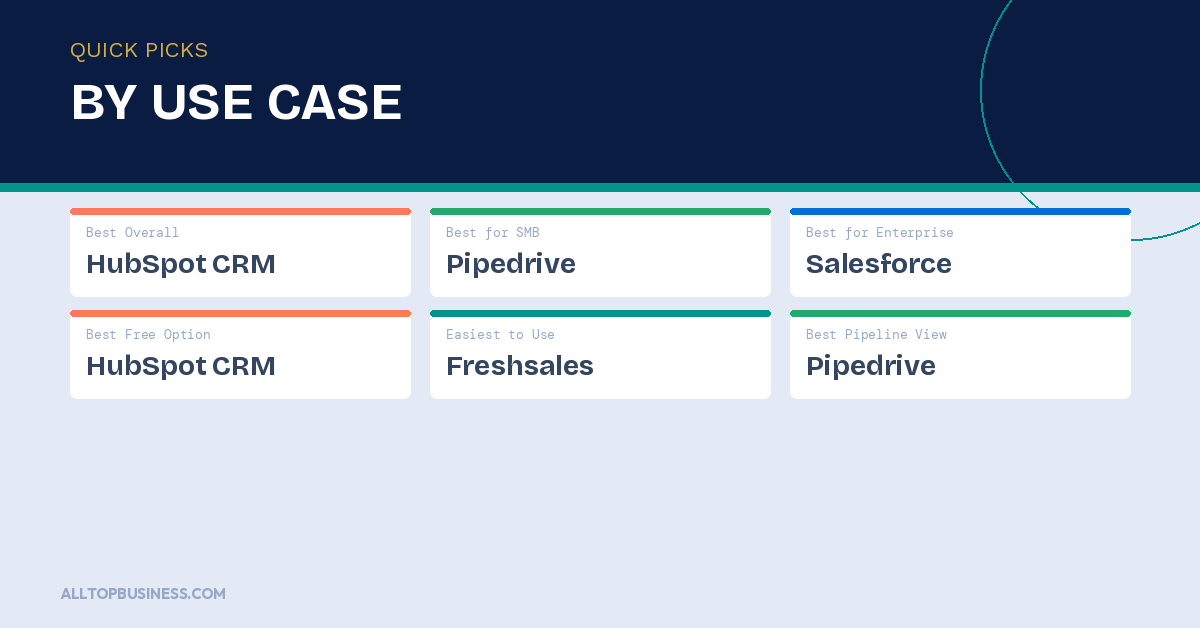
Best CRM Software for B2B Sales Teams: Quick Picks
| Label | Pick |
|---|---|
| Best Overall | HubSpot CRM is the most complete free tier with a powerful paid upgrade path |
| Best for Small Business | Pipedrive is a visual pipeline built for small, active sales teams |
| Best for Enterprise | Salesforce Sales Cloud with unmatched depth and flexibility at scale |
| Best Free or Low-Cost Option | HubSpot CRM has a genuinely powerful free tier with unlimited contacts |
| Best for Ease of Use | Freshsales has a clean interface with the fastest onboarding in the category |
| Best for Pipeline Management | Pipedrive with activity-based selling, with the clearest pipeline view available |
How We Selected These CRM Tools
Every CRM tool on this list was evaluated against six criteria:
- Pipeline management depth: deal stages, forecasting, and activity tracking built for B2B sales cycles
- Contact and account management: multi-stakeholder tracking, company records, and interaction history
- Automation capabilities: workflow automation, email sequences, and task triggers
- Integration quality: connectivity with email, calendar, marketing tools, and ERP systems
- Reporting and forecasting: pipeline visibility and forecast accuracy for sales managers
- User review consensus: ratings and review themes from G2, Capterra, and Gartner Peer Insights
Tools were only included if they had documented, substantive use cases in B2B sales environments with verifiable user reviews from independent platforms.
Best CRM Software for B2B Sales Teams: Comparison Table
| Tool | Best For | Starting Price | Free Plan | G2 Rating | Key Integration |
|---|---|---|---|---|---|
| HubSpot CRM | All-in-one sales and marketing | Free / from $20/user/mo | Yes | 4.4/5 | Gmail, Outlook, Salesforce |
| Salesforce Sales Cloud | Enterprise B2B sales | From $25/user/mo | No | 4.4/5 | Slack, Tableau, MuleSoft |
| Pipedrive | Visual pipeline management | From $14/user/mo | No | 4.3/5 | Gmail, Slack, Zapier |
| Zoho CRM | Budget-conscious teams | From $14/user/mo | Yes (3 users) | 4.1/5 | Google, Microsoft 365 |
| Microsoft Dynamics 365 Sales | Microsoft-ecosystem teams | From $65/user/mo | No | 3.7/5 | Microsoft 365, Teams |
| Freshsales | Fast-growing SMB sales teams | Free / from $9/user/mo | Yes | 4.5/5 | Gmail, Slack, Zapier |
| Close | Inside sales and high-volume outreach | From $49/user/mo | No | 4.7/5 | Zapier, Slack, Zoom |
| Copper | Google Workspace users | From $9/user/mo | No | 4.5/5 | Google Workspace native |
| Nutshell | SMB teams wanting simplicity | From $19/user/mo | No | 4.3/5 | Gmail, Outlook, Zapier |
| Streak | Gmail-native sales tracking | Free / from $15/user/mo | Yes | 4.5/5 | Gmail native |
| Monday Sales CRM | Teams already using Monday.com | From $12/user/mo | No | 4.6/5 | Gmail, Slack, Zapier |
| Insightly CRM | Post-sale project handoff teams | From $29/user/mo | Yes (2 users) | 4.2/5 | Gmail, QuickBooks |
| Zendesk Sell | Sales and support in one stack | From $19/user/mo | No | 4.2/5 | Zendesk Support, Gmail |
| Apollo.io | Prospecting-heavy outbound teams | Free / from $49/user/mo | Yes | 4.8/5 | Salesforce, HubSpot |
| Salesflare | Automated data entry for SMBs | From $29/user/mo | No | 4.8/5 | Gmail, LinkedIn, Zapier |
| Less Annoying CRM | Very small teams wanting simplicity | $15/user/mo flat | No | 4.9/5 | Gmail, Outlook, Mailchimp |
| Creatio CRM | Mid-market with complex workflows | From $25/user/mo | No | 4.6/5 | Microsoft 365, SAP |
1. HubSpot CRM
The most complete free CRM on the market and a serious paid platform for growing B2B teams
HubSpot CRM is the most widely adopted CRM for B2B companies that are scaling from early-stage through to mid-market. Its free tier is genuinely powerful with unlimited contacts, full deal pipeline management, email tracking, meeting scheduling, live chat, and a reporting dashboard, all at no cost. This makes it the default starting point for most B2B teams that have not yet committed to a paid CRM.
The platform’s real strength is its ecosystem. The CRM sits at the center of HubSpot’s Marketing Hub, Sales Hub, Service Hub, Content Hub, and Operations Hub, all sharing a single data layer. For B2B companies that want sales and marketing working from the same contact and deal data without a complex integration, HubSpot delivers this more naturally than almost any competitor.
In 2026, HubSpot has continued to invest in its AI capabilities through Breeze AI, which includes AI-powered prospecting, deal summarization, email drafting, and pipeline health scoring. These features are available across paid tiers and push HubSpot’s automation depth closer to Salesforce than the price difference might suggest.
The limitation shows at the enterprise scale. Companies with complex territory management, advanced forecasting hierarchies, or heavily customized sales processes will eventually find HubSpot’s flexibility ceiling below what Salesforce can support.
What it does well:
- Most powerful free tier in the CRM market with unlimited contacts and deals
- Seamless sales and marketing data alignment in one platform
- Breeze AI features across prospecting, deal management, and forecasting
- Clean, intuitive interface with fast onboarding for new reps
- Massive integration marketplace with 1,500+ native connectors
Where it falls short:
- Advanced customization and workflow complexity hit limits compared to Salesforce
- Costs escalate significantly as you move up tiers and add Hubs
- Reporting customization requires higher-tier plans
- Heavy marketing automation users sometimes find the Sales Hub secondary to the marketing focus
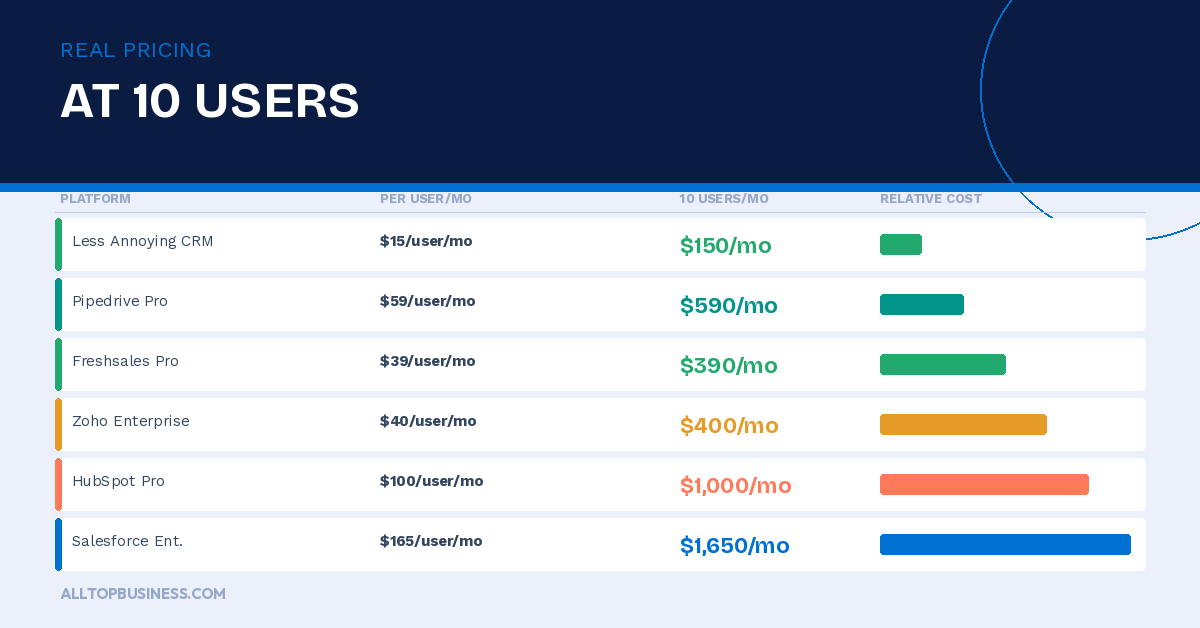
Pricing: Free plan available. Sales Hub Starter from $20 per user per month. Sales Hub Professional from $100 per user per month. Enterprise from $150 per user per month.
Best for: B2B companies from early-stage through mid-market that want sales and marketing on a shared data platform, and teams starting out that need a serious free CRM before committing to a paid platform.
2. Salesforce Sales Cloud
The most powerful and flexible CRM available. Built for enterprise B2B sales organizations
Salesforce Sales Cloud is the market-leading CRM globally and the benchmark against which every other platform is measured. It covers every dimension of enterprise B2B sales: territory management, advanced forecasting, CPQ, multi-product deal structures, complex approval workflows, partner relationship management, and account-based selling, all within a single, deeply customizable platform.
In 2026, Salesforce has doubled down on AI under its Agentforce branding. AI agents now handle prospecting research, meeting scheduling, post-call follow-up, and pipeline inspection autonomously alongside Einstein Copilot, which surfaces account insights and drafts communications directly in the CRM. For enterprise sales teams with large volumes of accounts and complex deal cycles, this reduces the administrative burden on reps meaningfully.
The Einstein AI suite covers predictive lead scoring, deal health monitoring, pipeline inspection, and conversation intelligence, giving sales managers a level of pipeline visibility that manual CRM hygiene never reliably produces.
The honest tradeoff is cost and complexity. Salesforce almost always requires a dedicated Salesforce administrator or a system integrator partner to configure and maintain it beyond basic usage. Budget for admin costs alongside licensing.
What it does well:
- Unmatched customization depth with custom objects, complex workflows, and multi-stage forecasting
- Agentforce AI agents handle prospecting, follow-up, and pipeline work autonomously
- Largest CRM ecosystem. AppExchange has 7,000+ third-party applications
- Native integration with Slack, Tableau, MuleSoft, and the broader Salesforce platform
- Industry-specific clouds for financial services, healthcare, manufacturing, and more
Where it falls short:
- Requires a dedicated Salesforce admin or SI partner. Not self-serve at scale
- Total cost of ownership is the highest in the category when admin and implementation are included
- Interface complexity creates user adoption challenges without proper training investment
- Implementation timelines of 3 to 6 months for mid-market deployments
Pricing: Starter Suite from $25 per user per month. Professional from $80. Enterprise from $165. Unlimited from $330. Einstein 1 Sales from $500 per user per month.
Best for: Enterprise B2B sales organizations with 50+ reps, complex deal structures, multiple products or territories, and the internal resources or partner budget to configure and maintain the platform properly.
3. Pipedrive
The best visual pipeline CRM for small and mid-sized B2B sales teams
Pipedrive is built around one core philosophy: sales is about activities, and the job of a CRM is to make those activities visible and manageable. Its pipeline view is the clearest and most intuitive in the market. Deals move through stages visually, activity reminders surface automatically, and the interface gets out of the way and lets reps focus on selling rather than data entry.
For B2B teams with 5 to 50 reps running an outbound or relationship-driven sales motion, Pipedrive consistently outperforms heavier platforms on user adoption. Reps actually use it because it is fast, visual, and directly reflects how salespeople think about their pipeline, not how a software architect designed a database.
The AI Sales Assistant surfaces deal health insights, identifies pipeline gaps, and suggests next actions based on deal activity patterns. The automation builder handles email sequences, task creation, and deal stage triggers without requiring technical skills to configure.
What it does well:
- The clearest, most intuitive visual pipeline view in the category
- The activity-based selling model keeps reps focused on the right actions
- AI Sales Assistant with deal health scoring and next-action recommendations
- 500+ integrations including Gmail, Slack, Zoom, and QuickBooks
- Competitive pricing with a transparent tier structure
Where it falls short:
- Reporting depth is lighter than HubSpot or Salesforce at comparable price points
- Marketing functionality is limited — not suited for inbound-heavy teams
- Less suitable for enterprise-scale deployments with complex territory or hierarchy needs
- Email marketing requires add-ons rather than native functionality
Pricing: Essential from $14 per user per month. Advanced from $29. Professional from $59. Power from $69. Enterprise from $99.
Best for: Small and mid-sized B2B sales teams with 5 to 100 reps running outbound, relationship, or transactional sales motions who prioritize pipeline clarity and rep adoption over marketing depth.
4. Zoho CRM
The strongest value-for-money CRM for budget-conscious B2B teams
Zoho CRM delivers a breadth of CRM functionality (pipeline management, AI scoring, workflow automation, email campaigns, and territory management) at a price point that significantly undercuts HubSpot and Salesforce at equivalent feature levels. For B2B teams that need serious CRM capability but are working within tight software budgets, Zoho CRM is consistently the strongest option.
The platform integrates natively with the broader Zoho ecosystem, including Zoho Books, Zoho Desk, Zoho Campaigns, and Zoho Analytics, which makes it particularly attractive for companies already using Zoho for other functions. Zia, Zoho’s AI assistant, handles lead scoring, deal predictions, sentiment analysis, and automation suggestions across the platform.
What it does well:
- Comprehensive CRM functionality at a significantly lower price than HubSpot or Salesforce
- Native integration with the full Zoho suite (accounting, support, marketing, and analytics)
- Zia AI for lead scoring, deal predictions, and automation suggestions
- Flexible customization without requiring developer resources
- Strong free tier for up to 3 users
Where it falls short:
- The interface is less polished than HubSpot or Pipedrive, with a steeper learning curve
- Customer support response times receive mixed reviews
- Some advanced features require higher-tier plans that reduce the price advantage
- Integration quality with non-Zoho tools is variable
Pricing: Free for up to 3 users. Standard from $14 per user per month. Professional from $23. Enterprise from $40. Ultimate from $52.
Best for: Budget-conscious B2B sales teams, particularly those already using other Zoho products, that need a full-featured CRM without the HubSpot or Salesforce price tag.
5. Microsoft Dynamics 365 Sales
The best CRM for B2B teams is deeply embedded in the Microsoft ecosystem
Microsoft Dynamics 365 Sales is the natural CRM choice for organizations where every rep works in Outlook, Teams, and Excel every day. The deep native integration with Microsoft 365 means CRM data surfaces directly in the tools reps already use, email context in Outlook, meeting notes in Teams, and pipeline data in Power BI dashboards, without requiring context-switching between applications.
Microsoft Copilot AI features embedded throughout Dynamics 365 generate email drafts, summarize customer histories, surface deal risks, and provide meeting preparation briefs directly in Teams and Outlook. For enterprise sales teams that spend most of their day in Microsoft tools, this integration reduces the “CRM as extra admin work” friction that kills adoption.
What it does well:
- Native integration with Outlook, Teams, Excel, and the entire Microsoft 365 suite
- Microsoft Copilot AI across email drafting, meeting preparation, and deal insights
- Strong enterprise-grade security and compliance, critical for regulated industries
- Power BI integration for advanced pipeline and forecast reporting
- Competitive for Microsoft-heavy organizations relative to Salesforce TCO
Where it falls short:
- Less intuitive for teams not already living in the Microsoft ecosystem
- Implementation and customization require Microsoft partner expertise
- The user interface is less modern than HubSpot or Pipedrive
- Partner quality for implementation varies significantly
Pricing: Dynamics 365 Sales Professional from $65 per user per month. Enterprise from $95. Premium from $135.
Best for: Mid-market and enterprise B2B sales teams that run their entire business on Microsoft 365 and want CRM data surfaced natively in Outlook, Teams, and Power BI.
6. Freshsales
The fastest to implement, cleanest CRM for fast-growing SMB sales teams
Freshsales by Freshworks is built for sales teams that need to get running fast. Its interface is the most intuitive in the category for new CRM users, with clean layouts, sensible defaults, and a setup process that gets most small teams operational within a day. For companies hiring their first sales reps and standing up a CRM for the first time, Freshsales removes virtually all the friction.
Freddy AI, Freshsales’ AI layer, handles contact scoring, deal insights, next-best-action suggestions, and automated email responses. The built-in phone, email, and chat capabilities mean teams do not need separate outreach tools for early-stage sales operations.
What it does well:
- Fastest implementation in the category. Most teams operational within 24 hours
- Built-in phone, email, and chat remove the need for separate outreach tools
- Freddy AI for contact scoring, deal insights, and automated responses
- Generous free plan with strong core CRM functionality
- Integrates naturally with the broader Freshworks suite (Freshdesk, Freshmarketer)
Where it falls short:
- Reporting depth is lighter than HubSpot or Salesforce at the growth stage
- Less suitable for complex enterprise sales processes
- Customization hits limits compared to Salesforce or Zoho at advanced configurations
- Some users report sync delays with Gmail and Outlook integrations
Pricing: Free plan available. Growth from $9 per user per month. Pro from $39. Enterprise from $59.
Best for: Fast-growing SMB and early mid-market B2B teams that prioritize fast implementation, built-in communication tools, and ease of adoption over deep customization.
7. Close
The best CRM for inside sales teams with high outreach volume
Close is purpose-built for inside sales. Where most CRMs treat calling and emailing as integrations, Close makes them native, built-in power dialer, email sequences, SMS, and call recording are core features, not add-ons. For B2B teams running high-volume inside sales motions where reps make 50 to 100 touches per day, Close is structurally faster than any general-purpose CRM.
The platform’s pipeline and activity views are designed around speed, bulk emailing, power dialing, and sequence management, all accessible from the same screen without context-switching. AI-powered call transcription and summary features reduce post-call admin time significantly.
What it does well:
- Built-in power dialer, email sequences, and SMS. No separate outreach tool needed
- Fastest workflow for high-volume inside sales motions
- AI call transcription and summary built into every plan
- Clean, activity-focused interface designed for rep speed
- Among the highest G2 satisfaction scores in the category
Where it falls short:
- Less depth in account management and complex deal structuring
- Not well-suited for long, relationship-driven enterprise sales cycles
- Marketing functionality is minimal. Not designed for inbound teams
- Limited advanced reporting compared to Salesforce or HubSpot
Pricing: Startup from $49 per user per month. Professional from $99. Enterprise from $139.
Best for: Inside sales teams of 3 to 50 reps running high-volume outbound B2B sales motions where calling, emailing, and sequence speed are the primary workflow requirements.
8. Copper CRM
The best CRM for teams that live inside Google Workspace
Copper is built natively inside Google Workspace. There is no separate application to log into: contacts, deals, and pipeline data surface directly inside Gmail and Google Calendar through a sidebar. For sales teams that operate entirely within Google’s ecosystem, Copper eliminates the context-switching that causes CRM abandonment in other platforms.
Automatic data capture is Copper’s standout feature. It logs emails, meetings, and calls automatically without requiring reps to manually update records. For small sales teams where CRM hygiene is a persistent problem, automatic capture removes the single biggest cause of poor data quality.
What it does well:
- Native Google Workspace integration. Works directly inside Gmail and Google Calendar
- Automatic data capture logs emails, meetings, and calls without manual input
- Simple, clean interface with a very low learning curve
- Strong contact enrichment from Google data sources
- Good fit for small teams that want CRM without heavy adoption investment
Where it falls short:
- Only valuable for Google Workspace users. No value for Microsoft 365 teams
- Limited functionality outside the Google ecosystem
- Reporting and forecasting depth is lighter than HubSpot or Salesforce
- Less suitable for complex enterprise sales processes
Pricing: Starter from $9 per user per month. Basic from $23. Business from $59.
Best for: B2B sales teams of 2 to 30 people that run all their communication in Google Workspace and want a CRM that works inside Gmail without a separate application.
9. Nutshell
A clean, underrated CRM for SMB teams that want simplicity without sacrificing pipeline control
Nutshell is a straightforward B2B CRM that consistently earns high marks for ease of use and customer support quality. It covers pipeline management, email sequences, contact management, reporting, and team collaboration without the configuration overhead of more complex platforms.
The platform supports multiple pipeline views (list, board, chart, and map), which let different team members work in the format that suits them. The built-in email marketing tool Nutshell Campaigns extends the platform into basic outbound marketing without requiring a separate tool.
What it does well:
- Multiple pipeline views, including list, board, chart, and map
- Built-in email marketing through Nutshell Campaigns
- Highly rated customer support. Consistently praised in user reviews
- Clean interface with low training burden for new reps
- Transparent, predictable pricing
Where it falls short:
- Less depth in automation compared to HubSpot or Pipedrive at an equivalent price
- Reporting customization is more limited than on larger platforms
- Less name recognition means fewer third-party integration templates available
Pricing: Foundation from $19 per user per month. Growth from $32. Pro from $49. Business from $67. Enterprise from $89.
Best for: SMB B2B sales teams of 5 to 50 people that want a clean, easy-to-use CRM with built-in email marketing and strong support, without the complexity of HubSpot or Salesforce.
10. Streak
The best CRM for very small teams that want pipeline management inside Gmail
Streak is a lightweight CRM that runs entirely inside Gmail as a browser extension. It turns Gmail into a simple pipeline tool by adding deal stages, contact tracking, and task management directly inside the email interface. For solo founders, very small sales teams, or consultants who live in Gmail and do not want to learn a separate CRM, Streak is the lowest-friction option in the category.
The free plan covers unlimited pipelines, 500 contacts, and basic email tracking, enough for a small team getting started with structured pipeline management for the first time.
What it does well:
- Runs entirely inside Gmail. Zero context-switching
- Unlimited pipelines on the free plan
- Email tracking and mail merge built in
- Extremely fast setup. Operational within minutes
- Good for teams that want pipeline management without a full CRM commitment
Where it falls short:
- Only works inside Gmail. Not suitable for Outlook or multi-tool teams
- Limited scalability beyond small teams
- Reporting and automation depth is minimal
- Not designed for complex B2B sales with multiple stakeholders per account
Pricing: Free plan available. Solo from $15 per user per month. Pro from $49. Pro+ from $69. Enterprise from $129.
Best for: Solo founders, freelancers, and very small B2B sales teams (1 to 5 people) that want basic pipeline management inside Gmail without learning a dedicated CRM platform.
11. Monday Sales CRM
The best CRM for teams already using Monday.com for project management
Monday Sales CRM sits within the Monday.com work operating system, which makes it the natural CRM choice for teams already using Monday for project management or operations. The visual board interface is identical to the rest of Monday, which means sales reps who already use Monday adopt the CRM with minimal training friction.
The platform covers contact and lead management, pipeline tracking, email integration, activity logging, and basic automation. It is not as deep in CRM-specific features as Pipedrive or HubSpot, but for Monday-native teams, it removes the friction of managing sales in a separate tool.
What it does well:
- Native Monday.com interface. Zero learning curve for existing Monday users
- Visual, flexible pipeline views that match Monday’s board design
- Strong customization of fields, views, and workflows
- Easy handoff between sales and post-sale project management in the same platform
Where it falls short:
- Less depth in CRM-specific features like forecasting, lead scoring, and email sequences
- Better suited as an entry CRM than a long-term enterprise solution
- Email integration requires a Gmail or Outlook connection. No native email tool
Pricing: Basic from $12 per user per month. Standard from $17. Pro from $28. Enterprise custom pricing.
Best for: Teams already running Monday.com for project management that want to bring sales pipeline management into the same platform without switching tools.
12. Insightly CRM
The best CRM for teams that need to hand off deals to project delivery seamlessly
Insightly is one of the few CRMs with a genuinely functional built-in project management module. After a deal is closed, it converts directly into a project inside the same platform (with tasks, milestones, and resource assignments) without a separate handoff to a project management tool.
For professional services firms, agencies, and implementation businesses where the post-sale delivery process is as important as the sale, this removes a significant coordination gap.
What it does well:
- Built-in project management for seamless sales-to-delivery handoff
- Solid pipeline management with customizable stages
- Native integration with QuickBooks and G Suite
- Reasonable pricing for the features offered
- Good fit for professional services and agency sales teams
Where it falls short:
- Email marketing and automation are less mature than HubSpot
- Less depth in reporting and forecasting than Salesforce or HubSpot
- Mobile app performance receives mixed reviews
Pricing: Plus from $29 per user per month. Professional from $49. Enterprise from $99.
Best for: Professional services firms, agencies, consultancies, and implementation businesses that need sales and post-sale project delivery managed in the same platform.
13. Zendesk Sell
The best CRM for teams that want sales and customer support in one stack
Zendesk Sell is the sales CRM from Zendesk, designed to work alongside Zendesk Support for teams that want full visibility across both the sales funnel and the support experience.
When a lead closes and becomes a customer, their entire history (sales conversations, contract details, and support tickets) lives in the same platform, giving both sales and support teams the same complete picture.
What it does well:
- Seamless integration with Zendesk Support for unified sales and service data
- Clean interface with solid pipeline management
- Built-in email, calling, and activity tracking
- Good reporting with Zendesk Explore integration
- Single vendor for sales and support stack simplification
Where it falls short:
- Less compelling as a standalone CRM compared to HubSpot or Pipedrive
- Best value only for teams already using Zendesk Support
- Marketing functionality is minimal
Pricing: Sell Team from $19 per user per month. Sell Growth from $55. Sell Professional from $115.
Best for: B2B teams already using Zendesk Support that want a native CRM without managing a separate vendor relationship for sales and service tools.
14. Apollo.io
The best CRM for outbound-heavy B2B teams that need prospecting and pipeline in one tool
Apollo.io blurs the line between CRM and sales engagement platform. It combines a contact database of over 275 million B2B contacts with built-in email sequences, calling, LinkedIn automation, and pipeline management in a single tool. For outbound-focused B2B sales teams, Apollo removes the need for a separate prospecting tool alongside a CRM.
The free plan is notably generous, including access to the contact database, email sequences, and basic CRM functionality, which makes it one of the strongest starting points for early-stage B2B companies building their first outbound motion.
What it does well:
- 275M+ contact database for prospecting built directly into the platform
- Email sequences, calling, and LinkedIn automation alongside pipeline management
- AI-powered prospect scoring and email personalization
- Among the most generous free tiers in the combined CRM/sales engagement category
- Fast-improving product with strong user satisfaction scores on G2
Where it falls short:
- Contact data accuracy varies — requires verification before heavy use
- Less depth in account management for complex enterprise deals
- Pipeline management is less sophisticated than dedicated CRMs like Salesforce or HubSpot
- Data enrichment quality inconsistency frustrates some users
Pricing: Free plan available. Basic from $49 per user per month. Professional from $79. Organization from $119.
Best for: Outbound-heavy B2B sales teams that want prospecting and pipeline management in a single tool, particularly early-stage companies building their first SDR motion.
15. Salesflare
The best CRM for teams that want automated data entry above everything else
Salesflare is built around a single promise: zero manual data entry. It automatically collects contact information, meeting notes, email threads, and company data from Gmail, Outlook, LinkedIn, and your calendar and populates CRM records without reps doing anything manually.
For small sales teams where CRM adoption consistently fails because reps do not update records, Salesflare removes the root cause. The pipeline visibility and relationship intelligence that results is often more accurate than manually maintained CRMs at much larger companies.
What it does well:
- Automatic data capture from email, calendar, LinkedIn, and phone calls
- Clean, simple interface with very low cognitive load for reps
- Strong contact and company enrichment from publicly available data
- Tight Gmail and Outlook integration with sidebar access
- Among the highest satisfaction scores in the SMB CRM category on G2
Where it falls short:
- Less depth in reporting and forecasting for sales managers
- Not designed for high-volume inside sales motions
- Limited marketing automation compared to HubSpot
Pricing: Growth from $29 per user per month. Pro from $49. Enterprise from $99.
Best for: Small B2B sales teams of 2 to 20 people where CRM adoption has historically been poor due to manual data entry burden, and where relationship-driven selling is the primary motion.
16. Less Annoying CRM
The best CRM for very small teams that want the simplest possible pipeline tool
Less Annoying CRM does exactly what its name promises. It is a single-price, single-tier CRM with no confusing upgrade paths, no feature gates, and no hidden costs. Every user gets access to every feature for $15 per user per month, including unlimited contacts, pipelines, tasks, and calendar integration.
The platform consistently earns the highest user satisfaction score in the small business CRM category on G2 (4.9 out of 5.0) driven primarily by its human customer support, which routes every ticket to a real person rather than an automated response system.
What it does well:
- Single flat price with no feature tiers. Every user gets everything
- Highest customer satisfaction score in the small business CRM category
- Human customer support. Real people, not bots
- Genuinely simple interface that non-technical teams can use immediately
- 30-day free trial with no credit card required
Where it falls short:
- Not designed for teams beyond 10 to 25 users
- No marketing automation, email sequences, or advanced reporting
- Not suitable for complex enterprise sales structures
Pricing: $15 per user per month flat. No tiers, no add-ons.
Best for: Very small B2B sales teams of 1 to 10 people that want the simplest possible CRM with no upgrade complexity, no hidden costs, and outstanding customer support.
17. Creatio CRM
The best CRM for mid-market teams with complex, customized sales workflows
Creatio is a no-code CRM and process automation platform that gives mid-market sales teams the ability to build highly customized sales workflows, approval processes, and reporting structures without developer resources. It sits in the gap between the simplicity of HubSpot and the developer-dependency of Salesforce.
The platform covers full CRM functionality alongside marketing automation and customer service tools, all on a shared no-code process builder that business users can configure directly. For mid-market companies with unique sales processes that do not fit standard CRM templates, Creatio provides flexibility without requiring a Salesforce admin.
What it does well:
- No-code process builder for highly customized sales workflows
- Full CRM, marketing, and service on a single platform
- Strong mid-market positioning between HubSpot and Salesforce
- Integrates well with SAP, Microsoft 365, and major ERPs
- Solid compliance and audit trail functionality for regulated industries
Where it falls short:
- Less brand recognition than Salesforce or HubSpot in North America
- Smaller integration marketplace than the category leaders
- Initial setup requires more investment than simpler CRM platforms
Pricing: Growth from $25 per user per month. Enterprise from $55. Unlimited from $85.
Best for: Mid-market B2B sales organizations with 20 to 200 reps that have complex, unique sales workflows requiring deep customization without developer dependency.
How to Choose the Right CRM for Your B2B Sales Team
The CRM market is crowded precisely because different sales motions require fundamentally different tools. Here are the four questions that narrow the field before you run a single demo.
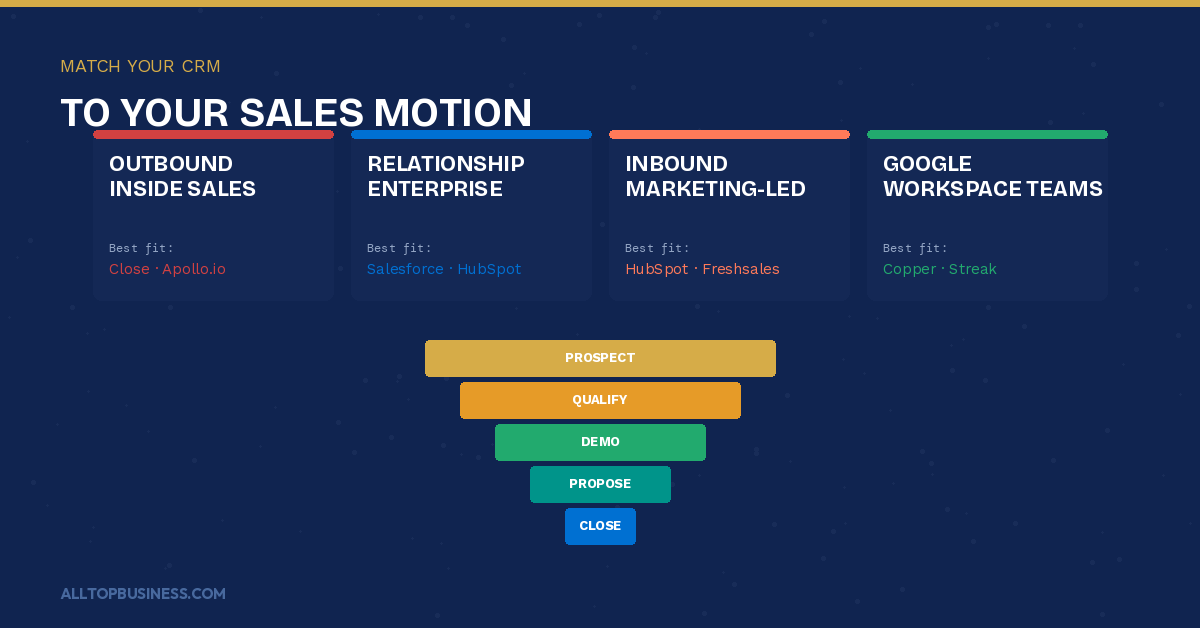
What is your primary sales motion?
Outbound inside sales with high call and email volume? Close or Apollo.io is structurally faster than any general-purpose CRM. Relationship-driven enterprise deals with long cycles and multiple stakeholders? Salesforce or HubSpot’s enterprise tier handles this depth. Inbound marketing-led growth? HubSpot’s native marketing and sales data alignment is the strongest option.
What is your team size today and in 18 months?
Platforms like Less Annoying CRM and Streak are excellent for 3 to 10 users but hit their ceiling quickly. Pipedrive and Freshsales scale comfortably from 5 to 100 users. HubSpot scales through mid-market, but costs accelerate. Salesforce has no meaningful ceiling, but costs and complexity scale accordingly.
What tools does your team already use?
Already on Google Workspace? Copper or Streak. Already on Microsoft 365 and Teams? Dynamics 365 is the path of least resistance. Already on Zendesk for support? Zendesk Sell connects the stacks. Already using Monday.com? Monday Sales CRM avoids a second platform.
What does pricing really look like at your team size?
CRM pricing is rarely what the per-user starting price suggests. Add up the cost at your current user count, at your 18-month projected user count, and include any add-ons your sales process requires. HubSpot at 20 users on the Professional plan costs $2,000 per month, which is significantly more than the $20/user/month headline price. Model the real cost before committing.
Frequently Asked Questions
What is the best CRM software for B2B sales overall?
HubSpot CRM is the strongest starting point for most B2B sales teams. Its free tier is genuinely powerful, the paid upgrade path is logical, and the sales and marketing data alignment is better than any competitor at comparable price points. For enterprise teams with complex processes and the admin resources to support them, Salesforce Sales Cloud is the market leader.
What is the difference between a B2B CRM and a B2C CRM?
A B2B CRM is designed for complex sales cycles with multiple stakeholders, longer decision timelines, and account-level relationship management. B2C CRMs focus on high-volume, short-cycle customer interactions. B2B CRMs emphasize company records, buying committee tracking, deal stage management, and forecast accuracy. B2C CRMs emphasize contact volume, segmentation, and marketing automation at scale.
How much does CRM software cost for a small business?
The range is wide. Less Annoying CRM charges a flat $15 per user per month with no add-ons. Pipedrive starts at $14. Freshsales has a free plan. HubSpot’s free CRM is genuinely functional for early-stage teams. A 10-person team on a mid-tier paid plan typically spends $150 to $500 per month, depending on the platform and tier.
What is the easiest CRM to use for a sales team with no CRM experience?
Freshsales and Less Annoying CRM are consistently rated the easiest to implement and adopt. Both have clean interfaces, sensible defaults, and support teams that help new users get operational quickly. Copper is the easiest option, specifically for Google Workspace users.
Do I need a CRM if I only have a small sales team?
Yes, even a 2-person sales team benefits from structured pipeline management and contact history. The question is not whether to use a CRM but which one fits your current stage. Streak or Less Annoying CRM gives a very small team the structure they need without the overhead of a platform designed for 50+ reps.
What CRM works best with Salesforce?
HubSpot has a native Salesforce integration used by thousands of companies to sync marketing and sales data. Apollo.io integrates directly with Salesforce for prospecting-to-pipeline workflows. Zendesk Sell also integrates cleanly with Salesforce for support data alignment.
Is HubSpot or Salesforce better for B2B sales?
For most B2B companies under $50M in revenue, HubSpot delivers more value at lower cost and complexity. Above $50M, particularly with 50+ reps, complex deal structures, and multiple products or territories, Salesforce’s depth and flexibility justify the investment. The honest answer is that both are excellent at their intended scale, and the mistake is using the wrong one for your current stage.
What is the best free CRM for B2B sales?
HubSpot CRM’s free plan is the strongest in the category, with unlimited contacts, full pipeline management, email tracking, and meeting scheduling at no cost. Freshsales and Zoho CRM also have legitimate free tiers. Apollo.io’s free plan is the best option for outbound-focused teams that need a contact database alongside basic CRM.
Final Verdict
For most B2B sales teams, the starting decision is straightforward: HubSpot CRM for teams that need sales and marketing on the same platform, Pipedrive for teams that want the clearest pipeline view and fastest rep adoption, or Salesforce Sales Cloud for enterprises that have outgrown everything else.
If you are on Google Workspace with a small team, Copper removes more friction than anything else. If you run a high-volume inside sales operation, Close is structurally faster than a general-purpose CRM. If budget is the primary constraint, Zoho CRM delivers the most features per dollar in the category.
The only wrong choice is staying in spreadsheets. Pick the platform that fits your current team size and sales motion, get your reps using it consistently, and upgrade when you have genuinely outgrown it.
For more B2B software reviews and comparisons, browse the AllTopBusiness blog. Have a specific CRM question for your team’s situation? Contact us directly.
External Sources:

I’m Adeyemi Adetilewa, a Content Marketing and SEO Specialist, Digital Strategist, Entrepreneur, and the Editor of AllTopBusiness.com. With over 13 years of experience helping businesses scale through content-driven growth, I’m happy to share all the top business tools I have discovered with you here.