Treasury management is the process of overseeing a company’s cash, financial assets, liabilities, and risks to ensure the business stays liquid, meets its financial obligations, and uses its money as efficiently as possible. It covers cash management, payments, investments, debt, and financial risk under one function.
Most finance teams at growing companies hit a familiar wall at some point. Cash is sitting across multiple bank accounts with no unified view. Payments are going out without proper controls. FX exposure is tracked in a spreadsheet that gets rebuilt every quarter. Cash forecasts are built each week manually and still end up being wrong by the time leadership looks at them.
That wall is what treasury management is designed to break through.
This guide covers what treasury management actually is, what it does in practice, how it functions inside banks and multinational corporations, and what tools and systems businesses use to manage it today. Whether you are a CFO at a mid-market company, a finance manager stepping into a treasury role for the first time, or a business owner trying to understand why your cash position is always a guessing game, this guide gives you a clear and practical answer.
At AllTopBusiness.com, we cover the tools, systems, and strategies that help business and finance teams operate more effectively. This article is the starting point for our full treasury management content series.
What is Treasury Management?
Treasury management is the function within a business responsible for managing the organization’s money. That means overseeing cash flow, bank accounts, payments, short-term investments, debt obligations, and financial risk, all to keep the company liquid, solvent, and financially efficient.
The Association for Financial Professionals defines treasury management as “the process of overseeing a company’s financial resources, including cash, assets, and liabilities, to achieve the company’s strategic goals.”
In practical terms, the treasury team is responsible for answering several critical questions at any given moment:
- How much cash does the company have right now, across all its accounts?
- How much cash will it need in the next 30, 60, and 90 days?
- Where is the business exposed to financial risk — currency swings, interest rate changes, counterparty credit risk?
- Are payments going out securely and efficiently?
- Is idle cash being put to work in appropriate short-term instruments?
In a small business, one person might handle all of this alongside other finance responsibilities. At a large enterprise, it is a dedicated team with specialist roles covering cash management, risk, payments, and capital markets.
The treasury management software market reflects how seriously businesses take this function. According to market research, the global treasury management system market was valued at approximately $6.1 billion in 2025 and is projected to reach $18.3 billion by 2035, growing at a compound annual growth rate of 11.6%. That growth is driven by increasing demand for real-time cash visibility, rising complexity in global operations, and the shift toward cloud-based financial systems.
Why Treasury Management Matters
Treasury management is not a back-office administrative function. Done well, it is a strategic capability that directly affects a company’s ability to grow, weather downturns, and compete effectively.
Liquidity is survival. A profitable company can still fail if it runs out of cash. Treasury management ensures there is always enough liquidity to meet payroll, pay suppliers, service debt, and fund operations even when revenue timing is uneven or unpredictable.
Financial risk is always present. Companies that buy from overseas suppliers, sell into foreign markets, or carry significant debt face currency risk, interest rate risk, and counterparty risk every single day. Treasury management identifies those exposures and puts controls and hedges in place before they become losses.
Capital efficiency drives growth. Idle cash sitting in a low-yield checking account is a missed opportunity. Treasury management puts that cash to work in appropriate instruments, reduces unnecessary borrowing, and optimizes the cost of capital across the balance sheet.
Payment fraud is a growing threat. Business payment fraud costs companies billions of dollars every year. Treasury management puts controls, approval workflows, and monitoring in place to prevent unauthorized or fraudulent payments from leaving the business.
Strategic decisions need real data. CFOs and CEOs making decisions about acquisitions, capital allocation, hiring, or expansion need accurate and timely financial data. Treasury management provides real visibility into the company’s actual cash position and risk exposure, not a two-week-old spreadsheet.
According to a Deloitte Global Corporate Treasury Survey, liquidity risk management is the top priority for treasury teams, with 49% of organizations now prioritizing scalable treasury infrastructure, up from 39% just two years earlier. That shift reflects how central treasury has become to corporate strategy, not just accounting.
The Core Functions of Treasury Management
Treasury management covers several interconnected functions. Most organizations handle all of them to some degree, though the tools and sophistication vary widely by company size.
1. Cash and Liquidity Management
This is the foundational function of treasury. It involves tracking cash balances across all bank accounts in real time, understanding the timing of cash inflows and outflows, and ensuring the business always has enough liquidity to meet its obligations.
For multi-entity or multinational companies, this also includes consolidating cash from subsidiaries, managing intercompany loans, and sweeping cash between accounts to maximize yield or reduce borrowing costs.
2. Cash Flow Forecasting
Cash forecasting is the process of predicting future cash inflows and outflows over a defined time horizon, typically a 13-week rolling forecast for short-term planning, and a 12-month forecast for annual planning.
Accurate forecasting helps finance teams anticipate cash shortfalls before they happen, plan financing, and make better decisions about investments, capital expenditure, and working capital. Our detailed guide on cash forecasting for treasury teams walks through how to build a practical forecasting process.
3. Payments and Banking
The treasury function is responsible for overseeing how money moves in and out of the business. This includes managing payment processing, bank relationships, payment controls, and approval workflows.
At scale, this means ensuring payments are executed securely, reconciled quickly, and auditable. It also means managing the company’s banking infrastructure, including how many bank accounts it holds, which banks it works with, and how those accounts are structured.
4. Financial Risk Management
Every business faces financial risks that can affect its cash position and profitability. Treasury management identifies and mitigates these risks through a structured risk management process.
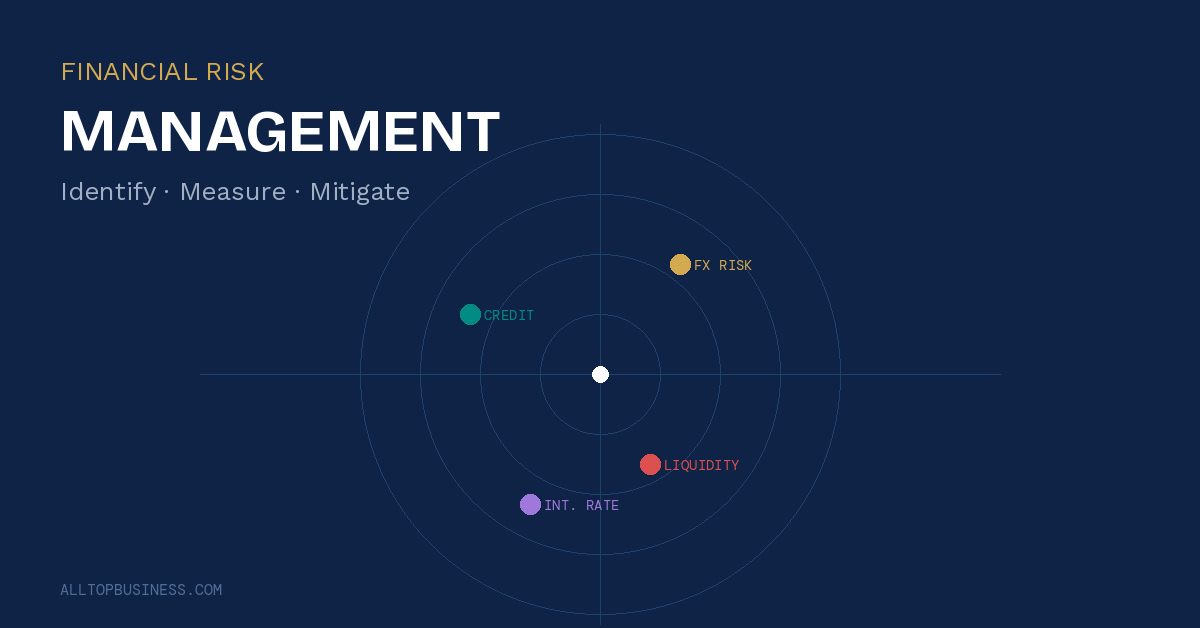
The main categories of financial risk that treasury teams manage include:
- Foreign exchange (FX) risk: The risk that currency movements will affect the value of revenues, costs, or assets denominated in foreign currencies. For companies that pay overseas suppliers or invoice in foreign currencies, FX risk can be material. Our guide on FX risk management for businesses covers how to identify and manage this exposure.
- Interest rate risk: The risk that changes in interest rates will affect the cost of borrowing or the value of fixed-rate investments.
- Counterparty and credit risk: The risk that a bank, trading partner, or customer fails to meet its financial obligations.
- Liquidity risk: The risk that the business cannot meet its short-term financial obligations due to insufficient cash or access to credit.
5. Debt and Investment Management
Treasury teams are responsible for managing the company’s borrowing and its short-term investment portfolio. On the debt side, this means tracking loan covenants, managing credit facilities, scheduling principal and interest payments, and ensuring the company is not over-leveraged.
On the investment side, it means putting idle cash into appropriate instruments like money market funds, Treasury bills, or short-term deposits that generate a return without compromising liquidity.
6. Compliance and Reporting
Treasury operations must comply with a range of financial regulations, accounting standards, and internal policies. This includes regulatory reporting, hedge accounting documentation under IFRS 9 or ASC 815, anti-money-laundering controls, and internal audit requirements.
Good treasury management keeps this compliance burden manageable through standardized processes, audit trails, and automated reporting.
What is Treasury Management in Banking?
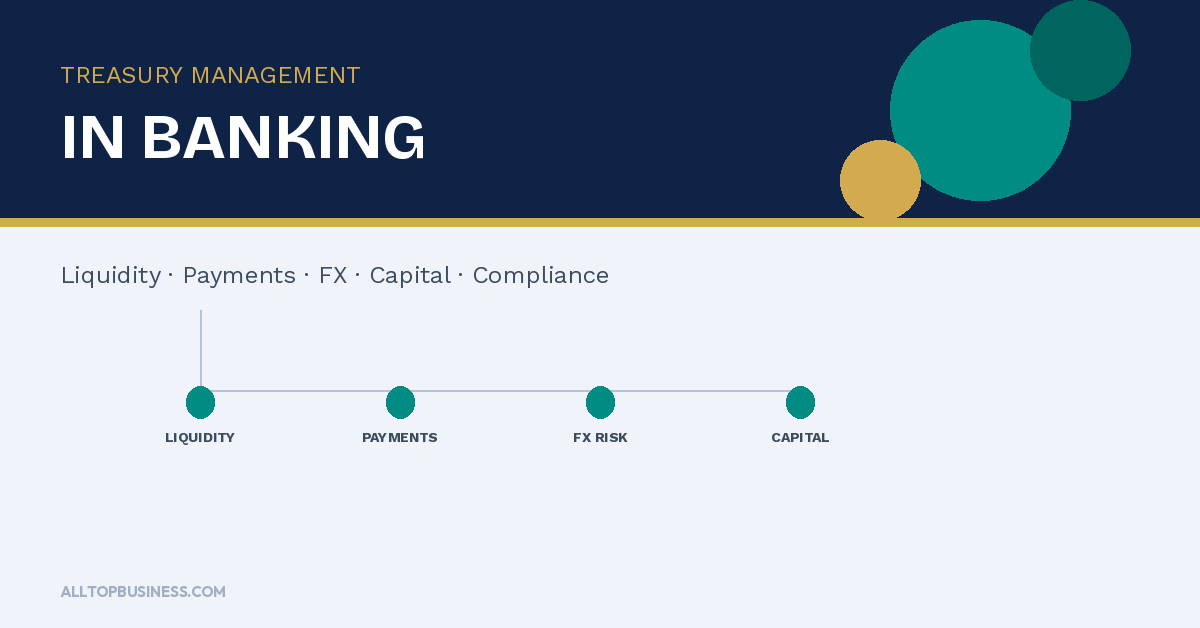
In the banking sector, treasury management takes on a specialized role. Banks use their treasury departments to manage the institution’s own financial assets, liabilities, and risks as well as to offer treasury management services to their corporate clients.
A bank’s treasury department is responsible for managing the institution’s liquidity position, ensuring it has enough liquid assets to meet customer withdrawals and regulatory requirements. It also manages the bank’s exposure to interest rate risk, as the gap between short-term deposit rates and long-term lending rates directly affects profitability.
For corporate clients, banks offer a range of treasury management services designed to help businesses manage their cash, payments, and financial risk more effectively. These services include cash pooling, payment processing, trade finance, FX services, and access to short-term investment products.
The key difference between corporate treasury management and bank treasury management is perspective: corporate treasury focuses on the operating business and its financial needs, while bank treasury focuses on the balance sheet of a financial institution and its regulatory obligations.
What are Treasury Management Services?
Treasury management services are the financial products and services offered by banks and financial institutions to help business clients manage their cash, payments, investments, and risk. Most commercial banks have a dedicated treasury management or cash management division that offers these services.
Common treasury management services include:
Cash concentration and pooling: Automatically sweeping cash from multiple accounts into a central account to maximize interest income and reduce borrowing costs. Notional pooling allows companies to offset balances across entities without physically moving funds.
Payment processing: ACH payments, wire transfers, real-time payments, check processing, and international payment services. Banks often provide fraud monitoring and payment controls as part of these services.
Receivables management: Lockbox services, remote deposit capture, and electronic invoicing that help companies collect customer payments faster and with fewer manual steps.
Liquidity investment products: Money market funds, Treasury bills, certificates of deposit, and sweep accounts that let businesses earn a return on short-term cash balances.
Foreign exchange services: Spot FX transactions, forward contracts, and currency options that help businesses manage their exposure to currency movements.
Trade finance: Letters of credit, bank guarantees, and supply chain finance programs that support international trade transactions.
When evaluating a banking relationship, the breadth and quality of treasury management services on offer are a major factor, particularly for mid-market and enterprise companies with complex cash management needs.
What is a Treasury Management System (TMS)?
A Treasury Management System, commonly called a TMS, is a software platform that automates and centralizes the core functions of treasury management. It replaces the manual processes, disconnected bank portals, and spreadsheet-based workflows that most growing companies rely on for far too long.
A modern TMS typically includes:
- Real-time cash positioning: A consolidated view of all cash balances across all bank accounts, currencies, and entities in a single dashboard
- Cash flow forecasting: Automated forecasting tools that pull data from bank feeds, ERP systems, and AR/AP pipelines
- Payment processing and controls: Workflow-based payment approval, fraud detection, and audit trails
- Bank connectivity: Direct connections to banks via SWIFT, H2H, or open banking APIs
- Risk management: FX exposure tracking, hedge management, and risk reporting
- Debt and investment tracking: Management of loan portfolios, credit facilities, and short-term investment instruments
- ERP integration: Data exchange with SAP, Oracle, NetSuite, and other core financial systems
- Compliance and reporting: Regulatory reporting, hedge accounting documentation, and internal audit support
The right TMS for a business depends on its size, complexity, and existing technology stack. For a detailed comparison of the leading platforms available today, read our guide on the best treasury software solutions for businesses.
For organizations implementing a TMS for the first time, our treasury management system implementation checklist covers the key steps to ensure a successful deployment.
Treasury Management in Practice: Real-World Examples
Understanding treasury management in theory is straightforward. Seeing how it plays out in real business situations makes the value much clearer.
A mid-market manufacturer with overseas suppliers: The company buys components from suppliers in Europe and Asia and pays in euros and Japanese yen. Without FX risk management, every currency movement directly affects the cost of goods and margins. Treasury management means mapping that FX exposure, putting forward contracts in place to lock in exchange rates for future purchases, and monitoring the portfolio of hedges regularly.
A fast-growing SaaS company: Revenue is monthly recurring, but enterprise deals close unevenly throughout the year. Treasury management means building a rolling 13-week cash forecast that accounts for payroll timing, software costs, and the lag between contract signing and cash collection — so the finance team always knows how much runway is available.
A retail chain with seasonal revenue: High cash balances in Q4 and tight cash in Q1 and Q2. Treasury management means investing Q4 cash surpluses in short-term instruments, arranging a revolving credit facility to cover Q1 gaps, and forecasting the seasonal cycle accurately so the business never faces a surprise cash shortfall.
A multinational corporation with 30 subsidiaries: Cash sits in dozens of accounts across multiple countries. Treasury management means deploying a cash pooling structure that sweeps subsidiary balances into a central account, reducing external borrowing and maximizing interest income across the group.
Key Treasury Management KPIs
Measuring the performance of a treasury function requires a specific set of metrics. The most important ones include:
- Days cash on hand: How many days of operating expenses the current cash balance covers
- Cash forecast accuracy: The variance between forecasted and actual cash flows, typically measured at the 30-day, 60-day, and 90-day horizon
- Liquidity ratio: The ratio of liquid assets to short-term liabilities
- FX hedge coverage ratio: The percentage of identified FX exposure that is currently hedged
- Days sales outstanding (DSO): The average number of days it takes to collect payment after a sale
- Interest income on cash: The yield being earned on short-term cash balances versus benchmark rates
- Payment processing time: The average time from payment initiation to settlement
For a detailed breakdown of each metric and what good performance looks like, read our full guide on treasury management KPIs every CFO should track.
Treasury Management Trends Shaping the Function in 2026
The treasury management function is evolving faster than at any point in recent history. Several forces are reshaping how companies manage their cash and financial risk.
AI-driven forecasting and automation. AI and machine learning are being embedded into treasury platforms to improve cash forecast accuracy, automate bank reconciliations, detect payment anomalies, and generate insights that previously required hours of manual analysis. Treasury teams that adopt AI-powered tools are seeing meaningful improvements in forecast accuracy and a significant reduction in manual workload.
Real-time payments and API bank connectivity. The shift away from batch payment processing toward real-time payment rails is changing how treasury teams think about cash timing. API-based bank connectivity means cash data is available instantly rather than overnight, which makes same-day decision-making possible in a way it was not five years ago.
Geopolitical risk as a daily input. Political risk, trade restrictions, sanctions, and currency volatility driven by geopolitical events have made FX and counterparty risk management more complex and more urgent. Treasury teams can no longer rely on static risk assumptions — exposure must be monitored and reassessed continuously.
The cloud-first treasury stack. Cloud-based treasury platforms have replaced most on-premise deployments for new implementations. Cloud solutions offer faster implementation, lower IT overhead, and the ability to scale quickly as business complexity grows.
Treasury as a strategic function. Treasury is increasingly acting as a strategic control function rather than a transaction-processing department. CFOs are asking their treasury teams to contribute to capital allocation decisions, M&A scenario planning, and strategic cash deployment, not just to keep the lights on.
Frequently Asked Questions
What is the difference between treasury management and accounting?
Accounting records and reports what has already happened financially, including transactions, expenses, revenues, and the resulting financial statements. Treasury management focuses on what is happening right now and what will happen in the future, including cash positioning, forecasting, risk management, and funding.
The two functions overlap and share data, but they serve different purposes. Accounting is backward-looking; treasury is forward-looking.
What does a treasury manager do day-to-day?
A treasury manager typically starts the day reviewing the company’s cash position across all bank accounts. From there, the role involves updating cash flow forecasts, reviewing payment queues and approvals, monitoring FX positions, managing bank relationships, and reporting to the CFO on liquidity and risk.
In companies with active debt or investment portfolios, the role also includes tracking loan covenant compliance and managing short-term investment decisions.
Is treasury management only for large companies?
No. While dedicated treasury departments are more common in mid-market and enterprise companies, the core principles of treasury management, like cash visibility, forecasting, risk management, and payment controls, apply to businesses of all sizes.
Many small businesses benefit from even basic treasury practices, such as building a 13-week cash forecast and putting simple payment approval workflows in place.
What is the difference between a TMS and banking software?
A TMS is a company-side platform that aggregates data from multiple banks and manages the full scope of treasury operations. Banking software is the bank’s own platform for delivering services to clients. A TMS sits above your banking relationships and connects to them; it does not replace them.
What qualifications does a treasury professional need?
Common credentials in corporate treasury include the Certified Treasury Professional (CTP) designation from the Association for Financial Professionals, the Associate Corporate Treasurer (ACT) qualification in the UK, and a background in finance, accounting, or economics. Many treasury professionals come from accounting, banking, or FP&A roles before specializing in treasury.
How do I know if my company needs a TMS?
Signs that a TMS is worth evaluating include: your team spends more than a few hours per week manually compiling cash reports from bank portals; you manage relationships with more than three or four banks; you have FX exposure that is tracked in a spreadsheet; your cash forecasts are consistently inaccurate; or your payment processes lack formal approval workflows and audit trails.
Final Thoughts
Treasury management is one of the highest-leverage functions in any finance organization. It sits at the intersection of cash, risk, payments, and strategy, and the quality of execution directly affects a company’s financial resilience and its ability to grow.
Whether your organization is just starting to formalize its treasury function or is evaluating enterprise TMS platforms, the principles are the same: get visibility into your cash, understand and manage your risk exposures, put controls around your payments, and use your capital as efficiently as possible.
For the tools and systems that make all of this possible, explore our full review of the best treasury software solutions available for businesses today. And for more guides on B2B SaaS tools and business operations, browse the AllTopBusiness blog or contact our team with any questions.
External Sources:
- Association for Financial Professionals (AFP) — Treasury Management Definition
- Deloitte — 2024 Global Corporate Treasury Survey

I’m Adeyemi Adetilewa, a Content Marketing and SEO Specialist, Digital Strategist, Entrepreneur, and the Editor of AllTopBusiness.com. With over 13 years of experience helping businesses scale through content-driven growth, I’m happy to share all the top business tools I have discovered with you here.