Picking the wrong treasury software is an expensive mistake. You end up with a tool that is too complex for your team, too limited for your growth, or too disconnected from your existing ERP to be useful.
The good news is that the market has matured significantly. Whether you run a lean finance team at a mid-market company or manage treasury operations across multiple entities and currencies, there is a purpose-built solution for your situation.
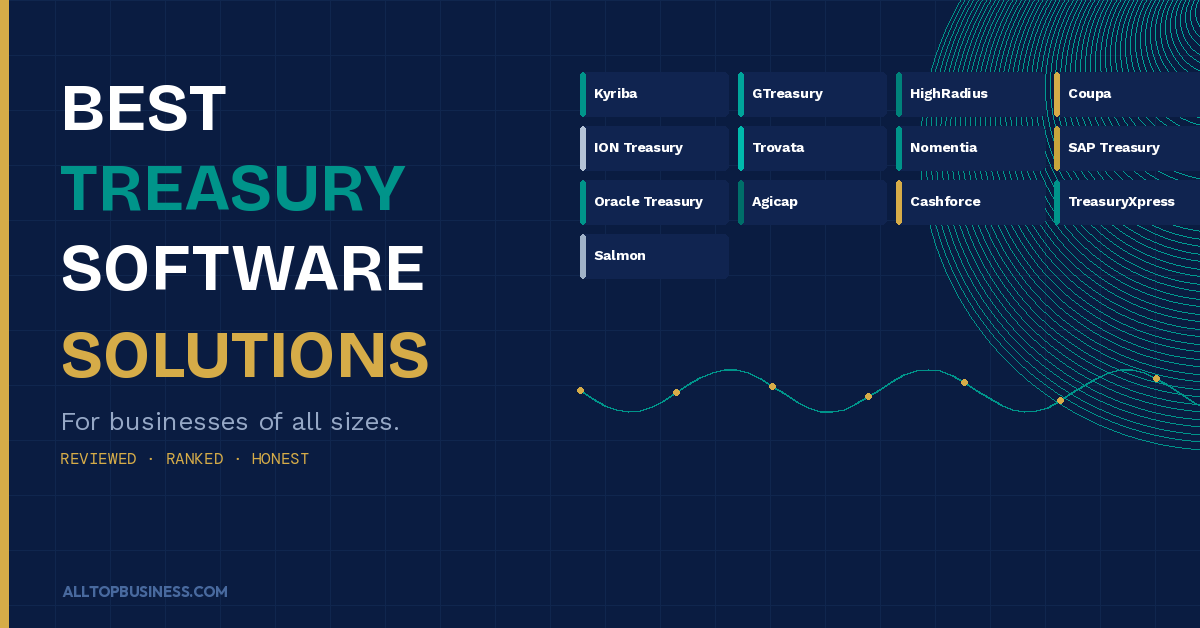
This guide covers the 10 best treasury software solutions available today. For each one, you will find a plain-English breakdown of what it does well, who it is best for, and where it falls short. No vendor fluff, no generic feature lists.
At AllTopBusiness.com, we focus on helping business and finance teams find the right B2B software tools. If you want to dig deeper into the fundamentals before choosing a platform, read our guide on what treasury management is and why it matters for your business.
Quick Summary: The best treasury software solutions in this guide are Kyriba, GTreasury, HighRadius, Coupa Treasury, ION Treasury, Trovata, Nomentia, SAP Treasury and Risk Management, Oracle Cash and Treasury Management, and Agicap. Each one serves a different company size, budget, and complexity level. Read the full breakdowns below to find the right fit for your team.
What Is Treasury Software?
Treasury software, also called a treasury management system (TMS), is a purpose-built financial platform that helps organizations manage cash, payments, investments, debt, and financial risk in one place.
Instead of relying on spreadsheets, disconnected bank portals, and manual reconciliations, treasury teams use these platforms to get real-time visibility into cash positions, automate routine tasks, and make faster, more informed financial decisions.
The core functions of most treasury software include:
- Cash and liquidity management
- Bank account management and reconciliation
- Payments processing and fraud controls
- Cash flow forecasting
- Foreign exchange (FX) risk management
- Debt and investment tracking
- Financial risk reporting and compliance
According to a PwC Global Treasury Survey, 74% of treasurers rank real-time cash visibility as their top priority. Yet most finance teams still struggle with fragmented data spread across multiple systems. That is exactly the gap that treasury software is designed to close.
How We Selected These Tools
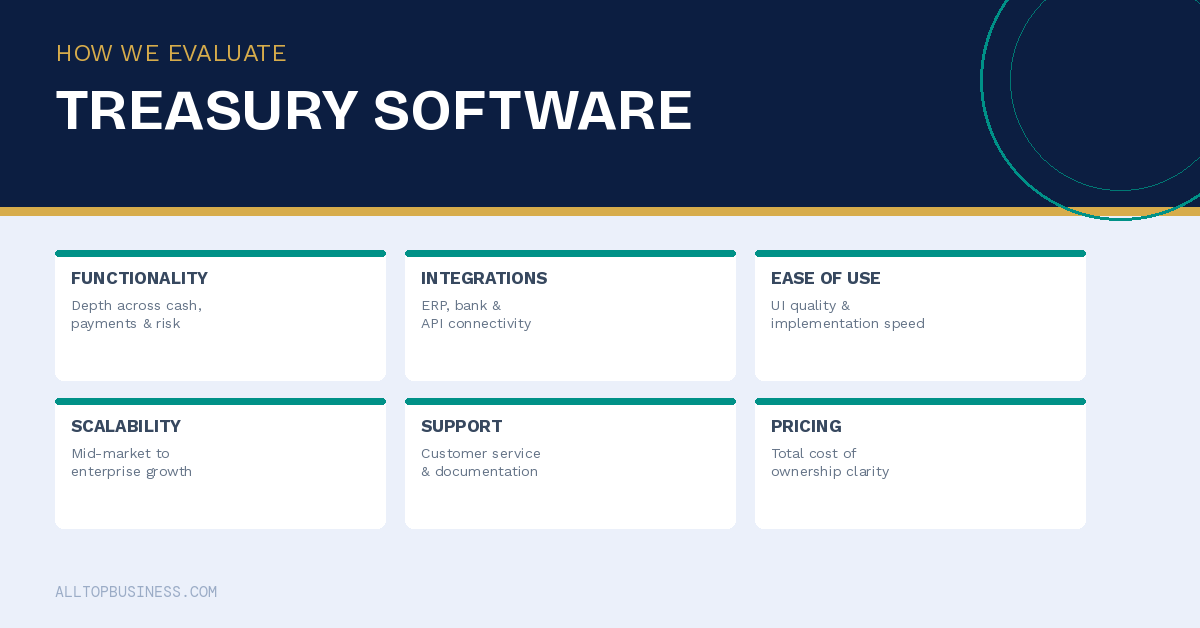
Every tool on this list was evaluated against the same set of criteria:
- Functionality depth across cash management, forecasting, payments, and risk
- Integration quality with common ERPs like SAP, Oracle, and NetSuite
- Ease of implementation and time to value
- Scalability from mid-market to enterprise
- User experience based on reviews from G2, Gartner Peer Insights, and Capterra
- Customer support quality and responsiveness
- Pricing transparency where available
With that framework in place, here are the 10 best treasury software platforms available today.
Best Treasury Software: Comparison Table
| Tool | Best For | Pricing | ERP Integration |
|---|---|---|---|
| Kyriba | Global enterprise treasury | Custom | SAP, Oracle, NetSuite |
| GTreasury | Mid-market to enterprise | Custom | SAP, Oracle, Workday |
| HighRadius | AR automation + treasury | Custom | SAP, Oracle, NetSuite |
| Coupa Treasury | Spend + treasury in one platform | Custom | SAP, Oracle, NetSuite |
| ION Treasury | Complex multi-entity operations | Custom | SAP, Oracle |
| Trovata | Real-time bank data via API | Starts ~$1,000/mo | QuickBooks, NetSuite |
| Nomentia | Mid-market modular treasury | Custom | SAP, Oracle, Microsoft |
| SAP Treasury | SAP-native treasury | Included in SAP | Native SAP |
| Oracle Treasury | Oracle-native treasury | Included in Oracle | Native Oracle |
| Agicap | SME cash flow planning | From €499/mo | Xero, QuickBooks, Datev |
10 Best Rated Treasury Management Software in the Market
1. Kyriba
Best for: Large enterprises with complex, multi-bank global treasury operations
Kyriba is one of the most widely recognized names in enterprise treasury management. It is a cloud-native platform built for organizations that operate across multiple countries, currencies, and banking relationships.
Where Kyriba stands out is in the breadth of its functionality. You get a full treasury workstation covering cash positioning, payments, in-house banking, debt management, FX risk, and financial risk analytics, all within a single system. The platform also offers robust bank connectivity, with direct links to over 1,000 banks globally through SWIFT, H2H, and API connections.
The cash forecasting module uses AI-driven modeling to help treasury teams build short, medium, and long-term forecasts with more accuracy than a spreadsheet ever could. You can layer in actuals from bank feeds automatically and run scenario analyses when business conditions shift.
Kyriba is particularly well-regarded for its payment fraud controls. The platform includes a payment validation layer that screens transactions against rules you define, flagging anomalies before funds leave the account.
What Kyriba does well:
- Comprehensive coverage across every core treasury function
- Strong bank connectivity (1,000+ banks globally)
- AI-powered forecasting and scenario planning
- Payment fraud prevention and controls
- Highly configurable for complex organizational structures
Where it falls short:
- Implementation can take several months for large deployments
- Pricing is enterprise-level and not suited for smaller organizations
- Some users on G2 report that the reporting module has a steep learning curve
Who should use Kyriba: Large enterprises and multinationals that need a full-suite treasury workstation with serious bank connectivity and risk management capabilities.
2. GTreasury
Best for: Mid-market to enterprise companies looking for a modern, flexible TMS
GTreasury is a cloud-based treasury management platform that has grown quickly in the mid-market and enterprise segments. It covers the full spectrum of treasury functions, including cash management, payments, FX risk, debt and investment tracking, and reporting.
One of GTreasury’s key differentiators is its API-first connectivity approach. It connects to banks, ERPs, and third-party data sources through modern APIs rather than legacy file-based integrations, which makes data more current and the implementation process faster.
The platform also offers a strong hedge accounting module, which is useful for companies that actively manage FX or interest rate exposure. Teams can track positions, generate hedge accounting entries, and produce the documentation needed for IFRS 9 or ASC 815 compliance.
Users consistently point to the clean, modern interface as a plus. The dashboards are well-designed and give treasury teams a clear picture of their cash position and risk exposure without needing to run separate reports.
What GTreasury does well:
- Modern API-first bank and ERP connectivity
- Strong hedge accounting and FX risk tools
- Clean, user-friendly interface and dashboards
- Scales well from mid-market to large enterprise
- Active product development with regular feature releases
Where it falls short:
- Some users report that the initial implementation takes longer than expected
- ERP integrations can have sync delays, according to some reviews
- Platform fees add to the overall cost of ownership
Who should use GTreasury: Mid-market finance teams and enterprise treasury departments that want a modern TMS with strong risk management capabilities and a faster implementation path than the legacy enterprise players.
For more context on how to evaluate and implement a treasury system, see our treasury management system implementation checklist.
3. HighRadius
Best for: Finance teams that want to automate AR alongside treasury functions
HighRadius takes a different approach from a traditional TMS. It is best known as an accounts receivable automation platform, but its Autonomous Treasury module extends that capability into cash management, forecasting, and bank reconciliation.
The platform uses AI and machine learning across all of its modules. In the treasury context, this means AI-driven cash flow forecasting that pulls data from your ERP, bank accounts, and AR pipeline to build predictions that improve over time as the model learns your business patterns.
Bank reconciliation is another standout feature. HighRadius can automatically match bank transactions to ledger entries with high accuracy rates, reducing the time your team spends on manual reconciliation work significantly.
For organizations that have a large volume of customer invoices and receivables, HighRadius brings a meaningful advantage: you can manage treasury and AR from the same platform, which gives you a more accurate and timely picture of incoming cash.
What HighRadius does well:
- AI-powered cash forecasting that improves over time
- Automated bank reconciliation with high match rates
- Strong AR and order-to-cash automation alongside treasury
- Real-time reporting across all bank accounts on one dashboard
- Well-designed interface with positive usability reviews
Where it falls short:
- Customer support receives mixed reviews, with some users reporting slow response times
- Bank feed integrations can be slow to update, according to several reviews
- ERP sync delays have been flagged by enterprise users
- Less suitable for companies that need deep FX risk or debt management capabilities
Who should use HighRadius: Finance teams at mid-market to enterprise companies who want to automate AR and treasury together, and who prioritize AI-driven forecasting and automated reconciliation.
4. Coupa Treasury
Best for: Organizations already using Coupa for procurement and spend management
Coupa Treasury is the treasury management module within the broader Coupa Business Spend Management platform. If your organization already uses Coupa for procurement, invoicing, or expense management, adding Coupa Treasury creates a unified view of cash outflows and working capital that few standalone TMS platforms can match.
The platform handles cash management, payments, liquidity planning, and risk management. Because it sits inside the Coupa ecosystem, procurement data flows directly into treasury forecasts, giving finance teams a more complete picture of future cash needs before commitments are made.
Coupa Treasury also has strong controls built in. Payment approvals, audit trails, and fraud detection capabilities are embedded throughout the workflow, which matters for organizations with complex approval hierarchies or strict compliance requirements.
What Coupa Treasury does well:
- Tight integration with procurement and spend data for better cash forecasting
- Strong payment controls and fraud detection
- Single platform across procurement, invoicing, expenses, and treasury
- Good compliance and audit trail features
- Well-suited for organizations with complex approval workflows
Where it falls short:
- Best value only for existing Coupa customers; switching costs are high otherwise
- Less depth in standalone FX risk and debt management compared to pure-play TMS vendors
- Pricing is enterprise-level
Who should use Coupa Treasury: Finance and treasury teams at mid-market to enterprise companies that already operate within the Coupa ecosystem and want to consolidate their spend and treasury visibility in one platform.
5. ION Treasury
Best for: Large enterprises with highly complex, multi-entity treasury structures
ION Treasury is part of the ION Group portfolio and brings together several well-established treasury platforms, including Openlink, Reval, and Wallstreet Suite, under one umbrella. This makes ION one of the most feature-rich treasury offerings on the market, particularly for organizations with sophisticated risk management needs.
The platform excels in financial risk management across FX, interest rate, commodities, and credit risk. Large corporations, financial institutions, and energy companies that deal with complex derivative instruments and trading positions often choose ION for its depth in this area.
The multi-entity and multi-currency capabilities are among the strongest in the market. If your treasury team manages cash and risk across dozens of legal entities in multiple countries, ION has the structural flexibility to support that complexity.
What ION Treasury does well:
- Deep financial risk management across multiple risk classes
- Multi-entity and multi-currency support at scale
- Covers complex derivative instruments and trading positions
- Proven track record with large enterprises and financial institutions
- Comprehensive compliance and regulatory reporting
Where it falls short:
- Implementation is lengthy and requires significant internal resources
- Less suited for mid-market companies without dedicated treasury staff
- UI is older in some modules compared to newer cloud-native competitors
- Pricing is at the top end of the market
Who should use ION Treasury: Large enterprises, financial institutions, and energy companies with sophisticated, multi-entity treasury operations and complex risk management requirements.
6. Trovata
Best for: Finance teams that want instant bank data visibility through direct API connections
Trovata takes a modern, API-first approach to treasury that is noticeably different from traditional TMS platforms. Rather than relying on SFTP file uploads or manual bank feeds, Trovata connects directly to banks through open banking APIs to pull real-time transaction data into the platform.
The result is near-instant visibility into cash positions across all your bank accounts, without the data lag that plagues many older treasury tools. Trovata then applies AI-powered tagging and categorization to transaction data, which feeds into automated cash reporting and forecasting.
The platform is particularly strong for cash reporting automation. Teams that spend hours each week pulling together cash reports from multiple bank portals and spreadsheets will find that Trovata eliminates most of that manual work very quickly after implementation.
Trovata also integrates with major ERPs, including NetSuite, QuickBooks, and SAP, allowing cash data to flow in both directions.
What Trovata does well:
- Direct bank API connections for real-time cash visibility
- Fast implementation compared to traditional TMS platforms
- Strong automated cash reporting and reconciliation
- AI-powered transaction tagging and categorization
- Good fit for companies with multiple banking relationships
Where it falls short:
- Less depth in risk management and hedge accounting than full-suite TMS platforms
- Bank coverage depends on API availability, which varies by region
- Better suited for companies in the mid-market than large global enterprises
Who should use Trovata: Mid-market finance and treasury teams that want real-time bank visibility and automated cash reporting without the complexity and cost of a full enterprise TMS.
7. Nomentia
Best for: Mid-market companies that want a modular, scalable treasury platform
Nomentia is a cloud-based, modular treasury platform built for mid-market companies that have outgrown spreadsheets but do not need the full complexity of an enterprise TMS. It was formed through the consolidation of several Nordic treasury software companies, which gives it a strong foundation in cash management, payments, and loan tracking.
The modular approach means you can start with the functionality you need today and add modules as your treasury operations grow. Core modules include cash and liquidity management, payments, FX derivatives, loan management, and bank connectivity.
Nomentia has particularly strong coverage of intercompany funding and loan portfolio management. For finance teams managing multiple entities, intercompany netting, or a portfolio of bank loans and credit facilities, Nomentia provides structure and automation that spreadsheets simply cannot.
What Nomentia does well:
- Modular design lets you start small and scale up
- Strong intercompany funding and loan management capabilities
- Good bank connectivity across European and global banks
- Straightforward implementation compared to enterprise TMS platforms
- Mid-market pricing that is more accessible than enterprise tools
Where it falls short:
- Less name recognition in the North American market
- Fewer out-of-the-box integrations than larger platforms
- Risk management depth is lighter than that of enterprise-focused competitors
Who should use Nomentia: Mid-market finance teams in Europe or internationally that need structured cash management, payments, and loan tracking without the complexity and cost of an enterprise system.
Understanding cash forecasting best practices alongside your TMS selection will help you get far more value from whichever platform you choose.
8. SAP Treasury and Risk Management
Best for: Organizations already running SAP ERP that want native treasury functionality
SAP Treasury and Risk Management is the treasury module that runs natively within the SAP ERP ecosystem. For organizations that are deeply invested in SAP, this is often the path of least resistance because it eliminates the need for a separate integration between your ERP and a third-party TMS.
The module covers cash and liquidity management, payment processing, financial risk management, and compliance reporting. Because everything runs within the same data model as your core SAP financials, transaction data is immediately available in treasury reports without reconciliation delays.
SAP’s strength is in the depth of its risk management capabilities, particularly for companies managing FX, interest rate, and commodity exposures. The hedge accounting functionality supports both IFRS and US GAAP standards.
The tradeoff is that SAP Treasury requires SAP expertise to configure and maintain. The user interface, while improved in recent releases, still lags behind newer cloud-native platforms in terms of intuitiveness.
What SAP Treasury does well:
- Native integration with SAP ERP eliminates separate TMS-to-ERP sync
- Deep financial risk management and hedge accounting
- Strong compliance with IFRS, US GAAP, and regulatory requirements
- No additional licensing needed if already on SAP
- Access to the full SAP support and consulting ecosystem
Where it falls short:
- Requires dedicated SAP expertise for configuration and ongoing management
- User interface is less modern than cloud-native TMS competitors
- Not practical for companies not already running SAP
Who should use SAP Treasury: Organizations already operating on SAP ERP that want integrated treasury management without adding a third-party system.
9. Oracle Cash and Treasury Management
Best for: Oracle ERP users who want treasury management built into their existing system
Oracle Cash and Treasury Management is Oracle’s native treasury module, designed to work within the Oracle Cloud ERP environment. Similar to SAP Treasury, the primary advantage here is the native integration with Oracle Financials, which means cash and transaction data flows seamlessly between your core financial system and treasury operations.
The platform covers cash positioning, bank account management, cash forecasting, payments, and basic risk management. Oracle’s reporting tools allow treasury teams to build customized dashboards and reports that pull from the same data source as the rest of the finance organization.
For companies running Oracle ERP, this native approach often reduces both implementation time and total cost of ownership compared to deploying a standalone TMS.
What Oracle Treasury does well:
- Native Oracle ERP integration with no data sync required
- Clean, modern UI consistent with Oracle Cloud’s interface
- Solid cash forecasting and bank account management
- Strong compliance and audit trail functionality
- Single vendor support relationship
Where it falls short:
- Limited depth in FX risk and hedge accounting compared to specialist TMS vendors
- Best value only for Oracle ERP customers
- Advanced risk management capabilities require additional Oracle modules
Who should use Oracle Treasury: Companies running Oracle Cloud ERP that want to manage treasury within their existing Oracle environment without a separate TMS vendor relationship.
10. Agicap
Best for: Small and medium-sized businesses that need accessible cash flow management
Agicap is a cash flow management and forecasting platform designed specifically for SMEs. Unlike the enterprise-focused tools above, Agicap is built for smaller finance teams that need to get control of their cash without a lengthy implementation or a large IT budget.
The platform connects to your bank accounts and accounting software to pull in real-time transaction data. From there, you can build cash flow forecasts, track variances against your plan, and run scenarios to understand how different business decisions affect your cash position.
Agicap’s interface is notably more accessible than enterprise TMS platforms. A small finance team can typically get set up and running within days rather than weeks or months. The platform integrates with Xero, QuickBooks, Datev, and several European accounting systems.
Pricing starts from around 499 euros per month, which makes it one of the few treasury tools on this list with transparent, accessible pricing for smaller businesses.
What Agicap does well:
- Simple, accessible interface designed for non-treasury specialists
- Fast implementation (days, not months)
- Real-time bank feed connectivity
- Cash flow forecasting with variance tracking
- Transparent pricing accessible for SMEs
Where it falls short:
- Not suitable for enterprise-level complexity or multi-entity structures
- Limited risk management functionality
- Payments and FX capabilities are lighter than full TMS platforms
Who should use Agicap: Small and medium-sized businesses that need practical, real-time cash visibility and forecasting without the complexity or cost of an enterprise treasury system.
What to Look For When Choosing the Best Rated Treasury Management Software
With ten strong options reviewed, here is a practical framework for narrowing down the right choice for your organization.
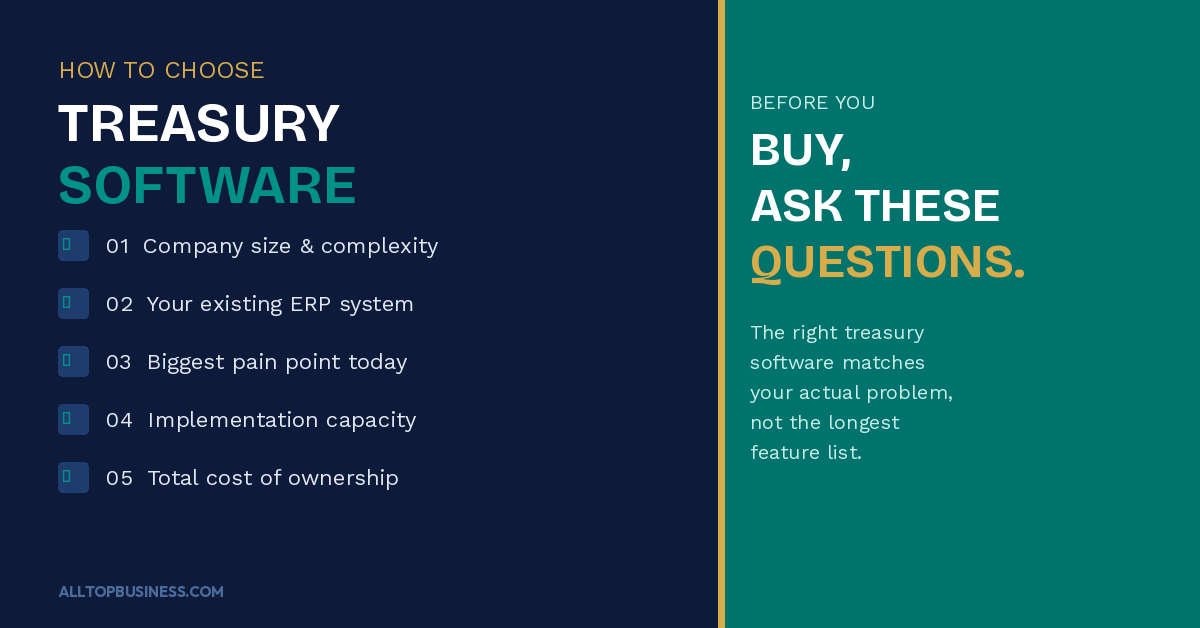
1. Company size and complexity
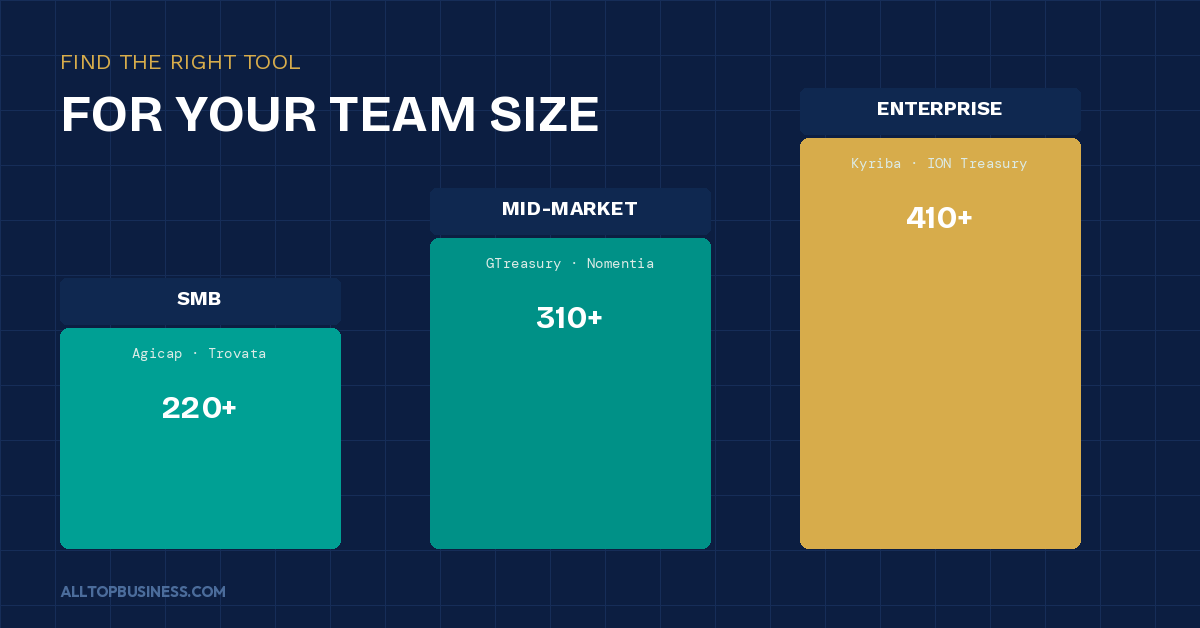
Small businesses and single-entity companies are better served by accessible tools like Agicap or Trovata.
Mid-market companies with multiple banking relationships will get strong value from GTreasury or Nomentia. Large enterprises with global operations and complex risk management needs should evaluate Kyriba, ION Treasury, or Coupa Treasury.
2. Your existing ERP
If you are already running SAP, the native SAP Treasury module deserves serious consideration before you add a separate vendor.
The same logic applies to Oracle users. If you run a more modern ERP like NetSuite or are ERP-agnostic, GTreasury, Kyriba, or Trovata will all integrate well.
3. Your biggest pain point
What is the one thing your treasury team struggles with most? If it is manual cash reporting, Trovata solves that faster than most. If it is FX risk and hedge accounting, GTreasury or ION Treasury are stronger choices.
If it is cash visibility across dozens of entities, Kyriba or ION are built for that. Matching the tool to your actual problem is more important than chasing the most feature-rich platform.
4. Implementation capacity
Some treasury implementations take six to twelve months and require significant internal resources.
If your team is lean, factor in the implementation burden before committing to a complex enterprise platform. Tools like Trovata and Agicap are designed for faster time to value.
5. Budget
Most enterprise TMS platforms do not publish pricing and require a custom quote.
Budget conversations with vendors typically include licensing, implementation, training, and annual support. Get quotes from at least three vendors and ask specifically about the total cost of ownership in year one versus year three.
Key Treasury KPIs to Track After Implementation
Buying the right software is only half the job. To get real value from your treasury platform, you need to track the metrics that matter. Our guide on treasury management KPIs every CFO should watch covers the specific numbers that indicate whether your treasury operations are performing well.
Managing FX Risk With Your Treasury Platform
For companies that pay overseas suppliers or manage multi-currency cash flows, FX risk management is a critical treasury function. Our guide on FX risk management for companies that pay overseas suppliers covers how to map your exposure and use your TMS effectively to manage it.
Frequently Asked Questions
What is the best treasury software for small businesses?
Agicap is the strongest option for small businesses due to its accessible pricing, fast setup, and straightforward cash flow forecasting. Trovata is also worth considering for SMBs with multiple bank accounts that need real-time cash visibility.
What is the difference between a TMS and an ERP treasury module?
A standalone TMS is a dedicated treasury platform built specifically for cash, risk, and payment management. An ERP treasury module (like SAP Treasury or Oracle Treasury) runs natively inside your ERP system. ERP modules offer tighter data integration but less depth in specialized functions like FX risk and hedge accounting compared to standalone TMS platforms.
How much does treasury software cost?
Enterprise TMS platforms typically range from $50,000 to several hundred thousand dollars per year, depending on company size and the modules required. Mid-market tools like Nomentia and GTreasury fall in a lower range. Agicap offers the most transparent pricing, starting from around 499 euros per month.
What is a treasury workstation?
A treasury workstation is another term for a TMS. It refers to the centralized software environment where treasury teams manage their daily operations, including cash positioning, payments, investments, and risk. The term originated when treasury software ran on dedicated workstations rather than cloud platforms.
How long does it take to implement treasury software?
Implementation timelines vary widely. Agicap and Trovata can be operational within days to a few weeks. Mid-market platforms like GTreasury and Nomentia typically take one to three months. Enterprise deployments with Kyriba or ION Treasury can take six to twelve months or longer for large, complex organizations.
Do I need treasury software if I already have an ERP?
Most ERP systems provide basic cash management functionality, but they are not built for the complexity of treasury operations at mid-market and enterprise scale. If your team is spending significant time on manual cash reporting, spreadsheet-based forecasting, or disconnected bank portals, a dedicated TMS will pay for itself quickly.
Final Thoughts
The best treasury software is not the most expensive one or the one with the longest feature list. It is the one that solves your specific cash visibility, forecasting, payment, or risk management problem with the least friction.
For most mid-market companies, GTreasury, Trovata, or Nomentia will hit the right balance of functionality and implementability. Enterprise teams with global operations should look hard at Kyriba or ION Treasury. SAP and Oracle shops should evaluate their native modules before adding another vendor. And smaller businesses will find Agicap genuinely useful without the enterprise overhead.
Take your shortlist, run demos with your actual use cases, and ask every vendor the same questions about total cost of ownership, implementation timeline, and customer support.
If you found this guide useful, explore more B2B SaaS tool reviews and business software comparisons on the AllTopBusiness blog. Have a specific treasury or finance tool question? Reach out to our team, and we are happy to help.
External Sources:
- Association for Financial Professionals (AFP) – Treasury Management Resources
- Gartner Peer Insights – Treasury Management Systems Reviews

I’m Adeyemi Adetilewa, a Content Marketing and SEO Specialist, Digital Strategist, Entrepreneur, and the Editor of AllTopBusiness.com. With over 13 years of experience helping businesses scale through content-driven growth, I’m happy to share all the top business tools I have discovered with you here.