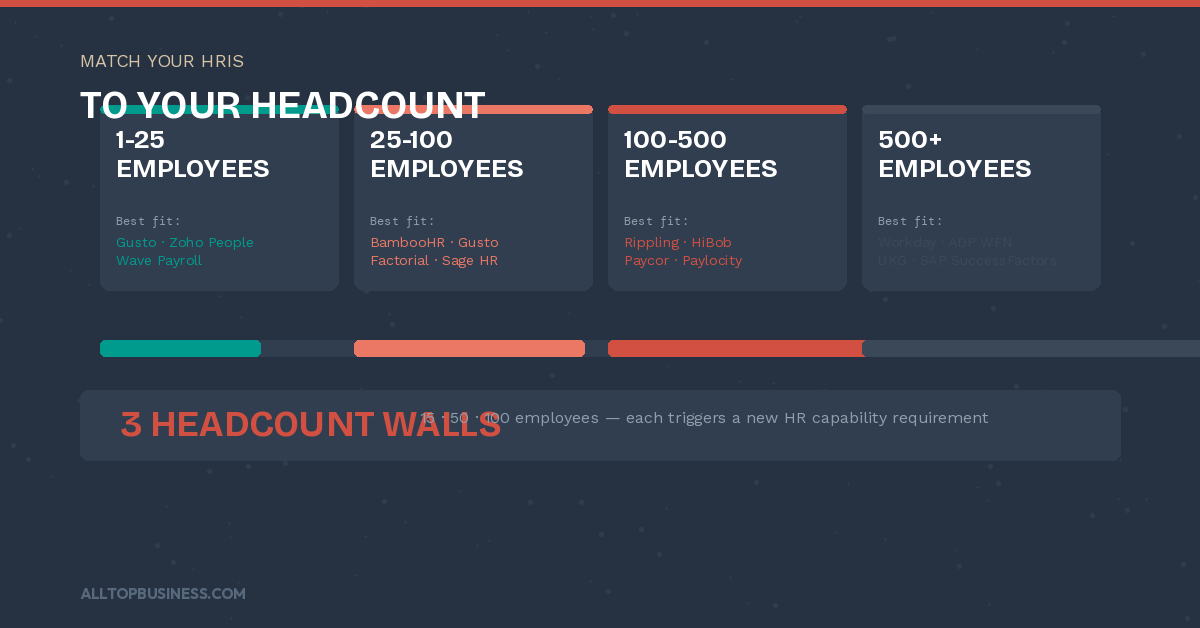
Growing companies hit the same HR wall at roughly the same headcount thresholds. At 15 employees, spreadsheets stop working for time-off tracking and onboarding. At 50, multi-state compliance becomes a genuine legal risk. At 100, performance management and compensation planning require dedicated tools. And at 200+, a single HR administrator simply cannot run everything manually anymore.
The ADP 2026 HR Trends Report identifies three forces hitting growing businesses simultaneously: AI integration demands, increasingly complex multi-state compliance requirements, and upskilling pressure as teams scale rapidly. Platforms built for solo HR administrators or Fortune 500 HRIS teams miss all three.
This guide covers the best HR software platforms that genuinely serve growing companies from 10-person startups building their first HR process to 500-person mid-market companies that have outgrown their original HRIS. We evaluated over 40 platforms to arrive at this list. Every entry is assessed against the same criteria and includes real pricing data, honest limitations, and a precise recommendation for who each tool fits.
For related reading on managing your broader business operations stack, explore the AllTopBusiness blog.
Quick Picks: Best HR Software for Growing Companies
| Label | Pick |
|---|---|
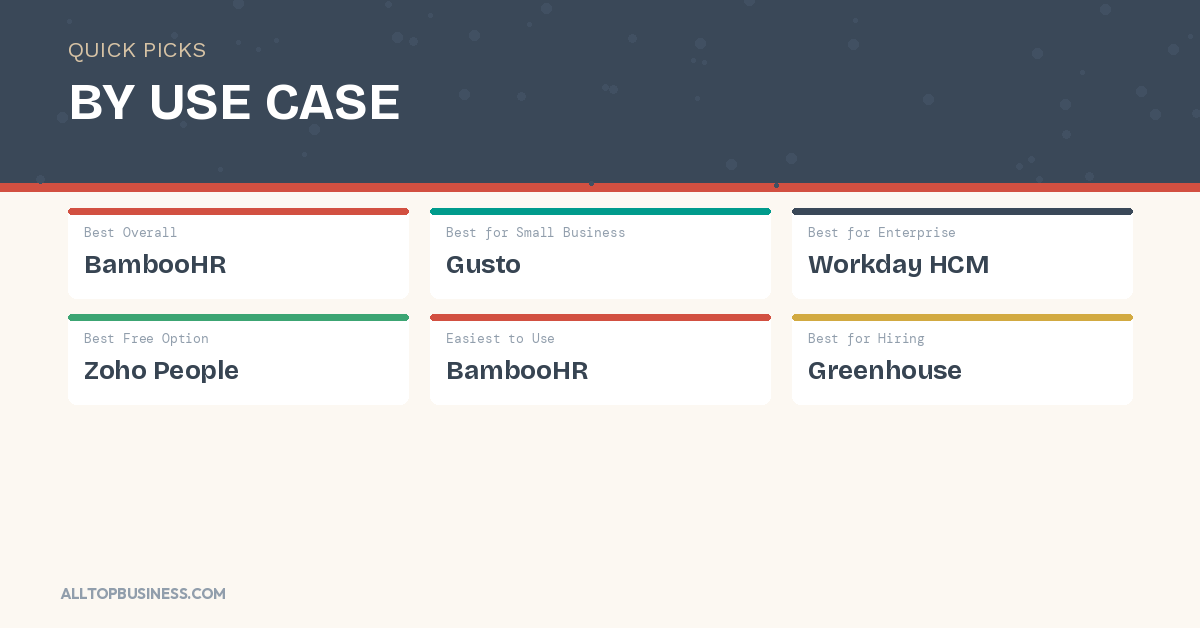
| Best Overall | BambooHR — the most human-centered, easy-to-use HRIS for SMB and mid-market companies |
| Best for Small Business | Gusto — payroll-first HRIS with benefits and onboarding built for teams under 100 |
| Best for Enterprise | Workday HCM — the gold standard for enterprise HR, finance, and workforce planning |
| Best Free or Low-Cost Option | Zoho People — solid HRIS free plan for up to 5 employees, paid tiers from $1.25 PEPM |
| Best for Ease of Use | BambooHR — consistently rated the most beginner-friendly HRIS in the category |
| Best for Hiring and Onboarding | Greenhouse — purpose-built ATS with structured hiring workflows and the strongest onboarding integration |
How We Selected These Tools
Every platform on this list was evaluated against six criteria:
- Core HR functionality — employee records, time-off management, onboarding, and compliance
- Payroll and benefits capabilities — native payroll, benefits administration, and tax compliance
- Talent management depth — recruiting, performance management, and learning
- Scalability — the ability to grow from early-stage through mid-market without a platform migration
- Integration quality — connectivity with payroll, accounting, communication, and productivity tools
- User review consensus — ratings and themes from G2, Capterra, and Gartner Peer Insights
Best HR Software for Growing Companies: Comparison Table
| Tool | Best For | Starting Price | Free Plan | G2 Rating | Key Integration |
|---|---|---|---|---|---|
| BambooHR | SMB and mid-market core HRIS | ~$10 PEPM / $250 min/mo | No | 4.4/5 | Slack, QuickBooks, Greenhouse |
| Rippling | Tech-forward teams wanting HR + IT unified | From $8/user/mo (modular) | No | 4.8/5 | Slack, Microsoft 365, GitHub |
| Gusto | Small businesses needing payroll-first HRIS | From $46/mo + $6 PEPM | No | 4.5/5 | QuickBooks, Xero, Slack |
| HiBob | Culture-first HRIS for mid-market teams | ~$16-25 PEPM | No | 4.5/5 | Slack, Google Workspace, Workday |
| Workday HCM | Enterprise HR, finance, and workforce planning | Custom (enterprise) | No | 4.0/5 | Salesforce, Slack, Microsoft 365 |
| ADP Workforce Now | Full HCM for scaling and enterprise teams | Custom | No | 4.1/5 | QuickBooks, Salesforce, Slack |
| Lattice | Performance management and engagement | From $11 PEPM | No | 4.7/5 | BambooHR, Rippling, Slack |
| Greenhouse | Structured hiring and ATS for scaling teams | Custom | No | 4.4/5 | BambooHR, Workday, Slack |
| Lever | Mid-market ATS with CRM-style recruiting | Custom | No | 4.3/5 | BambooHR, Slack, LinkedIn |
| Personio | European SMBs needing all-in-one HR | From €3 PEPM | No | 4.3/5 | Slack, Google Workspace, Datev |
| Zoho People | Budget-conscious teams in the Zoho ecosystem | Free / from $1.25 PEPM | Yes (5 users) | 4.4/5 | Zoho CRM, Slack, QuickBooks |
| Paycor | Mid-market payroll and compliance-heavy teams | Custom | No | 4.0/5 | QuickBooks, Salesforce |
| Paylocity | Mid-market engagement and payroll | Custom | No | 4.4/5 | QuickBooks, Salesforce, Slack |
| TriNet | SMBs wanting a PEO with full HR outsourcing | Custom | No | 3.9/5 | QuickBooks, Salesforce |
| Namely | Mid-market all-in-one HRIS with payroll | Custom | No | 3.9/5 | Salesforce, Slack, QuickBooks |
| Zenefits (now Adp) | SMBs wanting benefits-first HRIS | From $8/user/mo | No | 4.0/5 | QuickBooks, Salesforce, Slack |
| Factorial | European growing companies | From €5 PEPM | No | 4.4/5 | Slack, Google Workspace |
| Sage HR | SMBs and growing teams wanting modular HR | From $5.50 PEPM | No | 4.3/5 | Sage Accounting, Slack |
| Deel | Global teams and companies with contractors | From $49/contractor/mo | No | 4.8/5 | Slack, QuickBooks, Rippling |
| Leapsome | Performance, OKRs, and learning for scaling teams | From $8 PEPM | No | 4.8/5 | BambooHR, Rippling, Slack |
| Bob (HiBob Lite) | See HiBob — same platform, module-flexible entry | ~$16-25 PEPM | No | 4.5/5 | Slack, Google Workspace |
1. BambooHR
The most human-centered, beginner-friendly HRIS for small and mid-market companies
BambooHR is the benchmark HRIS for U.S.-based small and mid-market companies and has been for over a decade. Its reputation is built on three things: an interface that non-HR professionals can navigate without training, strong core HR functionality covering employee records, time-off management, performance reviews, and onboarding, and the most accessible implementation experience in the category.
In March 2026, BambooHR launched BambooHR Services, a managed services offering that includes expert-run payroll execution within the platform, expanding beyond pure software into HR services to help customers manage compliance complexity. This addition makes BambooHR a more complete solution for companies that want payroll managed rather than just processed.
The platform serves over 30,000 customers globally. Its Core and Pro plans cover the HRIS fundamentals, with payroll, benefits administration, and time tracking available as paid add-ons. The $250 per month minimum — which catches small teams by surprise — applies regardless of headcount, making BambooHR better value as headcount grows past 25 employees.
What it does well:
- Consistently rated the most beginner-friendly HRIS — HR and non-HR users adopt it with minimal training
- Strong core HR: employee records, org chart, PTO tracking, onboarding workflows, and eSignatures
- New BambooHR Services offering for managed payroll execution
- Large integration ecosystem including Greenhouse, Slack, and major accounting platforms
- Mobile app with strong employee self-service experience
Where it falls short:
- Payroll, benefits, and time tracking are paid add-ons — base price understates real cost by 30 to 50%
- No public pricing — requires a sales conversation for a quote
- Less depth in performance management than in dedicated tools like Lattice
- $250 per month minimum makes it expensive for companies under 25 employees
Pricing: Core from ~$10 PEPM. Pro from ~$17 PEPM. Elite from ~$25 PEPM. Minimum $250/month applies.
Best for: U.S.-based small and mid-market companies with 25 to 500 employees that want a proven, easy-to-use HRIS with strong core HR and an accessible implementation experience.
2. Rippling
The best HR software for tech-forward companies that want HR and IT managed in one platform
Rippling is the fastest-growing HRIS in the market and the strongest choice for technology companies, remote-first businesses, and any organization where managing employee devices, software access, and HR records from a single system would meaningfully reduce administrative overhead. Rippling starts lower per employee but uses a modular pricing structure where every capability — payroll, benefits, ATS, IT management — is a separate add-on. Stacking modules can push the total cost above BambooHR quickly.
The platform’s unique strength is its Unified Workforce Platform — it manages not just HR data but also device management, app provisioning, and identity and access management. When a new hire joins, Rippling can automatically provision their laptop, create their email account, grant Slack and GitHub access, and enroll them in benefits — all triggered by a single onboarding workflow. When someone offboards, the reverse happens automatically.
Rippling holds a 4.8/5 rating on G2 from over 5,000 reviews, the highest score among enterprise-capable HRIS platforms in the category.
What it does well:
- Unified HR + IT management — device provisioning, app access, and HR data in one workflow
- Strongest payroll automation and global payroll depth in the mid-market
- 4.8/5 on G2 — highest satisfaction score among full-featured HRIS platforms
- Fast implementation relative to competitors at an equivalent capability level
- Strong automation across onboarding, offboarding, and compliance workflows
Where it falls short:
- Modular pricing means every capability adds cost — total cost can significantly exceed the headline price
- Can be more than necessary for companies that only need core HR without IT integration
- The performance management module is less mature than dedicated tools like Lattice
- Customer support receives mixed reviews at scale
Pricing: From $8 per user per month for core HR. Every additional module (payroll, benefits, IT, ATS) adds to the base cost.
Best for: Technology companies, remote-first businesses, and fast-growing companies with 50 to 1,000 employees that want HR and IT managed in one platform and are comfortable with modular pricing.
3. Gusto
The best payroll-first HRIS for small businesses under 100 employees
Gusto is the most widely adopted payroll platform for small U.S. businesses and the natural first HRIS for companies that start with payroll and grow into broader HR functionality. It covers payroll, benefits administration, time tracking, hiring, onboarding, and basic HR management in a clean, accessible platform that does not require an HR background to use.
The platform’s payroll engine handles federal, state, and local tax calculations automatically, files tax documents on behalf of the employer, and supports contractors and W-2 employees in the same system. The benefits administration module connects to a curated marketplace of health, dental, vision, life, and 401(k) plans.
For companies that graduate from Gusto to a more capable HRIS as they scale, Gusto integrates cleanly with BambooHR, Rippling, and other platforms — meaning payroll data does not need to be rebuilt when you add a separate HRIS layer.
What it does well:
- The most beginner-friendly payroll and HRIS for companies starting from scratch
- Automatic federal, state, and local tax filing — no manual tax management required
- Benefits marketplace with health, dental, vision, and 401(k) options
- Clean onboarding workflows for both W-2 employees and contractors
- Strong integrations with QuickBooks, Xero, and major accounting platforms
Where it falls short:
- Less depth in performance management and talent development than dedicated HRIS platforms
- Per-employee pricing adds up quickly above 50 employees compared to alternatives
- Less suitable for companies with complex multi-state compliance requirements at scale
- International payroll requires a separate Gusto Global product
Pricing: Simple from $46/mo + $6 PEPM. Plus from $80/mo + $12 PEPM. Premium custom pricing.
Best for: Small U.S. businesses with 5 to 100 employees that want payroll, benefits, and basic HR management in the most accessible and affordable package available.
4. HiBob
The best culture-first HRIS for mid-market companies that prioritize employee experience
HiBob — known within the platform as “Bob” — has earned a strong reputation among mid-market companies for its modern, visually engaging interface and its depth in people analytics, DEI tracking, and employee engagement tools. In September 2025, HiBob launched native U.S. payroll powered by Gusto’s engine, with general availability from January 2026. This means HiBob now offers payroll in three of its largest markets natively.
The platform covers core HRIS, performance management, compensation management, surveys, recognition, and workforce analytics. Its org chart and headcount planning tools give HR and finance teams a real-time view of organizational structure and compensation that most HRIS platforms do not provide without a separate analytics tool.
HiBob scores around 4.5/5 on G2 and review sites consistently. Users praise the modern UX and engagement tools, while some note the higher cost compared to BambooHR and occasional lag in reporting.
What it does well:
- Modern, visually engaging interface that employees actually want to use
- Native U.S. payroll from January 2026 — no longer requires a separate payroll provider
- Strong people analytics: org charts, headcount planning, DEI tracking, and workforce insights
- Performance management, OKR tracking, and employee surveys built into the core platform
- Strong global capability for companies with international teams
Where it falls short:
- Higher per-employee cost than BambooHR or Zoho People
- No built-in ATS — recruiting requires a separate tool
- Reporting can lag on large datasets, according to some user reviews
- Less suitable for very small companies under 50 employees, where cost-to-value is harder to justify
Pricing: ~$16 to $22 PEPM for 50 to 200 employees. ~$20 to $25 PEPM for 200 to 1,000 employees. Custom quote required.
Best for: Mid-market companies with 50 to 1,000 employees that prioritize employee experience, people analytics, and a modern HRIS interface — particularly companies with international or hybrid teams.
5. Workday HCM
The gold standard enterprise HR, finance, and workforce planning platform
Workday is the most widely deployed enterprise HCM platform globally and the standard against which all other enterprise HR software is measured. It combines financial management, HR, payroll, workforce planning, and talent management in a single cloud platform — built from the ground up rather than assembled through acquisitions.
Workday’s strength is the integration between HR and finance data. Compensation decisions, headcount plans, and organizational changes flow directly into financial models and reports without reconciliation between separate systems. For CFOs and CHROs who want a unified view of workforce cost and organizational performance, Workday delivers that integration more naturally than any competitor.
What it does well:
- Best-in-class integration between HR and financial management data
- Comprehensive talent management, including learning, succession, and career development
- Real-time workforce analytics with no batch processing delays
- Trusted by the majority of Fortune 500 companies for HR and finance operations
- Continuous cloud updates with no on-premise upgrade cycles
Where it falls short:
- Enterprise pricing and implementation timelines of 3 to 9 months are not suitable for growing companies under 500 employees
- Requires dedicated Workday administrators or implementation partner resources
- Less nimble than newer platforms for companies that need to move fast
- Customization requires Workday-certified consultants
Pricing: Custom enterprise pricing. Typically starts at $100 to $150 per employee per year for core HCM, with financials adding significantly.
Best for: Enterprises with 500+ employees — particularly professional services, technology, and financial services companies — that want HR and finance data unified in a single platform and have the resources to implement and maintain it.
6. ADP Workforce Now
The best full HCM platform for companies scaling past 100 employees with complex compliance needs
ADP Workforce Now is the most widely used HR and payroll platform for mid-market and enterprise companies globally. Its breadth of functionality — payroll, benefits, time and attendance, talent management, compliance, and analytics — covers every HR need without requiring a separate tool for any core function.
Gartner’s 2026 workforce management reviews identify ADP Workforce Now as a leading platform for full HCM at scale. Forbes Advisor rates it 4.0 stars as the best HR software for scaling businesses, acknowledging that its breadth of features rewards organizations with dedicated HRIS resources.
ADP’s compliance library is one of the strongest in the market — federal, state, and local regulatory updates are applied automatically, which is critical for companies operating across multiple states or countries.
What it does well:
- Comprehensive full HCM covering payroll, benefits, time, talent, and compliance in one platform
- Industry-leading compliance library — automatic regulatory updates across all jurisdictions
- Largest payroll processing network in the U.S. — unmatched reliability and scale
- Strong analytics and reporting for workforce cost and performance
- Integrates with virtually every major business software platform
Where it falls short:
- The interface is less modern and intuitive than BambooHR, Rippling, or HiBob
- Requires dedicated HRIS resources to configure and maintain at full capability
- Customer support quality receives mixed reviews, particularly for complex multi-state issues
- Pricing requires a custom quote and contract negotiation
Pricing: Custom pricing. Typically requires dedicated HRIS resources — best suited for companies that have or are ready to hire an HR operations professional.
Best for: Companies with 100 to 5,000+ employees in heavily regulated industries or with complex multi-state compliance requirements that need a proven, full-suite HCM platform.
7. Lattice
The best performance management and employee engagement platform for growing companies
Lattice is a purpose-built performance management and people development platform — not a full HRIS, but the strongest tool in the category for growing companies that need structured performance reviews, OKR tracking, 360 feedback, engagement surveys, and compensation management in a single platform.
Most growing companies use Lattice alongside a core HRIS like BambooHR or Rippling rather than as a standalone HR system. The integrations between Lattice and the leading HRIS platforms are well-developed, with employee records syncing automatically so performance data stays current without manual maintenance.
Lattice holds a 4.7/5 on G2 and consistently earns top marks in performance management software reviews. Platforms with strong employee experience ratings include HiBob, Lattice, and BambooHR, which consistently score highest in employee satisfaction surveys.
What it does well:
- Best-in-class performance review workflows — structured, customizable, and scalable
- OKR and goal tracking connected to performance reviews and compensation cycles
- 360 feedback, manager check-ins, and engagement surveys in a clean, unified interface
- Compensation management module for salary bands, merit cycles, and equity tracking
- Strong integration with BambooHR, Rippling, Workday, and other core HRIS platforms
Where it falls short:
- Not a full HRIS — does not replace core HR, payroll, or benefits administration
- Per-employee pricing adds up quickly for large teams using multiple modules
- Implementation requires deliberate configuration of review templates and cycles
- Less suitable as a standalone tool for very small teams under 25 employees
Pricing: Performance Management from $11 PEPM. Engagement from $4 PEPM. Growth (compensation + career) from $6 PEPM. Full platform pricing varies.
Best for: Growing companies with 50 to 1,000 employees that want structured performance management, OKR tracking, and compensation planning alongside their core HRIS.
8. Greenhouse
The best applicant tracking system for structured, scalable hiring
Greenhouse is the most widely adopted ATS for mid-market and growth-stage companies that take structured hiring seriously. Its interview kits, scorecard templates, and standardized evaluation workflows produce more consistent hiring decisions and reduce unconscious bias compared to unstructured interview processes.
The platform covers job posting, candidate management, interview scheduling, structured evaluation, offer management, and onboarding — with reporting that shows where candidates drop out of the pipeline and which sources produce the best hires.
Greenhouse integrates with BambooHR, Workday, Rippling, and most major HRIS platforms, making it a natural addition to any growing HR stack where recruiting volume justifies a dedicated ATS.
What it does well:
- Structured interview kits and scorecards produce more consistent hiring decisions
- Strong pipeline reporting — source tracking, stage-by-stage conversion, and time-to-hire
- Integrates cleanly with every major HRIS platform
- Robust offer management and approval workflows
- DEI hiring analytics and bias reduction tools
Where it falls short:
- Custom pricing means a higher cost threshold than self-serve ATS tools
- Can be more than necessary for companies hiring fewer than 5 to 10 roles per year
- Implementation requires a configuration investment to realize the structured hiring benefits
Pricing: Custom pricing based on company size and modules.
Best for: Growing companies with 50 to 1,000 employees that hire 10 or more roles per year and want structured, data-driven hiring workflows with strong HRIS integration.
9. Lever
The best ATS for mid-market companies that want CRM-style candidate relationship management
Lever combines a traditional ATS with a CRM-style candidate nurturing approach — treating recruiting as a long-term relationship-building function rather than a reactive job-posting exercise. It is particularly strong for companies building talent pipelines for roles that are difficult to fill quickly.
The platform covers sourcing, pipeline management, interview scheduling, offer management, and analytics. Its two-in-one TalentSuite approach — combining Lever ATS and Lever Nurture — is designed for talent teams that want to build candidate relationships before a role opens rather than scrambling to fill it after.
What it does well:
- CRM-style nurture campaigns for building candidate pipelines ahead of demand
- Strong visual pipeline management with drag-and-drop candidate tracking
- Good diversity and inclusion reporting across the hiring funnel
- Clean integration with LinkedIn, Slack, and major HRIS platforms
- Particularly strong for technical and hard-to-fill role recruiting
Where it falls short:
- Less structured than Greenhouse for companies that need rigorous interview standardization
- Custom pricing requires a sales conversation
- Less well-known outside North America
Pricing: Custom pricing.
Best for: Mid-market companies with active talent acquisition teams that want CRM-style pipeline building alongside traditional ATS functionality — particularly for technical and hard-to-fill roles.
10. Personio
The best all-in-one HRIS for European SMBs and growing companies
Personio is the leading HR platform for small and mid-market companies in Europe, covering core HR, recruiting, payroll (in select European countries), performance management, and time tracking in a single platform. It handles European employment law, GDPR compliance, and local payroll requirements in Germany, Austria, Spain, the UK, the Netherlands, and several other European markets natively.
For European companies that find Workday and ADP oversized and BambooHR too US-centric, Personio occupies a practical middle ground — comprehensive enough for professional HR operations but accessible enough for SMBs without dedicated HR technology resources.
What it does well:
- Purpose-built for European employment law and GDPR compliance
- All-in-one platform covering core HR, recruiting, payroll, and performance
- Strong localization across Germany, Austria, Spain, the UK, and the Netherlands
- Clean interface accessible for SMBs without dedicated HR technology teams
- Transparent per-employee-per-month pricing
Where it falls short:
- Less depth in talent development and learning management than in enterprise HCM platforms
- Payroll availability varies by country — not available in all European markets
- Less suitable for companies outside Europe
Pricing: From €3 PEPM for core HR. Full-suite pricing scales with modules and headcount.
Best for: European SMBs and growing companies with 10 to 500 employees that need a professional all-in-one HRIS with native European compliance and payroll support.
11. Zoho People
The best budget-friendly HRIS for teams already in the Zoho ecosystem
Zoho People delivers a comprehensive HRIS feature set — employee records, time and attendance, leave management, performance management, learning management, and case management — at a price point that significantly undercuts BambooHR, Rippling, and HiBob.
The free plan covers up to 5 employees — genuinely useful for very early-stage companies that want to establish HR processes before committing to a paid platform. Paid tiers start at $1.25 PEPM, making Zoho People the most affordable full-featured HRIS on this list.
What it does well:
- Most affordable HRIS on this list — paid tiers from $1.25 PEPM
- Free plan for up to 5 employees
- Comprehensive feature set covering core HR through performance and learning
- Native integration with Zoho CRM, Zoho Books, and other Zoho products
- Strong automation for workflows, approvals, and document management
Where it falls short:
- The interface is less polished than BambooHR or HiBob
- Best value for teams already in the Zoho ecosystem
- Customer support response times receive mixed reviews
- Less U.S. payroll depth than Gusto or ADP
Pricing: Free for 5 users. Essential from $1.25 PEPM. Professional from $2 PEPM. Premium from $3 PEPM. Enterprise from $4.50 PEPM.
Best for: Budget-conscious growing companies — particularly those already using Zoho CRM or Zoho Books — that need a comprehensive HRIS at the lowest possible per-employee cost.
12. Paycor
The best HR and payroll platform for mid-market companies in compliance-heavy industries
Paycor is a full HCM platform covering payroll, benefits, time and attendance, recruiting, onboarding, performance, and analytics. It is particularly well-regarded in healthcare, manufacturing, and retail — industries where shift scheduling, hourly workforce management, and regulatory compliance are core HR requirements.
The platform’s compliance tools — including federal, state, and local tax management alongside industry-specific compliance templates — are among the strongest in the mid-market HRIS category. For companies in regulated industries that have experienced compliance exposure from inadequate HR tools, Paycor is a meaningful upgrade.
What it does well:
- Strong compliance depth for healthcare, manufacturing, and retail industries
- Comprehensive shift scheduling and time and attendance management
- Full HCM covering the entire employee lifecycle
- Good analytics and workforce reporting for operations managers
- Strong customer support ratings compared to larger HCM vendors
Where it falls short:
- The interface is less modern than BambooHR or HiBob
- Custom pricing makes cost comparison difficult without a sales conversation
- Less suitable for technology companies or knowledge-worker-focused organizations
Pricing: Custom pricing based on company size and modules.
Best for: Mid-market companies with 50 to 1,000 employees in healthcare, manufacturing, retail, and hospitality that need strong shift scheduling, time management, and industry-specific compliance alongside full HCM.
13. Paylocity
The best mid-market HRIS for companies that prioritize employee engagement alongside operations
Paylocity is a modern mid-market HRIS that covers payroll, benefits, time and attendance, recruiting, onboarding, performance, learning, and employee engagement in a single platform. Its Community module — an internal social feed for company news, recognition, and peer engagement — differentiates it from more operationally focused HRIS platforms.
For companies that view HR technology as part of their employee experience strategy rather than just an administrative tool, Paylocity’s combination of operational HR and engagement features provides value that Paycor and ADP do not match at comparable pricing.
What it does well:
- Community engagement module for internal communication and recognition alongside core HRIS
- Strong payroll and benefits administration
- Modern interface with high employee self-service adoption rates
- Solid recruiting and onboarding workflows
- Good analytics and compliance reporting
Where it falls short:
- Custom pricing requires a sales conversation
- Performance management is less structured than Lattice or Leapsome
- Some users report integration complexity with third-party tools
Pricing: Custom pricing.
Best for: Mid-market companies with 50 to 500 employees that want a modern HRIS combining operational HR with employee engagement and internal communication tools.
14. TriNet
The best option for small businesses that want to fully outsource HR through a PEO
TriNet is a Professional Employer Organization (PEO) rather than a pure HRIS platform. When you work with TriNet, they become the co-employer of your workforce — handling payroll processing, tax filing, benefits administration, workers’ compensation, and HR compliance on your behalf. Your team gets access to enterprise-level benefits packages that a small company could not negotiate independently.
For small businesses that want to completely outsource their HR function rather than build an internal one, TriNet removes the entire administrative burden. The tradeoff is that you give up some control and pay a premium for the outsourcing model.
What it does well:
- Full HR outsourcing — payroll, compliance, benefits, and workers’ comp handled by TriNet
- Access to large-company benefit packages at small-company headcount
- Significant compliance risk reduction — TriNet handles regulatory exposure as co-employer
- Particularly valuable for companies entering new states or hiring in complex jurisdictions
- HR expertise on call through TriNet advisors
Where it falls short:
- Higher total cost than self-service HRIS for companies with internal HR capacity
- Less control over HR processes compared to self-managed platforms
- Transitioning away from a PEO can be complex and time-consuming
Pricing: Custom pricing. Typically $125 to $200 per employee per month.
Best for: Small businesses with 10 to 150 employees that want to outsource HR entirely rather than build an internal function, and companies entering new states or countries where compliance complexity exceeds internal capability.
15. Namely
The best all-in-one mid-market HRIS with native payroll for U.S. companies
Namely is a cloud HRIS built for mid-market U.S. companies that want core HR, payroll, benefits, time tracking, and performance management in a single system with a social, employee-friendly interface. It targets the segment that has outgrown Gusto but is not ready for Workday — companies between 50 and 1,000 employees that need a more professional HRIS than their current tool provides.
What it does well:
- All-in-one platform with native payroll — no separate payroll vendor required
- Social news feed and employee engagement features alongside core HRIS
- Clean interface that HR teams and employees adopt readily
- Strong compliance support for U.S. multi-state payroll
- Dedicated customer success manager on higher tiers
Where it falls short:
- Custom pricing and implementation costs require a sales conversation
- Performance management is less deep than Lattice or Leapsome
- Some users report that the platform has not scaled as expected with rapid growth
Pricing: Custom pricing.
Best for: Mid-market U.S. companies with 50 to 500 employees that want native payroll alongside core HRIS in a social, employee-friendly platform.
16. Zenefits (Now Part of ADP)
The best benefits-focused SMB HRIS for teams that need affordable all-in-one HR
Zenefits — now integrated into the ADP ecosystem — remains a recognized option for SMBs that want benefits administration as the centerpiece of their HRIS. The platform covers employee onboarding, benefits enrollment, time tracking, payroll (via a partnership), and basic performance management in an accessible, low-friction interface.
What it does well:
- Benefits administration as the centerpiece — strong broker-level benefits tools
- Clean onboarding workflows with automated compliance documentation
- Accessible pricing for small teams
- ADP ecosystem integration adds payroll reliability
- Simple interface for non-HR administrators
Where it falls short:
- Less depth in talent management and performance than dedicated platforms
- Now part of ADP — the roadmap and independence are less clear than before
- Less compelling for companies whose primary need is payroll rather than benefits
Pricing: From $8 per user per month.
Best for: Small businesses with 10 to 100 employees that prioritize benefits administration and onboarding automation over deep talent management or performance features.
17. Factorial
The best all-in-one HR platform for European growing companies outside Personio’s core markets
Factorial is a Barcelona-based HR platform that has grown quickly across Spain, Latin America, and broader Europe as an accessible, affordable alternative to Personio. It covers core HR, time tracking, payroll (in Spain, France, Germany, and the UK), recruiting, performance, and expenses in a clean all-in-one platform.
What it does well:
- Strong European localization, including Spain, France, Germany, the UK, and Latin America
- Clean, modern interface with fast implementation
- All-in-one coverage removing the need for separate tools
- Competitive pricing relative to Personio and BambooHR
- Good automation for time tracking, approval workflows, and document management
Where it falls short:
- Less depth outside its core European and Latin American markets
- Payroll not available in all markets
- Smaller integration ecosystem than BambooHR or Rippling
Pricing: From €5 PEPM.
Best for: Growing companies in Spain, Latin America, France, and Germany that want an accessible all-in-one HRIS with local payroll and compliance support.
18. Sage HR
The best modular HRIS for small and growing teams wanting incremental HR capability
Sage HR is a modular cloud HRIS designed for small and growing businesses that want to add HR capabilities incrementally rather than buying a full suite they are not yet ready to use. Core HR, leave management, shift scheduling, performance, and recruitment are available as separate modules — you activate and pay for what you need today and add more as you grow.
What it does well:
- Modular design — start with core HR and add capability as needed
- Clean, simple interface appropriate for companies without HR technology experience
- Strong integration with Sage Accounting for small businesses already on Sage
- Transparent per-employee pricing
- Good time-off management and shift scheduling for operations-heavy businesses
Where it falls short:
- Less depth in talent management and analytics than BambooHR or HiBob
- Less suitable for companies above 200 employees, where module costs accumulate
- Smaller integration ecosystem than category leaders
Pricing: From $5.50 PEPM for core HR. Each module adds to the per-employee cost.
Best for: Small and growing businesses with 10 to 200 employees that want to build HR capability incrementally and are already using Sage Accounting.
19. Deel
The best HR platform for companies with global teams, contractors, and distributed hiring
Deel is the category leader for global employment and contractor management — combining international payroll, employer of record (EOR) services, contract management, compliance, and HRIS in one platform. For companies hiring across borders, Deel removes the legal and administrative complexity of employing people in countries where you do not have a legal entity.
The platform supports hiring in 150+ countries either through Deel’s own legal entities as an EOR or through contractor agreements with automatic compliance documentation. In 2026, Deel’s HRIS has matured to cover onboarding, equipment provisioning, equity management, and performance alongside the global payroll core.
What it does well:
- Global employment in 150+ countries through EOR or contractor agreements
- Automatic compliance documentation for each jurisdiction
- Contractor management with automatic invoice generation and payment
- Full HRIS capabilities for distributed global teams
- Equipment provisioning and expense management in the same platform
Where it falls short:
- Pricing adds up quickly for companies with large numbers of global contractors
- EOR model means Deel is the legal employer — less suitable for companies that need direct employment relationships
- HRIS depth is less mature than BambooHR or HiBob for purely domestic teams
Pricing: Contractors from $49/contractor/month. EOR from $599/employee/month. HRIS from $20/employee/month.
Best for: Remote-first companies and scale-ups with global teams, significant contractor headcount, or expansion into new countries where local employment entities do not yet exist.
20. Leapsome
The best platform for performance management, OKRs, and learning in growing teams
Leapsome is a people enablement platform covering performance reviews, OKR tracking, learning management, engagement surveys, and compensation management. Like Lattice, it is designed to sit alongside a core HRIS rather than replace it — and it competes directly with Lattice for the performance-first HR tech buyer.
Leapsome holds a 4.8/5 on G2 and consistently earns top marks in ease of use, customer support, and product direction. Its learning module is more developed than Lattice’s, making it the stronger choice for companies where employee development and structured learning are as important as performance reviews.
What it does well:
- 4.8/5 on G2 — the highest satisfaction score in the performance management category
- The learning management module is significantly more developed than most HRIS competitors
- OKR tracking is integrated directly with performance reviews for aligned goal-setting
- Strong engagement surveys and pulse feedback tools
- Clean, modern interface with high employee adoption rates
Where it falls short:
- Not a full HRIS — requires a separate core HR and payroll platform
- Per-employee pricing on multiple modules adds up for large teams
- Less brand recognition in North America compared to Lattice
Pricing: From $8 PEPM. Full platform pricing varies by module.
Best for: Growing companies with 50 to 2,000 employees that want best-in-class performance management combined with structured learning and development alongside their core HRIS.
21. Paychex Flex
The best payroll and HR platform for small U.S. businesses wanting a full-service provider
Paychex Flex is one of the most widely used payroll and HR platforms for small and mid-market U.S. businesses — serving over 730,000 businesses. It covers payroll processing, tax administration, benefits management, time and attendance, recruiting, and HR compliance in a single platform with dedicated payroll specialist support.
Paychex’s strongest differentiator is its full-service support model. Unlike self-service platforms, Paychex assigns a dedicated payroll specialist to each account — a meaningful advantage for small businesses that want human support alongside software.
What it does well:
- Dedicated payroll specialist assigned to every account — human support, not just software
- Comprehensive payroll and tax administration with automatic regulatory updates
- Strong benefits administration including health insurance, 401(k), and FSA
- 730,000+ business customers — proven reliability at scale
- Good mobile app for employee self-service
Where it falls short:
- The interface is less modern than BambooHR, Rippling, or HiBob
- Less depth in talent management and performance tools
- Custom pricing requires a sales conversation
- Some users report that switching away from Paychex is administratively complex
Pricing: Custom pricing based on company size and modules.
Best for: Small and mid-market U.S. businesses with 10 to 300 employees that want comprehensive payroll and HR with dedicated human support rather than a purely self-service platform.
How to Choose the Right HR Software for Your Growing Company
Four questions cut through the complexity before you run a single demo.
What is your most urgent HR problem today?
Payroll and compliance? Start with Gusto, Paychex, or ADP. Structured hiring? Greenhouse or Lever. Performance management? Lattice or Leapsome. Global team management? Deel. Core HRIS with a great employee experience? BambooHR or HiBob. Matching the tool to your actual problem today is more valuable than buying the broadest platform you might need in three years.
What is your headcount now and in 18 months?
Below 25 employees, Gusto or Zoho People provide the best value. From 25 to 200, BambooHR, Rippling, or HiBob hit the right balance. Above 200, ADP Workforce Now, Paylocity, or Workday become relevant depending on complexity. European companies should evaluate Personio or Factorial before defaulting to U.S.-centric platforms.
Do you need payroll on the same platform, or are you comfortable with a separate payroll provider?
Rippling, BambooHR, and HiBob can all work with or without their native payroll. Gusto and Paychex are payroll-first. If your payroll is already running smoothly on a platform you trust, starting with a core HRIS and keeping payroll separate is a legitimate strategy that reduces implementation risk.
What does the total cost look like over 24 months?
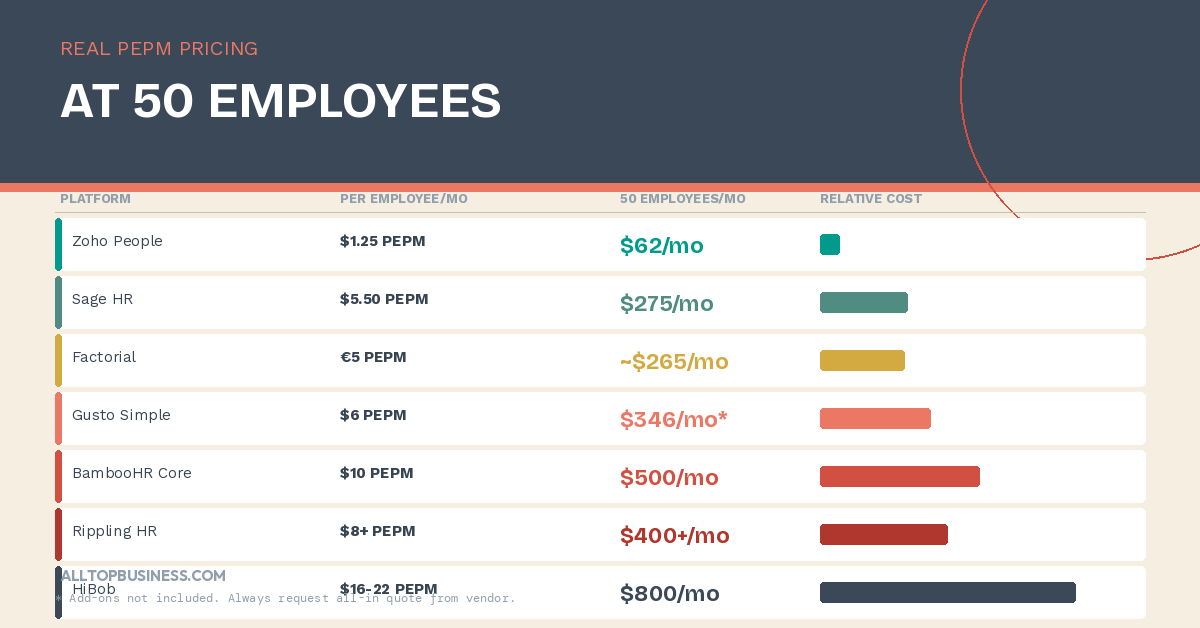
Per-employee-per-month pricing compounds significantly. A 50-person company on BambooHR Pro at $17 PEPM pays $850 per month — but once payroll, benefits, and time-tracking add-ons are included, the real cost is typically 30 to 50% higher than the base PEPM. Always ask vendors for an all-in quote that includes the modules you actually need, not just the base platform price.
Frequently Asked Questions
What is the best HR software for a growing company overall?
BambooHR is the strongest starting point for most U.S.-based growing companies — it has the most accessible implementation, the best user experience for non-HR professionals, and covers core HRIS needs from 25 to 500 employees. Rippling is the stronger choice if IT management alongside HR is a priority. HiBob is better for culture-first companies with international teams.
What is the difference between HRIS, HRMS, and HCM?
HRIS (Human Resource Information System) covers core employee data and processes — records, time-off, compliance. HRMS (Human Resource Management System) adds workflow automation, payroll, and self-service. HCM (Human Capital Management) is the broadest term — covering everything from core HR through talent acquisition, performance, learning, succession planning, and workforce analytics. Most modern platforms use these terms interchangeably, so focus on the features you need rather than the label.
When should a growing company upgrade from Gusto to a full HRIS?
The common trigger points are: headcount crossing 50 employees, needing structured performance reviews, hiring in multiple states with complex compliance requirements, or adding an HR professional who needs a platform built for HR operations rather than payroll administration. Gusto integrates with BambooHR and Rippling, so the transition does not require rebuilding your payroll.
What HR software is best for remote teams?
Rippling and Deel are the strongest options for remote and globally distributed teams. Rippling handles HR and IT provisioning together. Deel manages global employment, contractor agreements, and payroll across 150+ countries. For remote-first companies hiring domestically, BambooHR and HiBob both have strong remote team capabilities.
How long does HR software implementation take?
Small businesses using Gusto or Zoho People can be fully operational within one to two weeks. Mid-market platforms like BambooHR or Rippling typically take four to eight weeks. Enterprise implementations of Workday or ADP Workforce Now often require three to nine months. A phased implementation starting with core HR and payroll before adding performance and recruiting is the safest approach.
What is the cheapest HR software for a small business?
Zoho People has the lowest-paid entry price at $1.25 PEPM, with a free plan for up to 5 employees. Gusto starts at $46/month plus $6 per employee for payroll and basic HR. BambooHR has a $250/month minimum that makes it less cost-effective below 25 employees. Wave Payroll (from the accounting category) is worth considering for very small businesses that just need payroll.
Final Verdict
For most U.S.-based growing companies, the right starting point is BambooHR for core HRIS and employee experience, Gusto if payroll is the primary need, or Rippling if HR and IT management unified is a priority.
For culture-first mid-market companies, particularly those with international or hybrid teams, HiBob’s January 2026 native U.S. payroll launch makes it a more complete platform than it was a year ago and genuinely competitive with BambooHR at the 100 to 500 employee range.
For performance management alongside your core HRIS, add Lattice or Leapsome, both integrate cleanly with BambooHR and Rippling and deliver structured performance workflows that generic HRIS performance modules cannot match.
For global teams or contractor-heavy organizations, Deel removes the compliance complexity that domestic HRIS platforms cannot handle.
For more B2B software reviews, browse the AllTopBusiness blog. Questions about your specific HR stack? Contact us directly.
External Sources:

I’m Adeyemi Adetilewa, a Content Marketing and SEO Specialist, Digital Strategist, Entrepreneur, and the Editor of AllTopBusiness.com. With over 13 years of experience helping businesses scale through content-driven growth, I’m happy to share all the top business tools I have discovered with you here.