Most small business owners do not need more accounting software features. They need fewer hours spent on bookkeeping, faster invoicing, and a clear answer to the question their accountant asks every March: “Can you send me everything from last year?”
The accounting software market is projected to reach $23.47 billion in 2026, growing at nearly 9% annually. Over 75% of U.S. small and mid-sized businesses now use cloud accounting software for financial tracking, invoicing, and tax compliance, yet choosing the wrong platform still costs businesses dozens of hours per year in manual workarounds, compatibility issues with their bookkeeper, and re-entry of data that should have synced automatically.
This guide cuts through the noise. We evaluated several accounting software programs and narrowed the list to the ones that genuinely serve small businesses, from solo freelancers to growing teams with complex multi-entity needs. Every entry includes honest pricing, real limitations, and a precise recommendation for who each tool actually fits.
For related reading on managing your broader business finance stack, explore the AllTopBusiness blog.
Quick Picks: Best Accounting Software for Small Businesses
| Label | Pick |
|---|---|
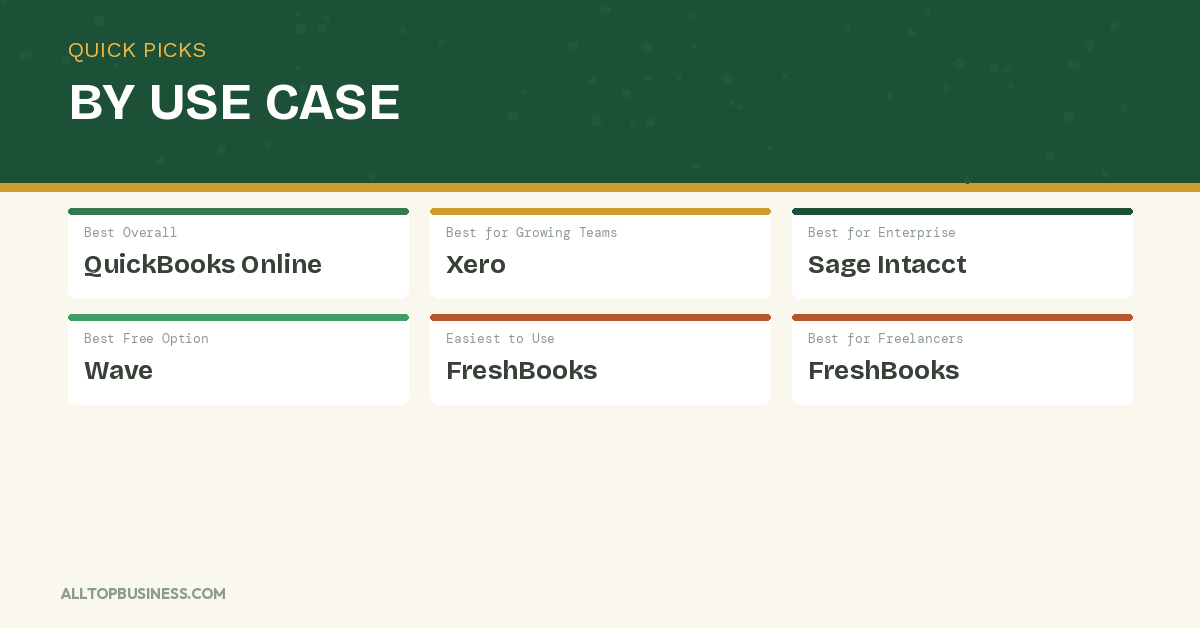
| Best Overall | QuickBooks Online — the most widely supported, feature-complete small business accounting platform |
| Best for Small Business | Xero — unlimited users on every plan, strong integrations, built for growing teams |
| Best for Enterprise | Sage Intacct — best-in-class multi-entity financial management for complex mid-market companies |
| Best Free or Low-Cost Option | Wave — genuinely powerful free accounting for freelancers and very small businesses |
| Best for Ease of Use | FreshBooks — the cleanest interface in the category, built for service businesses and freelancers |
| Best for Self-Employed and Freelancers | FreshBooks — professional invoicing, time tracking, and client management in one place |
How We Selected These Accounting Tools
Every platform on this list was evaluated against six criteria:
- Core accounting functionality — invoicing, expense tracking, bank reconciliation, and financial reporting
- Ease of use — learning curve for non-accountants and time to first productive use
- Integration quality — connectivity with banks, payment processors, payroll, and business tools
- Pricing transparency — clarity of tier structure and total cost of ownership
- Accountant and bookkeeper compatibility — how easily external finance professionals can access and work within the platform
- User review consensus — ratings and themes from G2, Capterra, and independent review platforms
Best Accounting Software for Small Business: Comparison Table
| Tool | Best For | Starting Price | Free Plan | G2 Rating | Key Integration |
|---|---|---|---|---|---|
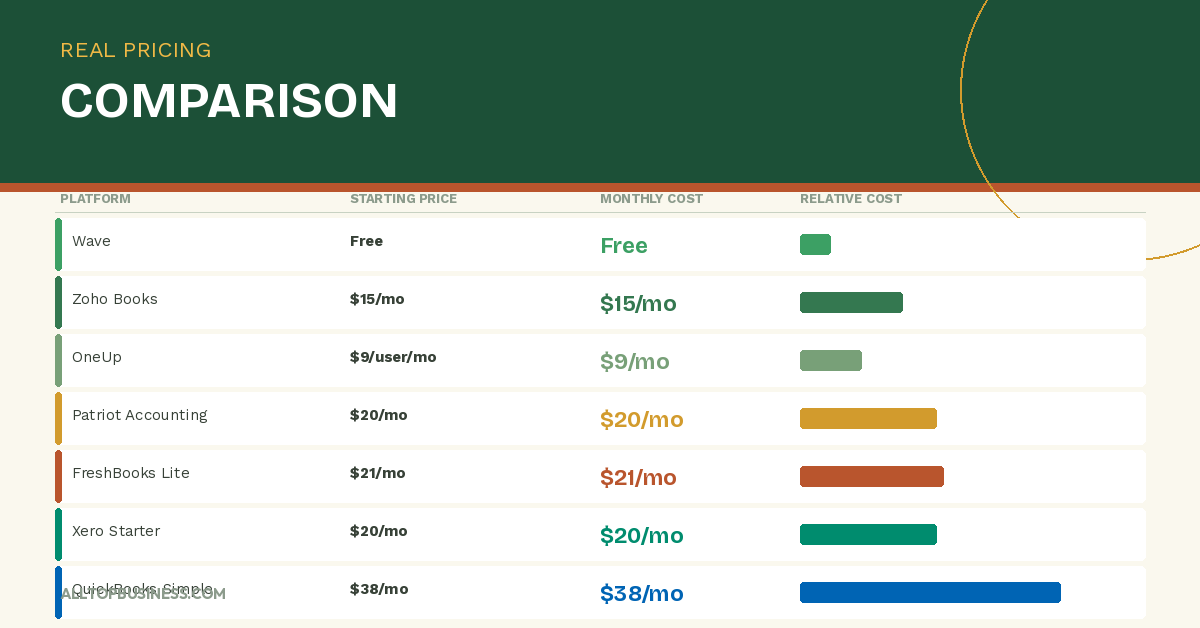
| QuickBooks Online | Most small businesses needing full-featured accounting | From $38/mo | No | 4.0/5 | Shopify, PayPal, Stripe, 750+ apps |
| Xero | Growing teams needing unlimited users | From $20/mo | No | 4.3/5 | Stripe, HubSpot, Shopify, 1,000+ apps |
| FreshBooks | Freelancers and service-based businesses | From $21/mo | No | 4.5/5 | Stripe, PayPal, Gusto, HubSpot |
| Wave | Freelancers and very small businesses | Free core / from $16/mo | Yes | 4.3/5 | Stripe, PayPal, Google Sheets |
| Zoho Books | Budget-conscious teams in the Zoho ecosystem | Free / from $15/mo | Yes (1 user) | 4.5/5 | Zoho CRM, Stripe, PayPal |
| Sage 50cloud | Small businesses wanting desktop-power with cloud access | From $58.92/mo | No | 3.9/5 | Microsoft 365, Stripe |
| Sage Intacct | Mid-market multi-entity financial management | From ~$400/mo | No | 4.3/5 | Salesforce, ADP, Expensify |
| QuickBooks Solopreneur | Solo self-employed and freelancers | From $20/mo | No | 4.0/5 | Stripe, PayPal, TurboTax |
| FreeAgent | UK-based freelancers and small businesses | From $12/mo | No | 4.6/5 | Stripe, PayPal, Xero |
| Kashoo | Very small businesses wanting maximum simplicity | From $30/mo | No | 4.6/5 | Stripe, Square |
| Patriot Accounting | Small businesses wanting affordable US payroll integration | From $20/mo | No | 4.8/5 | Patriot Payroll, QuickBooks |
| Bench | Small businesses wanting done-for-you bookkeeping | From $299/mo | No | 4.1/5 | Stripe, Square, PayPal |
| Odoo Accounting | SMBs wanting accounting as part of a broader ERP | Free / from $9.90/user/mo | Yes | 4.2/5 | Stripe, PayPal, Shopify |
| Holded | European SMBs wanting all-in-one business management | From €12/mo | No | 4.5/5 | Stripe, WooCommerce, Shopify |
| OneUp | Very small businesses wanting AI-powered auto-accounting | From $9/mo | No | 4.3/5 | Stripe, PayPal, bank feeds |
1. QuickBooks Online
The most widely adopted small business accounting platform — the default choice for US-based businesses
QuickBooks Online is the most recognized name in small business accounting and commands an estimated 60% or more of the U.S. domestic accounting software market. For most U.S. small businesses, the practical case for QuickBooks is straightforward: your bookkeeper almost certainly uses it, your CPA definitely knows it, and the 750+ app integrations mean it connects to virtually every business tool you might already have.
The platform covers invoicing, expense tracking, bank feeds, payroll integration, sales tax calculation, inventory management (on higher tiers), and financial reporting — with an AI assistant for analyzing financial data that has improved meaningfully in 2026.
Intuit raised prices 15 to 25% across all tiers in May 2026 — Simple Start now starts at $38 per month, Essentials at $75, and Plus at $115. The price increases have frustrated many small business owners, and for businesses that do not need the full QuickBooks feature set, the alternatives below represent genuinely better value. But for businesses that need accountant compatibility above everything else, QuickBooks remains the default.
What it does well:
- Universal accountant and bookkeeper compatibility — the first question most CPAs ask
- 750+ third-party app integrations covering virtually every business tool
- Comprehensive feature set from invoicing through to inventory and payroll
- AI assistant for financial analysis and data queries
- Largest help ecosystem — documentation, forums, and ProAdvisor network
Where it falls short:
- Prices have increased 15 to 25% in 2026 — now among the most expensive options per feature
- Aggressive feature gating — payroll is a separate add-on starting at $50/month plus $6 per employee
- Per-user pricing adds up quickly for teams of more than 3 to 5 people
- Customer support quality receives mixed reviews, particularly for complex issues
Pricing: Solopreneur from $20/mo. Simple Start from $38/mo. Essentials from $75/mo. Plus from $115/mo. Advanced from $235/mo.
Best for: U.S.-based small businesses where accountant and bookkeeper compatibility is the top priority, and businesses already embedded in the QuickBooks ecosystem that have no reason to migrate.
2. Xero
The best accounting platform for growing small businesses that need unlimited users and deep integrations
Xero is the strongest alternative to QuickBooks for growing small businesses — and in several dimensions it genuinely outperforms QuickBooks at the same or lower price. Every Xero plan includes unlimited users, which means your bookkeeper, your business partner, your operations manager, and your accountant can all have access without per-seat charges. QuickBooks charges extra per user at every tier.
Xero starts at $20 per month and connects to over 1,000 apps, offering real-time reporting alongside strong multi-currency support that QuickBooks charges premium pricing for. The platform covers invoicing, bank reconciliation, expense tracking, payroll, inventory, and project tracking — with a clean, modern interface that non-accountants find easier to navigate than QuickBooks.
Xero’s international footprint is broader than QuickBooks — it is the dominant cloud accounting platform in Australia, New Zealand, and the UK, and is growing strongly in North America. For businesses with international operations or non-US contractors, Xero handles multi-currency significantly more cleanly.
What it does well:
- Unlimited users on every plan — no per-seat charges for bookkeepers or partners
- 1,000+ app integrations, including Stripe, HubSpot, Shopify, and Gusto
- Strong multi-currency support without a premium tier requirement
- Clean, modern interface with strong mobile app experience
- Competitive pricing compared to QuickBooks at equivalent feature levels
Where it falls short:
- Smaller U.S. accountant network than QuickBooks — verify your CPA uses Xero before switching
- Payroll via Gusto requires a separate subscription
- Inventory management is less deep than QuickBooks Plus
- Phone support is not available — email and chat only
Pricing: Starter from $20/mo (limited invoices). Standard from $47/mo. Premium from $80/mo. Ultimate from $180/mo (up to 10 users for payroll).
Best for: Growing small businesses with multiple team members or external finance professionals who want unlimited user access, strong integrations, and multi-currency support at competitive pricing.
3. FreshBooks
The best accounting software for freelancers and service-based small businesses
FreshBooks is built for the way service businesses actually work — you bill for your time, you manage client relationships, and you need professional invoices out the door fast. Its invoicing interface is the most polished in the category, time tracking is built in natively, and client portals let customers view and pay invoices online without friction.
FreshBooks is widely considered the best accounting software for freelancers in 2026, offering professional invoicing, built-in time tracking, client management, and a very easy learning curve. For consultants, designers, attorneys, and agencies, FreshBooks delivers the workflow that QuickBooks and Xero — designed primarily for product businesses — do not prioritize.
The double-entry accounting under the hood meets professional standards, and the reports your accountant needs at tax time are all available. FreshBooks is not the right choice for businesses managing inventory, complex payroll, or multi-entity structures. But for service businesses that invoice clients, track time, and manage expenses, it is the cleanest platform available.
What it does well:
- The best invoicing interface in the category — professional, customizable, and fast
- Built-in time tracking tied directly to client projects and invoices
- Client portals for online invoice viewing and payment
- Clean, simple interface with the lowest learning curve in the category
- Strong mobile app for on-the-go invoicing and expense capture
Where it falls short:
- Not designed for inventory-heavy or product-based businesses
- More expensive per user than QuickBooks for teams larger than 5 people
- Double-entry accounting features are less deep than QuickBooks or Xero
- Bank reconciliation is functional but less automated than competitors
Pricing: Lite from $21/mo (5 billable clients). Plus from $38/mo. Premium from $65/mo. Custom pricing for larger teams.
Best for: Freelancers, consultants, agencies, and service-based small businesses where invoicing, time tracking, and client management are the primary accounting workflows.
4. Wave
The best free accounting software for freelancers and very small businesses
Wave is the strongest genuinely free accounting platform available. Its core features — invoicing, expense tracking, bank connections, and financial reports — are permanently free with no time limit and no feature degradation. Wave covers the essentials of bookkeeping, invoicing, and expense tracking without a subscription fee, making it the strongest entry-level option for freelancers and very small businesses.
The platform makes money on payment processing (competitive rates) and on optional add-ons, including payroll starting at $20/month and bookkeeping support services. For a solo freelancer or a business generating under $500K annually with straightforward finances, Wave provides everything needed at zero software cost.
The limitation shows as business complexity grows. Wave does not handle inventory, multi-currency, or advanced reporting well. If you need more than the basics, the paid alternatives above deliver significantly more capability for a manageable monthly cost.
What it does well:
- Core accounting, invoicing, and expense tracking are permanently free
- Clean interface that non-accountants can navigate without training
- Integrated payment processing (credit cards and bank transfers)
- Optional payroll add-on for businesses ready to add that capability
- Solid mobile app for receipt scanning and expense capture
Where it falls short:
- No inventory management or multi-currency support
- Customer support is limited on the free plan — community forums rather than direct support
- Less suitable for businesses with complex accounting needs
- The feature set has not expanded as quickly as paid competitors in recent years
Pricing: Core accounting free. Payments: 2.9% + $0.60 per transaction. Payroll from $20/mo plus $6 per employee. Wave Pro (advisor features) from $16/mo.
Best for: Freelancers, solopreneurs, and very small businesses that want solid accounting without a software subscription cost, and businesses that are just starting out and want to establish accounting habits before committing to a paid platform.
5. Zoho Books
The best value accounting software for businesses already using Zoho products
Zoho Books delivers a breadth of accounting functionality — automated bank feeds, payment reminders, expense categorization, multi-currency, inventory management, client portals, and workflow automation — at a price point that consistently undercuts QuickBooks and Xero. Zoho Books automates repetitive tasks like payment reminders, bank reconciliation, and expense categorization, reducing the manual work that eats up time for small business owners.
The free plan covers one user with unlimited invoices — a genuinely useful starting point for solo operators. The paid tiers are significantly cheaper than QuickBooks at equivalent feature levels, and for businesses already using Zoho CRM or other Zoho products, the native integration makes financial data flow between systems automatically.
What it does well:
- Comprehensive feature set at a significantly lower price than QuickBooks
- Native integration with Zoho CRM, Zoho Projects, and Zoho Inventory
- Automation for payment reminders, bank reconciliation, and expense rules
- Multi-currency support on all paid plans — not locked behind premium tiers
- Free plan for solo operators covering core invoicing and bookkeeping
Where it falls short:
- Best value for businesses already in the Zoho ecosystem — less compelling as a standalone
- U.S. accountant network much smaller than QuickBooks
- The interface is functional but less polished than FreshBooks or Xero
- Customer support can be slow for complex issues
Pricing: Free for 1 user. Standard from $15/mo. Professional from $40/mo. Premium from $60/mo. Elite from $120/mo.
Best for: Small businesses on a budget — particularly those already using Zoho CRM or other Zoho tools — that want comprehensive accounting functionality at a fraction of QuickBooks pricing.
6. Sage 50cloud
The best accounting platform for small businesses that want desktop-level power with cloud flexibility
Sage 50cloud sits in the gap between cloud-only platforms and traditional desktop software. It runs as a desktop application with cloud sync — giving businesses the processing power and offline capability of desktop accounting alongside the remote access and collaboration of the cloud. For businesses in construction, manufacturing, and distribution where accounting involves complex job costing, inventory tracking, and industry-specific reports, Sage 50cloud provides depth that pure cloud platforms do not match.
What it does well:
- Desktop-level accounting depth with cloud sync for remote access
- Strong job costing and project accounting for construction and manufacturing
- Advanced inventory management with assembly and bill of materials
- Deep Microsoft 365 integration — data flows naturally into Excel and Outlook
- 30 years of accounting pedigree with a large U.S. user base
Where it falls short:
- Desktop architecture means less real-time collaboration than cloud-native competitors
- The interface looks and feels older than modern cloud platforms
- Higher starting price than cloud-only alternatives
- Less suitable for businesses with purely online operations
Pricing: Pro Accounting from $58.92/mo. Premium Accounting from $96.58/mo. Quantum Accounting from $160/mo.
Best for: Small businesses in construction, manufacturing, and distribution that need desktop-level accounting depth, job costing, and advanced inventory alongside cloud flexibility.
7. Sage Intacct
The best accounting platform for mid-market companies with complex multi-entity financial management
Sage Intacct is not a small business accounting tool in the traditional sense — it is a best-in-class cloud financial management platform for mid-market companies with multiple entities, complex revenue recognition requirements, or sophisticated reporting needs that QuickBooks and Xero cannot support.
For growing businesses that have hit the ceiling of QuickBooks or Xero — dealing with multi-entity consolidation, project accounting, dimensional reporting, or GAAP-compliant revenue recognition — Sage Intacct is the strongest upgrade path that does not require stepping up to a full ERP.
The platform carries the AICPA preferred financial management software designation and is particularly strong in nonprofit, healthcare, SaaS, and professional services sectors. For more on how Sage Intacct compares to full ERP platforms, read our guide on the best treasury software solutions covering how financial tools connect to broader operations.
What it does well:
- Best-in-class multi-entity consolidation and intercompany accounting
- Dimensional reporting that slices financial data by department, project, location, and more
- AICPA preferred software — trusted by accounting and audit teams
- Strong revenue recognition for subscription and project-based revenue models
- Clean API for connecting best-of-breed tools across the finance stack
Where it falls short:
- Not designed for very small businesses — pricing and complexity require mid-market scale to justify
- Implementation requires professional services engagement
- No manufacturing or supply chain management beyond financial tracking
Pricing: From approximately $400/mo for smaller deployments. Mid-market implementations typically range from $15,000 to $60,000 annually.
Best for: Mid-market companies with $5M to $100M in revenue that need multi-entity accounting, dimensional reporting, and revenue recognition capabilities beyond what QuickBooks or Xero can handle.
8. QuickBooks Solopreneur
The best accounting tool for solo self-employed workers and independent contractors
QuickBooks Solopreneur is Intuit’s purpose-built product for solo self-employed workers — freelancers, independent contractors, and single-member LLCs. Unlike QuickBooks Online, it is not designed for a business with employees or multiple users. It is designed for one person who needs to track income and expenses, separate business from personal finances, calculate estimated quarterly taxes, and invoice clients simply.
At $20 per month, it is the most accessible entry point in the QuickBooks family, and the TurboTax integration makes year-end tax filing significantly less painful for self-employed filers.
What it does well:
- Purpose-built for solo self-employed workers — not a stripped-down version of QuickBooks Online
- Automatic mileage tracking via mobile GPS
- Quarterly estimated tax calculation with Schedule C categorization
- TurboTax integration for seamless self-employed tax filing
- Cleanest QuickBooks interface — no features included that a solo operator does not need
Where it falls short:
- Single user only — not designed for any team use
- Cannot be upgraded to QuickBooks Online — requires a separate subscription if the business grows
- Less feature depth than FreshBooks for client-facing invoicing workflows
Pricing: From $20/mo.
Best for: Solo freelancers, independent contractors, and single-member LLC owners who need clean income and expense tracking, quarterly tax calculation, and simple invoicing without full small business accounting complexity.
9. FreeAgent
The best accounting software for UK-based freelancers and small businesses
FreeAgent is a cloud accounting platform built specifically for the UK market — freelancers, contractors, and small businesses that deal with UK VAT, Self Assessment, Making Tax Digital, and HMRC compliance. Where QuickBooks and Xero offer UK support as part of a broader global product, FreeAgent is designed from the ground up for UK tax and compliance requirements.
The platform handles VAT returns, payroll, Self Assessment tax returns, project tracking, expense management, and invoicing in a clean interface designed for non-accountants. Many UK banks, including NatWest, Royal Bank of Scotland, and Ulster Bank, offer FreeAgent free to business account holders.
What it does well:
- Purpose-built for UK tax compliance — VAT, Making Tax Digital, Self Assessment
- Available free through many UK bank business accounts
- Clean, non-accountant-friendly interface
- Strong project and time tracking alongside financial management
- Excellent user satisfaction scores among UK freelancers and contractors
Where it falls short:
- Limited value outside the UK — tax compliance features are UK-specific
- Less depth for product-based businesses with complex inventory
- Smaller integration ecosystem than Xero or QuickBooks
Pricing: From $12/mo (often free with UK bank partnerships).
Best for: UK-based freelancers, contractors, and small businesses that need clean accounting with native UK VAT, Making Tax Digital, and Self Assessment compliance built in.
10. Kashoo
The best accounting software for very small businesses that want the simplest possible experience
Kashoo focuses relentlessly on simplicity. Its interface removes every feature that a very small business does not actually need, leaving a clean accounting experience covering income and expense tracking, invoicing, bank reconciliation, and basic reporting. Setup takes under an hour, and most users are running their first invoice within minutes.
Kashoo’s accounting software focuses on simplicity, helping small business owners manage their books without a steep learning curve, with automation for transaction categorization, invoicing, and sales tax tracking.
What it does well:
- The simplest accounting setup process in the category
- Automated transaction categorization that learns from corrections over time
- Clean invoice builder with online payment acceptance
- Solid bank reconciliation with automatic matching
- Good customer support quality for the price
Where it falls short:
- Feature set is intentionally limited — not suitable for businesses with complex accounting needs
- No inventory management or payroll
- Reporting depth is basic compared to QuickBooks or Xero
- Smaller integration ecosystem
Pricing: From $30/mo.
Best for: Very small businesses — restaurants, retail shops, local service businesses — that want clean bookkeeping without learning a complex accounting platform.
11. Patriot Accounting
The best affordable accounting software for small U.S. businesses that need integrated payroll
Patriot Accounting is a straightforward U.S.-focused accounting platform whose biggest differentiator is its tightly integrated payroll product. For small U.S. businesses that want accounting and payroll from the same vendor at a significantly lower price than QuickBooks, Patriot is the strongest option in the market.
The platform consistently earns the highest customer satisfaction scores in its category — 4.8 out of 5.0 on G2 — with users consistently citing the responsive U.S.-based support team as a primary reason.
What it does well:
- Tightly integrated payroll at a much lower price than QuickBooks Payroll
- Highest customer satisfaction score in the small business accounting category on G2
- U.S.-based customer support with strong responsiveness ratings
- Straightforward interface that non-accountants can manage independently
- Transparent pricing with no surprise add-on costs
Where it falls short:
- The feature set is narrower than QuickBooks or Xero for complex accounting needs
- Less suitable for businesses with significant international operations
- Smaller integration ecosystem than the category leaders
Pricing: Basic Accounting from $20/mo. Premium Accounting from $30/mo. Payroll from $17/mo plus $4 per employee.
Best for: Small U.S. businesses with fewer than 50 employees that want clean accounting and affordable payroll from a single provider with outstanding customer support.
12. Bench
The best option for small businesses that want done-for-you bookkeeping alongside their accounting software
Bench is a different product from every other platform on this list. It is not just accounting software — it is a bookkeeping service that uses software. When you sign up for Bench, a team of professional bookkeepers handles your monthly reconciliations, categorizes transactions, and delivers clean financial statements each month. The software is the interface through which you communicate with your bookkeeping team and access your reports.
For business owners who genuinely hate bookkeeping and are willing to pay to not think about it, Bench removes the problem entirely. At $299 per month, it is more expensive than any other entry on this list, but it replaces both the software cost and the bookkeeper cost for many businesses.
What it does well:
- Professional bookkeeping included — not just software, but a real team doing the work
- Clean, simple interface for reviewing monthly financials without accounting knowledge
- Tax-ready financials delivered monthly without owner involvement
- Year-end tax package preparation is included in higher tiers
- Catch-up bookkeeping service for businesses with months of unreconciled transactions
Where it falls short:
- Significantly more expensive than self-service accounting platforms
- Less control for business owners who want hands-on visibility into their books
- Switching away from Bench can be complex — data portability has been flagged in some user reviews
- Not suitable for businesses with complex accounting structures
Pricing: Essential from $299/mo. Premium from $499/mo.
Best for: Small business owners who want to completely outsource their bookkeeping and receive clean monthly financials without any self-service accounting work, and businesses catching up on months or years of unreconciled books.
13. Odoo Accounting
The best accounting module for SMBs that want accounting as part of a broader business platform
Odoo Accounting is the financial management module within the Odoo open-source business platform. It covers invoicing, bank reconciliation, expense management, tax reporting, and multi-currency alongside Odoo’s broader suite of inventory, CRM, project management, and HR modules.
For businesses that want accounting deeply integrated with their operations — sales orders triggering invoices automatically, inventory movements updating cost of goods in real time, project time entries flowing into client billing — Odoo provides a level of operational integration that standalone accounting tools cannot match.
What it does well:
- Deep integration with Odoo’s inventory, CRM, and project modules
- Community edition available free for single-company deployments
- Multi-currency, multi-company, and multi-warehouse on all plans
- Strong automation for invoice generation from sales and project data
- Active global developer community with extensive customization options
Where it falls short:
- Technical resources required for implementation and customization
- Less U.S. accountant familiarity than QuickBooks or Xero
- Support quality depends on the implementation partner
Pricing: Community edition free. Enterprise from $9.90/user/mo.
Best for: SMBs that want accounting tightly integrated with their operations — inventory, sales, and project management — and are comfortable with open-source software or have a technical resource available.
14. Holded
The best all-in-one accounting and business management platform for European SMBs
Holded is a cloud business management platform built for European SMBs that covers accounting, invoicing, inventory, project management, CRM, and HR in a single platform. It handles VAT for Spain and other EU countries natively and supports the SII (Immediate Information Supply) electronic invoicing requirements in Spain.
For European businesses — particularly Spanish-speaking markets — Holded provides a level of local tax compliance integration that Xero and QuickBooks do not offer natively. The platform’s all-in-one design reduces the integration overhead of running separate tools for accounting, CRM, and projects.
What it does well:
- Native EU VAT and Spanish SII electronic invoicing compliance
- All-in-one platform covering accounting, CRM, inventory, and HR
- Clean, modern interface with strong mobile experience
- Multi-currency and multi-language support
- Good value for the breadth of features included
Where it falls short:
- Less suitable for non-European businesses
- Smaller integration ecosystem than Xero or QuickBooks
- Less depth in individual modules compared to best-of-breed specialists
Pricing: From €12/mo for the basic plan. Business from €36/mo. Advanced from €60/mo.
Best for: European SMBs — particularly in Spain and Spanish-speaking markets — that want all-in-one business management with native EU VAT and electronic invoicing compliance.
15. OneUp
The best AI-powered accounting software for very small businesses that want automated bookkeeping
OneUp uses AI to automate accounting tasks that most platforms still require manual input for — transaction categorization, invoice matching, bank reconciliation, and financial statement preparation. For very small business owners with no accounting background, OneUp’s AI automation reduces the time spent on bookkeeping to near zero in many cases.
The platform starts at $9 per month — the lowest-priced entry on this list — and covers core accounting, invoicing, inventory tracking, and CRM in a single package. The AI learns from corrections and improves categorization accuracy over time.
What it does well:
- AI-powered automated bookkeeping — minimal manual input required
- Lowest paid entry price in the category at $9/mo
- Includes basic CRM and inventory alongside accounting
- Clean interface designed for non-accountants
- The continuous learning model improves over time
Where it falls short:
- AI automation accuracy requires correction in the early months while the model learns
- Less depth in reporting and advanced accounting features
- Smaller user base and community than category leaders
- Less accountant familiarity — verify CPA compatibility before switching
Pricing: Self from $9/mo (1 user). Pro from $19/mo. Plus from $29/mo. Team from $69/mo. Unlimited from $169/mo.
Best for: Very small businesses and solo operators that want AI-powered automated bookkeeping at the lowest possible price point and are comfortable with a newer, AI-first platform.
How to Choose the Best Accounting Software for Your Small Business
Four questions narrow the field before you commit to a free trial.
Are you a service business or a product business?
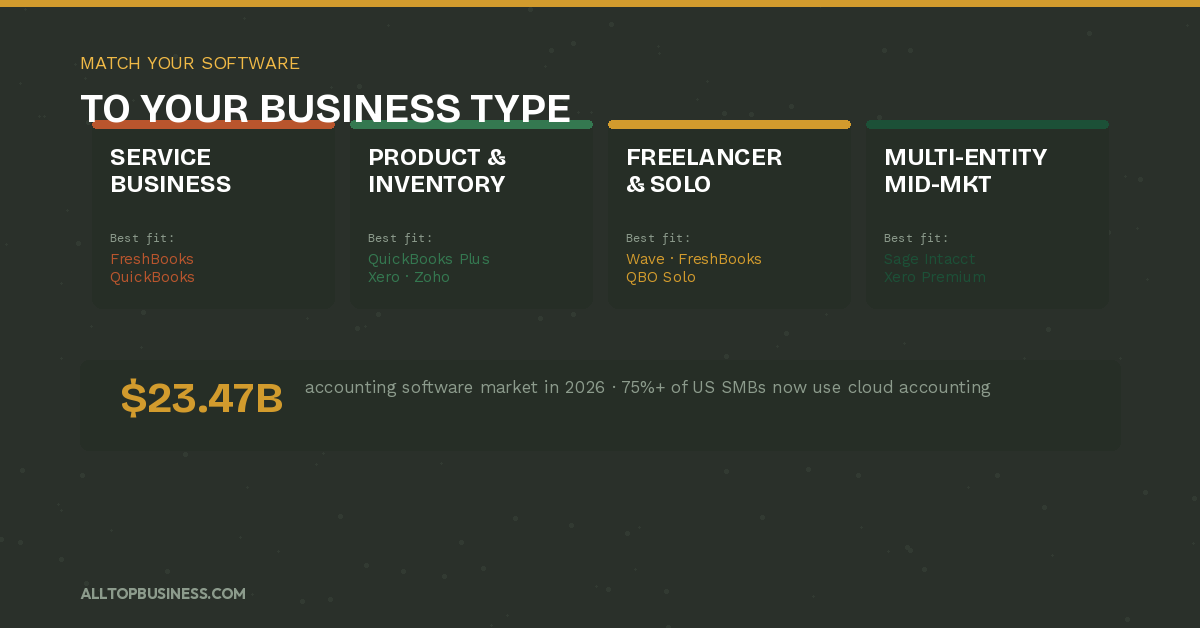
Service businesses — consultants, agencies, attorneys, designers — bill for time and projects. FreshBooks and QuickBooks Solopreneur serve this workflow better than any other platform. Product businesses that manage inventory need QuickBooks Online Plus, Xero, Zoho Books, or Sage 50cloud — platforms with genuine inventory management built in.
How important is accountant compatibility?
If you work with a U.S. CPA or bookkeeper, QuickBooks compatibility is the safest default. Ask your accountant which platform they prefer before choosing — a mismatch means extra manual work every tax season. Xero compatibility is growing rapidly among U.S. accountants but is not yet universal.
What does pricing look like at your team size in 12 months?
QuickBooks and FreshBooks both price per user — which means a team of 5 paying QuickBooks Plus rates costs $115 per month today and more after the next price increase. Xero includes unlimited users on every plan. Wave is free for any number of users. Model your 12-month cost at your projected team size, not just your current headcount.
Do you need accounting only, or operations too?
If you need accounting tightly integrated with your CRM, inventory, projects, or HR, standalone accounting software will always require integrations that create friction. Zoho Books within the Zoho ecosystem, Odoo Accounting within the Odoo platform, or Holded for European businesses offer accounting as part of a broader operational system. If you need accounting only, any of the top five platforms serves that need cleanly.
Frequently Asked Questions
What is the best accounting software for small businesses overall?
QuickBooks Online is the strongest all-around choice for most U.S. small businesses due to its universal accountant compatibility, 750+ integrations, and comprehensive feature set. If price is a concern, Xero delivers comparable functionality at a lower cost with unlimited users. Wave is the best option if you want to start for free.
Is QuickBooks worth the price for a small business?
For businesses that work with a U.S. CPA or bookkeeper, yes — the accountant compatibility and ecosystem depth justify the cost. For businesses where price increases are a concern, Xero at $55 per month gives unlimited users and multi-currency support that QuickBooks charges extra for. If you sell physical products and need inventory tracking, Sage at $25 per month provides equivalent capability to QuickBooks Plus at a fraction of the price.
What is the easiest accounting software for a non-accountant?
FreshBooks is consistently rated the easiest accounting platform for non-accountants — particularly for service businesses where invoicing and time tracking are the primary workflows. Wave is the easiest free option. Kashoo and OneUp both target non-accountant users explicitly with simplified interfaces.
Can I switch accounting software without losing my data?
Yes, but it requires careful planning. Best practices for switching: do it at the start of a new fiscal year, export all historical data from your old platform first, and verify that your new platform can import your chart of accounts and transaction history. Most platforms accept imports from QuickBooks and Xero via CSV or direct migration tools.
What accounting software works best with Shopify?
QuickBooks Online and Xero both have native Shopify integrations that sync sales, refunds, fees, and payouts automatically. Xero’s Shopify integration is widely considered the cleaner of the two. Zoho Books also integrates with Shopify and is significantly cheaper for businesses that do not need QuickBooks compatibility.
Do I need accounting software or just invoicing software?
If you only need to send invoices and track payments, a standalone invoicing tool like Invoice Ninja or PayPal Invoicing may be sufficient. Once you need to track expenses, reconcile bank accounts, prepare tax reports, or manage multiple clients simultaneously, accounting software provides the structure that standalone invoicing tools cannot.
What is the best free accounting software for small businesses?
Wave is the strongest genuinely free accounting platform — core bookkeeping, invoicing, and expense tracking are permanently free. Zoho Books offers a free single-user plan. QuickBooks and Xero both offer 30-day free trials but no permanent free tier.
Final Verdict
For most U.S. small businesses, the starting decision comes down to three options: QuickBooks Online if accountant compatibility is non-negotiable, Xero if you want unlimited users and comparable features at lower cost, or Wave if you want to start for free and upgrade later.
For freelancers and service-based businesses, FreshBooks delivers a better invoicing and time-tracking experience than either QuickBooks or Xero. For solo self-employed workers, QuickBooks Solopreneur or Wave covers everything needed at the lowest cost.
If you have hit the ceiling of QuickBooks or Xero with multi-entity structures or complex revenue recognition, Sage Intacct is the strongest upgrade path before full ERP.
The worst outcome is not choosing the wrong software, it is continuing to run your business finances in spreadsheets or bank statements. Any platform on this list is a meaningful upgrade from that.
For more B2B software reviews, browse the AllTopBusiness blog. Have a question about which accounting platform fits your specific situation? Contact us.
External Sources:
- G2 — Accounting Software Reviews
- U.S. Chamber of Commerce — Small Business Technology Adoption Report

I’m Adeyemi Adetilewa, a Content Marketing and SEO Specialist, Digital Strategist, Entrepreneur, and the Editor of AllTopBusiness.com. With over 13 years of experience helping businesses scale through content-driven growth, I’m happy to share all the top business tools I have discovered with you here.