Choosing ERP software is the largest single software decision most companies ever make. ERP Research describes it as a 7 to 15-year operating commitment that touches finance, operations, HR, supply chain, and customer experience simultaneously. Getting it wrong does not just waste money — it locks your organization into a platform that constrains growth for a decade.
Mid-market companies occupy the most difficult position in the ERP market. They have real operational complexity: multiple departments with distinct process requirements, regulatory obligations, and a need for cross-functional visibility. Yet they rarely have the budget or change management capacity of a Fortune 500 enterprise. The ERP must deliver enterprise-grade functionality at mid-market economics.
ERP pricing for mid-market companies ranges from $100 per user per month to enterprise-level custom pricing. Typical total cost of ownership ranges from $150,000 to $600,000. Implementation timelines for mid-market companies typically range from 3 to 6 months to 9 to 18 months, depending on scope and complexity.
This guide covers the best ERP platforms evaluated against the same criteria. We assessed over 30 platforms to arrive at this list — only tools with genuine mid-market track records, substantive user review data, and documented pricing transparency were included.
For a deeper look at how ERP treasury modules compare to standalone treasury management systems, read our guide on the best treasury software solutions. And for a full comparison of Oracle’s ERP platforms specifically, see our guide on Oracle ERP systems and alternatives.
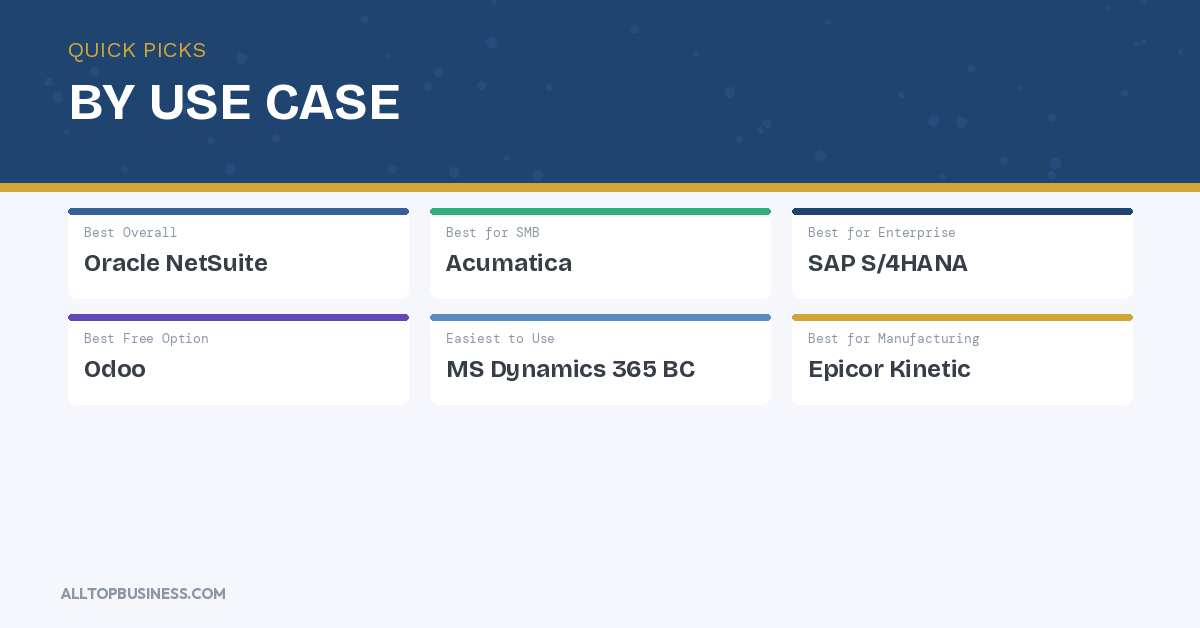
Quick Picks: Best ERP Software for Mid-Market Companies
| Label | Pick |
|---|---|
| Best Overall | Oracle NetSuite — the most proven cloud ERP for growing mid-market companies |
| Best for Small Business | Acumatica — consumption-based pricing with no per-user fees, strong for 20-200 employees |
| Best for Enterprise | SAP S/4HANA — the deepest ERP available for global enterprise operations |
| Best Free or Low-Cost Option | Odoo — open-source ERP with a free Community edition and paid plans from $9.90/user/mo |
| Best for Ease of Use | Microsoft Dynamics 365 Business Central — familiar Microsoft interface, fastest adoption |
| Best for Manufacturing Companies | Epicor Kinetic — purpose-built for discrete manufacturing with the strongest shop floor management |
How We Selected These ERP Tools
Every ERP on this list was evaluated against six criteria:
- Functional depth across financials, supply chain, procurement, manufacturing, and HR
- Mid-market fit — genuine value for companies with $25M to $1B in revenue without enterprise-only pricing
- Total cost of ownership — licensing, implementation, training, and ongoing support combined
- Implementation timeline — realistic time from contract to go-live for a 50 to 250-user deployment
- Integration quality — connectivity with CRM, HRIS, e-commerce, and third-party tools
- User review consensus — ratings and themes from G2, Gartner Peer Insights, and Capterra
Best ERP Software for Mid-Market Companies: Comparison Table
| Tool | Best For | Starting Price | Free Plan | G2 Rating | Key Integration |
|---|---|---|---|---|---|
| Oracle NetSuite | Growing mid-market cloud ERP | ~$2,499/mo + $129/user/mo | No | 4.0/5 | Salesforce, Shopify, HubSpot |
| Microsoft Dynamics 365 BC | Microsoft-ecosystem mid-market | From $70/user/mo | No | 3.8/5 | Microsoft 365, Teams, Power BI |
| Acumatica | SMB to mid-market, consumption pricing | From ~$10K/year | No | 4.5/5 | Shopify, Salesforce, Avalara |
| Sage Intacct | Finance-first mid-market companies | From ~$400/mo | No | 4.3/5 | Salesforce, ADP, Expensify |
| SAP S/4HANA Cloud | Global enterprise manufacturing | Custom ($500K+) | No | 3.9/5 | SAP BTP, SuccessFactors |
| Epicor Kinetic | Mid-market discrete manufacturing | Custom | No | 3.9/5 | Salesforce, Power BI |
| Infor CloudSuite | Healthcare and distribution enterprise | Custom | No | 3.8/5 | Salesforce, AWS |
| Odoo | SMBs wanting open-source modular ERP | Free / $9.90/user/mo | Yes | 4.2/5 | Shopify, Stripe, PayPal |
| Syspro | Mid-market manufacturing and distribution | Custom | No | 4.1/5 | Microsoft 365, Power BI |
| SAP Business One | SMB manufacturing and distribution | From ~$94/user/mo | No | 4.3/5 | Salesforce, Stripe |
| Priority Software | SMB to mid-market all-in-one | From ~$65/user/mo | No | 4.3/5 | WooCommerce, Salesforce |
| ERPNext | Technically capable SMBs and NGOs | Free / $10/user/mo | Yes | 4.4/5 | Shopify, Stripe, PayPal |
| Sage X3 | Mid-market manufacturing and distribution | Custom | No | 4.0/5 | Salesforce, Microsoft 365 |
| Deltek Vantagepoint | Project-based professional services | Custom | No | 4.2/5 | Salesforce, Microsoft 365 |
| IFS Cloud | Service-intensive manufacturing and defense | Custom | No | 4.2/5 | Salesforce, Microsoft 365 |
| Unit4 ERPx | Professional services and nonprofits | Custom | No | 3.8/5 | Microsoft 365, Power BI |
| Workday Financials | People-centric services enterprises | Custom | No | 4.0/5 | Salesforce, Slack, Okta |
1. Oracle NetSuite
The gold standard cloud ERP for growing mid-market companies
Oracle NetSuite is the most widely deployed cloud ERP for mid-market companies and the default starting point for most mid-market ERP evaluations. It is cloud-native, covers financials, inventory, CRM, and order management in one platform, and has a large partner ecosystem for industry-specific customization. More than 43,000 companies globally run NetSuite — making it the most proven cloud ERP at mid-market scale.
The platform’s real strength is in multi-entity and multi-currency financial management. Growing companies with multiple subsidiaries, international operations, or acquisition-driven structures get genuine consolidation and intercompany accounting that most accounting tools and lower-tier ERPs cannot handle.
Where NetSuite falls short: the UI feels dated compared to newer platforms, customization requires SuiteScript developers, and the total cost for a 50-user deployment typically runs $75,000 to $150,000 per year once you factor in per-user fees and module costs. Implementation timelines of 8 to 12 months are common.
NetSuite’s SuiteSuccess methodology provides industry-specific configurations for manufacturing, wholesale distribution, SaaS, retail, and professional services that reduce implementation time and avoid the blank-slate configuration problem that plagues generic ERP deployments.
What it does well:
- Multi-entity consolidation and multi-currency management built into the core platform
- SuiteSuccess industry configurations reduce implementation time
- 1,000+ SuiteApp marketplace integrations covering virtually every business tool
- AI-powered financial insights and cash forecasting embedded across modules
- Strong professional services automation for services-oriented companies
Where it falls short:
- UI is dated compared to newer cloud-native competitors
- Customization beyond SuiteSuccess requires SuiteScript developers
- Pricing increases significantly at renewal for established customers
- Total cost of ownership of $75K to $150K per year at 50 users surprises some buyers
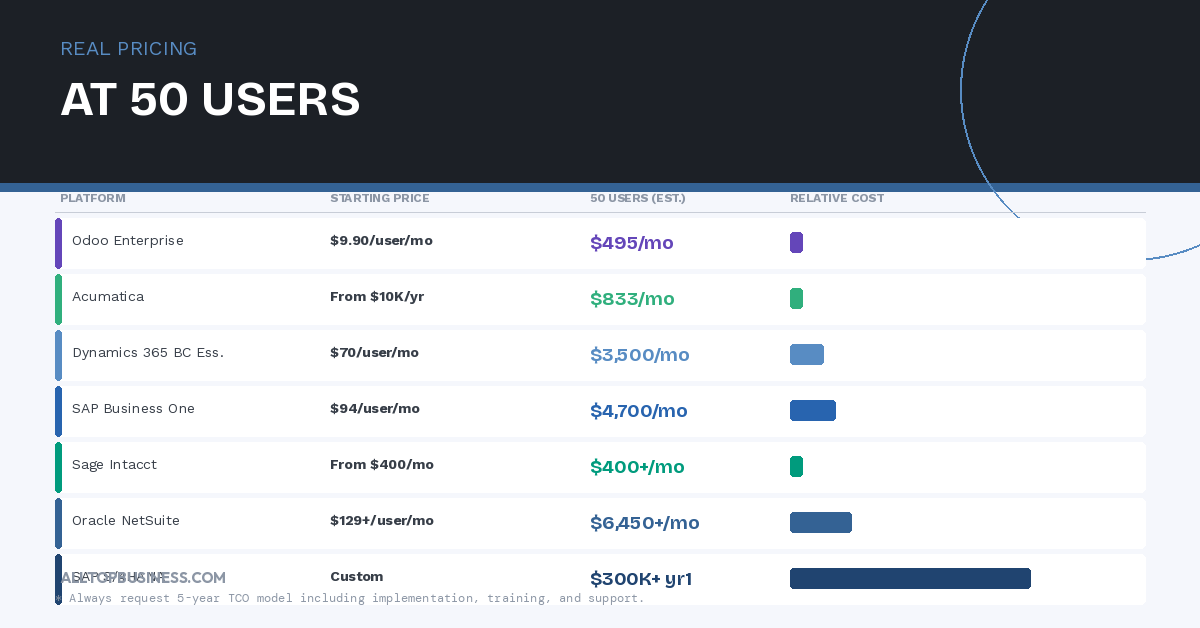
Pricing: Base license from approximately $2,499/month plus $129 per user per month. Annual TCO for a 50-user mid-market deployment is typically $75,000 to $150,000.
Best for: Growing mid-market companies with $5M to $250M in revenue that need proven, cloud-native ERP with strong multi-entity financials, inventory management, and order management.
2. Microsoft Dynamics 365 Business Central
The best ERP for mid-market companies already running Microsoft 365
Microsoft Dynamics 365 Business Central starts at $70 per user per month and is the natural ERP choice for organizations where every employee already works in Outlook, Teams, Excel, and SharePoint. The native integration with the Microsoft 365 suite reduces the user adoption friction that kills many ERP implementations — finance teams get familiar interfaces, operations teams get data in tools they already use.
Microsoft Copilot AI features are embedded throughout Business Central — generating financial insights, automating reconciliations, drafting purchase orders from natural language, and surfacing anomalies in transaction data. For mid-market finance teams that want AI augmentation without a separate tool, Business Central’s Copilot integration is the most seamlessly delivered AI in the mid-market ERP category.
The platform covers financial management, inventory, supply chain, manufacturing (light), project management, sales, and service management. For companies that need deeper manufacturing, Dynamics 365 Supply Chain Management extends these capabilities at enterprise scale.
What it does well:
- Native integration with Microsoft 365, Teams, Excel, and Power BI
- Microsoft Copilot AI embedded across financial management and operations workflows
- Strong inventory, sales, and project management alongside core financials
- Competitive pricing at $70/user/month versus NetSuite’s per-user charges
- Large global implementation partner network
Where it falls short:
- Less depth in complex manufacturing compared to Epicor or Infor
- Partner quality for implementation varies significantly — choosing incorrectly is a common failure mode
- Licensing costs compound quickly when combining multiple Dynamics 365 apps
- Less suitable for companies with no Microsoft ecosystem investment
Pricing: Business Central Essentials from $70/user/month. Premium from $100/user/month. Dynamics 365 Finance from $180/user/month.
Best for: Mid-market companies with 20 to 500 employees already running Microsoft 365 that want ERP data surfaced natively in Outlook, Teams, and Power BI with Copilot AI integration.
3. Acumatica
The best ERP for SMBs and growing mid-market companies that want consumption-based pricing
Acumatica is a cloud ERP platform with a genuinely differentiated pricing model — you pay by resource usage rather than per seat, which means unlimited users at any given tier. For companies with large numbers of occasional ERP users — warehouse staff, field service teams, or customers with portal access — Acumatica’s consumption model produces significantly lower total cost than per-user platforms.
The platform covers financial management, distribution, manufacturing, construction, retail, and field service in industry-specific editions. It consistently earns some of the highest user satisfaction scores in the SMB and lower mid-market ERP category — 4.5/5 on G2 — driven by its modern UI, strong North American partner ecosystem, and the flexibility to deploy in the cloud, on-premise, or hybrid.
What it does well:
- Consumption-based pricing — unlimited users, no per-seat charges
- 4.5/5 on G2 — among the highest satisfaction scores in the mid-market ERP category
- Modern, intuitive interface that reduces training burden
- Strong construction, manufacturing, and distribution industry editions
- Cloud, on-premise, or hybrid deployment flexibility
Where it falls short:
- Less global footprint and partner availability outside North America
- Less depth for very large or complex enterprise deployments
- Financial management not as deep as Sage Intacct for complex multi-entity accounting
Pricing: From approximately $10,000 per year. Scales based on transaction volume and resource consumption rather than users.
Best for: SMBs and growing mid-market companies with 20 to 500 employees that want flexible cloud ERP with consumption-based pricing and strong construction, distribution, or manufacturing functionality.
4. Sage Intacct
The best ERP for finance-first mid-market companies with complex accounting needs
Sage Intacct is consistently recognized as the strongest cloud financial management platform for mid-market companies that need multi-entity accounting, dimensional reporting, project accounting, and revenue recognition beyond what QuickBooks or Xero can handle — but do not yet need the full complexity of Oracle Fusion or SAP.
It is best for finance-led organizations in services, SaaS, or nonprofits that need deep GL capabilities and do not require operational modules. The AICPA preferred software designation reflects how widely trusted it is among accounting professionals, and the platform’s clean API ecosystem supports best-of-breed integrations with Salesforce, ADP, Expensify, and other tools.
For a deeper understanding of how Sage Intacct fits within the broader treasury and financial management landscape, read our guide on what treasury management is.
What it does well:
- Best-in-class multi-entity consolidation and intercompany accounting
- Dimensional reporting slicing financials by department, project, location, and more
- AICPA preferred software — trusted by accounting and audit teams
- Strong revenue recognition for subscription and project-based revenue models
- Clean API for building a best-of-breed finance stack
Where it falls short:
- Not a full ERP — no manufacturing, supply chain, or production management
- HR and CRM require third-party integrations
- Implementation complexity increases with organizational size and customization
Pricing: From approximately $400/month for smaller deployments. Mid-market implementations typically cost $15,000 to $60,000 annually.
Best for: Mid-market companies with $5M to $100M in revenue in professional services, SaaS, nonprofit, and healthcare that need best-in-class financial management without manufacturing or supply chain complexity.
5. SAP S/4HANA Cloud
The most functionally complete ERP for global enterprise manufacturing and operations
SAP S/4HANA is the most powerful ERP available and the only platform that competes with Oracle Fusion at true enterprise scale. Built on SAP’s in-memory HANA database, it delivers real-time analytics across every module without batch processing delays. SAP dominates in manufacturing, automotive, consumer goods, and chemicals in a way that no other ERP platform matches.
For mid-market companies in these industries that have genuine enterprise-level operational complexity — multi-country supply chains, complex regulatory environments, and advanced procurement requirements — SAP S/4HANA Cloud (the public cloud edition) provides a faster path to SAP capability than a traditional on-premise deployment.
What it does well:
- Unmatched depth in manufacturing, supply chain, and procurement workflows
- Real-time analytics on HANA database — no reporting lag
- The largest ERP ecosystem of consultants, partners, and integrations globally
- SAP Business AI across demand forecasting, procurement, and financial close
- Proven at the largest enterprise scale globally
Where it falls short:
- Among the most expensive ERP platforms to license, implement, and maintain
- Implementation timelines for companies with 251 to 1,000 employees typically run 4 to 9 months, with significant organizational change management required
- Requires dedicated SAP administrators and certified implementation partners
- Less intuitive for non-technical finance users than newer cloud platforms
Pricing: Custom enterprise pricing. Mid-market implementations typically start at $300,000 to $500,000 in year one, including licensing and implementation.
Best for: Mid-market and enterprise companies in manufacturing, consumer goods, chemicals, and automotive that need the deepest ERP functionality available and have the internal resources to implement and maintain it.
6. Epicor Kinetic
The best ERP for mid-market discrete manufacturers
Epicor Kinetic is purpose-built for discrete manufacturing, distribution, automotive, and building supply businesses. It offers both cloud and on-premise deployment — one of the few mid-market ERPs that still supports both. Its customization framework allows deep modifications without forking the codebase. The platform combines IoT connectivity, shop floor execution, configure-price-quote (CPQ), and supply chain management in a manufacturing-specific package that general-purpose ERPs cannot match at this price point.
What it does well:
- Deep shop floor execution, production planning, and discrete manufacturing workflows
- IoT integration for equipment monitoring and predictive maintenance
- Cloud and on-premise deployment options — rare in the modern ERP market
- CPQ capabilities for engineer-to-order and configure-to-order manufacturers
- Faster deployment and lower TCO than Oracle JDE for mid-market manufacturers
Where it falls short:
- Limited to financial services, professional services, and non-manufacturing industries
- Smaller global partner ecosystem than SAP or Oracle
- Financial management depth is lighter than Sage Intacct or NetSuite
Pricing: Custom pricing. Typically more accessible than Oracle JDE and SAP S/4HANA for mid-market manufacturers.
Best for: Mid-market discrete manufacturers, distributors, and automotive suppliers with $50M to $500M in revenue that need deep production management without full enterprise ERP complexity or cost.
7. Infor CloudSuite
The best industry-specific ERP for healthcare, manufacturing, and distribution enterprises
Infor CloudSuite is built on AWS infrastructure with pre-configured industry editions for healthcare, manufacturing, distribution, fashion, and hospitality. Each CloudSuite variant comes with industry-specific workflows, terminology, and compliance frameworks built in — reducing the configuration burden that makes generic ERP implementations so complex.
Pricing for Infor CloudSuite runs from $150 to $250 per user per month, with implementation costs of $100,000 to $400,000. For mid-market and enterprise companies in its target verticals, Infor competes on industry depth and faster time to value versus the blank-slate complexity of Oracle or SAP.
What it does well:
- Deep industry-specific pre-configurations across healthcare, manufacturing, and distribution
- Built on AWS with strong security, compliance, and global scalability
- Industry-specific regulatory compliance reduces configuration burden
- CloudSuite Healthcare covers EHR integration, patient supply chain, and clinical operations
- Lower implementation complexity than Oracle Fusion or SAP for target verticals
Where it falls short:
- Smaller consulting ecosystem than Oracle or SAP
- Less well-suited for companies outside Infor’s target verticals
- Brand recognition challenges when compared to Oracle and SAP in procurement conversations
Pricing: $150 to $250 per user per month. Implementation $100,000 to $400,000.
Best for: Enterprise and upper mid-market companies in healthcare, manufacturing, and distribution that need deep industry-specific ERP without the full complexity of Oracle Fusion or SAP S/4HANA.
8. Odoo
The best open-source ERP for SMBs that want modular, affordable software
Odoo is the most popular open-source ERP platform globally and the strongest option for cost-sensitive SMBs evaluating NetSuite or Business Central. The free Community edition has zero licensing cost and an active open-source community with frequent updates. It is a good fit for businesses in emerging markets where large ERP licenses are cost-prohibitive.
The Enterprise edition adds hosting, support, and advanced features starting at $9.90 per user per month — making it one of the most affordable ERPs covering accounting, inventory, manufacturing, CRM, ecommerce, HR, and project management in 50+ modules.
What it does well:
- Genuinely free Community edition for single-company deployments
- 50+ integrated modules covering virtually every business function
- Enterprise edition from $9.90/user/month — the lowest paid price in the full-ERP category
- Modern interface that competes favorably with paid mid-market ERPs
- Active global developer community with extensive customization options
Where it falls short:
- Self-hosting requires technical expertise. Support quality varies depending on your implementation partner.
- Less suitable for complex multi-entity or heavily regulated enterprise environments
- Financial management depth is lighter than NetSuite or Sage Intacct
Pricing: Community edition free. Enterprise from $9.90/user/month.
Best for: SMBs and startups with technical resources that want modular, affordable ERP — and mid-market companies that want to evaluate ERP capability before committing to a larger investment.
9. Syspro
The best mid-market ERP for food, beverage, electronics, and industrial manufacturing
Syspro is a mid-market ERP focused exclusively on manufacturing and distribution. Its narrow vertical focus produces genuine depth in production planning, bill of materials management, quality control, and supply chain operations. Syspro is particularly strong in food and beverage, electronics, medical devices, and industrial equipment manufacturing — where regulatory compliance (FDA, ISO) and traceability are core requirements.
What it does well:
- Deep manufacturing and distribution functionality, including quality management and traceability
- Strong compliance frameworks for FDA, ISO, and other regulated manufacturing environments
- Flexible deployment across cloud, on-premise, and hybrid
- Good mid-market pricing relative to Oracle JDE and Epicor for similar functionality
- Responsive customer support is rated positively by mid-market users
Where it falls short:
- Limited outside manufacturing and distribution verticals
- Less modern UI compared to Epicor Kinetic or Acumatica
- Smaller global partner ecosystem
Pricing: Custom pricing based on modules and deployment type.
Best for: Mid-market manufacturers in food and beverage, electronics, medical devices, and industrial equipment with $20M to $200M in revenue that need regulatory compliance depth alongside production management.
10. SAP Business One
The best ERP for SMB manufacturers and distributors that want SAP credibility at accessible pricing
SAP Business One is SAP’s purpose-built ERP for small and mid-sized businesses — particularly in manufacturing, distribution, and retail. SAP Business One starts at approximately $94 per user per month for cloud deployment and provides genuine ERP capability, including financials, inventory, production, and purchasing in a single system without S/4HANA’s enterprise complexity.
For SMBs that need to signal ERP credibility to enterprise customers or investors, the SAP brand carries weight that Acumatica or Odoo does not. The large global implementation partner network means quality consultants are accessible in virtually every market.
What it does well:
- Right-sized SAP ERP for SMBs without enterprise complexity
- Strong inventory, production, and distribution functionality
- Large global implementation partner network
- SAP brand credibility for enterprise-facing businesses
- Available on-premise, cloud, or hybrid
Where it falls short:
- The interface feels dated compared to modern cloud-native ERPs
- Advanced analytics require add-ons beyond the base platform
- Less suitable for services-oriented businesses
Pricing: From approximately $94/user/month for cloud. On-premise licensing higher upfront.
Best for: SMBs with $5M to $100M in revenue in manufacturing, distribution, and retail that need structured ERP with genuine production management and want SAP brand credibility at a mid-market price point.
11. Priority Software
The best all-in-one ERP for SMB to mid-market companies wanting broad functionality at competitive pricing
Priority Software is a cloud ERP covering financials, CRM, manufacturing, distribution, procurement, and HR in a single system. It is particularly strong in Israel and growing in Europe, Asia, and North America as an alternative to NetSuite and Dynamics 365 Business Central for companies that want broader ERP coverage, including a built-in CRM at lower cost.
What it does well:
- Broad functionality, including a genuinely capable built-in CRM
- Competitive pricing at approximately $65/user/month
- Strong manufacturing and distribution modules alongside financials
- Good mid-market fit for companies wanting everything in one system
- Multilingual and multi-currency support for international deployments
Where it falls short:
- Less brand recognition in North America
- Smaller implementation partner network in North American markets
- Advanced analytics require an add-on investment
Pricing: From approximately $65/user/month.
Best for: SMB to mid-market companies globally that want broad ERP including CRM at competitive pricing — particularly companies with international operations across Europe, Asia, and the Middle East.
12. ERPNext
The best open-source ERP for technically capable teams that want maximum flexibility at minimum cost
ERPNext is a fully open-source ERP platform covering accounting, inventory, manufacturing, HR, CRM, and project management. The self-hosted version has zero licensing cost and benefits from an active open-source community with frequent updates. The Frappe Cloud hosted version starts at $10/user/month.
ERPNext is the right choice when technical capability is available internally, and the business need is for maximum customization flexibility at the lowest possible total cost. Nonprofits, educational institutions, and businesses in emerging markets where large ERP licenses are cost-prohibitive represent the strongest use cases.
What it does well:
- Fully open-source — maximum customization flexibility with no licensing cost
- Comprehensive module coverage across most business functions
- Hosted cloud option from $10/user/month
- Active developer community with strong documentation
- Zero vendor lock-in — full data portability
Where it falls short:
- Requires technical resources for implementation and ongoing customization
- Support quality entirely depends on your implementation partner or internal team
- Not suitable for highly complex enterprise requirements or businesses without technical staff
Pricing: Free to self-host. Frappe Cloud from $10/user/month.
Best for: Technically capable SMBs and nonprofits that want maximum customization flexibility at minimum cost and have internal or partner technical resources available.
13. Sage X3
The best mid-market ERP for companies that have outgrown accounting software but are not ready for SAP
Sage X3 targets companies that have outgrown entry-level accounting software but do not need — or cannot afford — the full complexity of SAP. It covers financial management, distribution, manufacturing, and procurement in a mid-market platform with more depth than Sage Intacct and more operational breadth than most finance-only tools.
Sage X3 is particularly well-positioned for food and beverage, chemicals, and process manufacturing companies that need lot tracking, recipe management, and regulatory compliance alongside core financials.
What it does well:
- Strong process manufacturing — food and beverage, chemicals, and pharmaceuticals
- Lot tracking, recipe management, and regulatory compliance built in
- Deeper operational coverage than Sage Intacct, while less complex than SAP
- Available cloud, on-premise, or hosted
- Good global coverage including French, German, and multilingual deployments
Where it falls short:
- Less modern interface than Acumatica or Dynamics 365
- Smaller North American partner network than NetSuite or SAP Business One
- Implementation timeline longer than simpler alternatives
Pricing: Custom pricing based on modules and deployment type.
Best for: Mid-market process manufacturers and distributors with $25M to $250M in revenue that need production management and compliance depth beyond accounting software without SAP’s complexity.
14. Deltek Vantagepoint
The best ERP for project-based professional services firms
Deltek Vantagepoint is the most purpose-built ERP for project-based businesses — engineering firms, architecture practices, management consultancies, IT services companies, and government contractors. It covers project management, financial management, resource planning, CRM, and business development in a single platform designed specifically around how project-based businesses bill, manage resources, and recognize revenue.
What it does well:
- Unmatched depth for project-based professional services businesses
- Government contracting compliance — DCAA, FAR, and CAS built in
- Integrated resource planning and utilization tracking
- Purpose-built CRM for business development in services firms
- Strong project profitability tracking and revenue recognition
Where it falls short:
- Very limited outside its target verticals
- Requires Deltek-certified implementation partners
- Less suitable for product-based businesses
Pricing: Custom pricing.
Best for: Engineering firms, architecture practices, management consultancies, IT services companies, and government contractors that need project-centric ERP designed specifically for their billing and resource management model.
15. IFS Cloud
The best ERP for service-intensive manufacturers, defense, and asset-heavy enterprises
IFS Cloud is a mid-market and enterprise ERP platform particularly strong in service management, maintenance and repair operations (MRO), field service, and asset lifecycle management. For manufacturers and defense contractors where post-sale service management is as operationally complex as production, IFS provides depth that Oracle and SAP struggle to match without significant add-on investment.
What it does well:
- Best-in-class field service management and MRO capabilities
- Strong asset lifecycle management — ideal for capital-intensive industries
- Defense and aerospace compliance credentials
- Modern cloud platform with clean, role-based UX
- Good integration with Salesforce for service-to-sales workflows
Where it falls short:
- Less depth in discrete manufacturing production management versus Epicor
- Custom pricing requires an enterprise sales conversation
- Smaller North American implementation partner network
Pricing: Custom pricing.
Best for: Mid-market and enterprise companies in aerospace, defense, utilities, and service-intensive manufacturing where asset management and field service are core operational requirements.
16. Unit4 ERPx
The best ERP for professional services firms, nonprofits, and public sector organizations
Unit4 ERPx is a cloud ERP designed for people-intensive service organizations — professional services firms, nonprofits, higher education, and the public sector. Its people-centric architecture means workflows are built around projects, billable time, grant management, and workforce planning rather than being adapted from manufacturing-focused systems.
What it does well:
- Purpose-built for professional services, nonprofits, and higher education
- Strong project management and professional services automation
- People-centric design matches how service organizations actually operate
- Modern cloud platform with regular feature releases
- Genuine alternative to Oracle for organizations that find Fusion oversized
Where it falls short:
- Not suitable for manufacturing, distribution, or product-based businesses
- Smaller brand recognition than Oracle or SAP in procurement
- Less depth in financial management than Sage Intacct
Pricing: Custom pricing.
Best for: Professional services firms, nonprofits, higher education institutions, and public sector organizations that need ERP designed around projects and people.
17. Workday Financials
The best financial management and HR platform for people-centric services enterprises
Workday is the strongest cloud-native alternative to Oracle Fusion for services-oriented enterprises where HR and financial management need to share the same data model. Its financial management module is particularly strong for services businesses — combining financial planning, procurement, expenses, and project accounting in a platform that integrates natively with Workday HCM.
For CFOs and CHROs at enterprise services companies who want workforce cost and financial performance on the same platform, Workday’s data integration delivers a level of people-to-finance visibility that bolt-on integrations cannot replicate.
What it does well:
- Native integration between financial management and HCM data
- Best-in-class workforce planning connected to financial forecasts
- Workday Adaptive Planning for FP&A alongside core financials
- Modern, intuitive interface with high adoption rates
- Continuous cloud innovation with a strong product roadmap
Where it falls short:
- Supply chain and manufacturing capabilities are limited
- Enterprise pricing and implementation timelines
- Customization more constrained than Oracle or SAP
Pricing: Custom enterprise pricing.
Best for: Mid-market and enterprise services companies — technology, financial services, healthcare, professional services — where HR and financial management integration on a single platform is a strategic requirement.
How to Choose the Right ERP for Your Mid-Market Company
Companies in this size bracket typically use 13 ERP modules on average. Four decisions narrow the field before you enter a vendor selection process.
Product or service business?
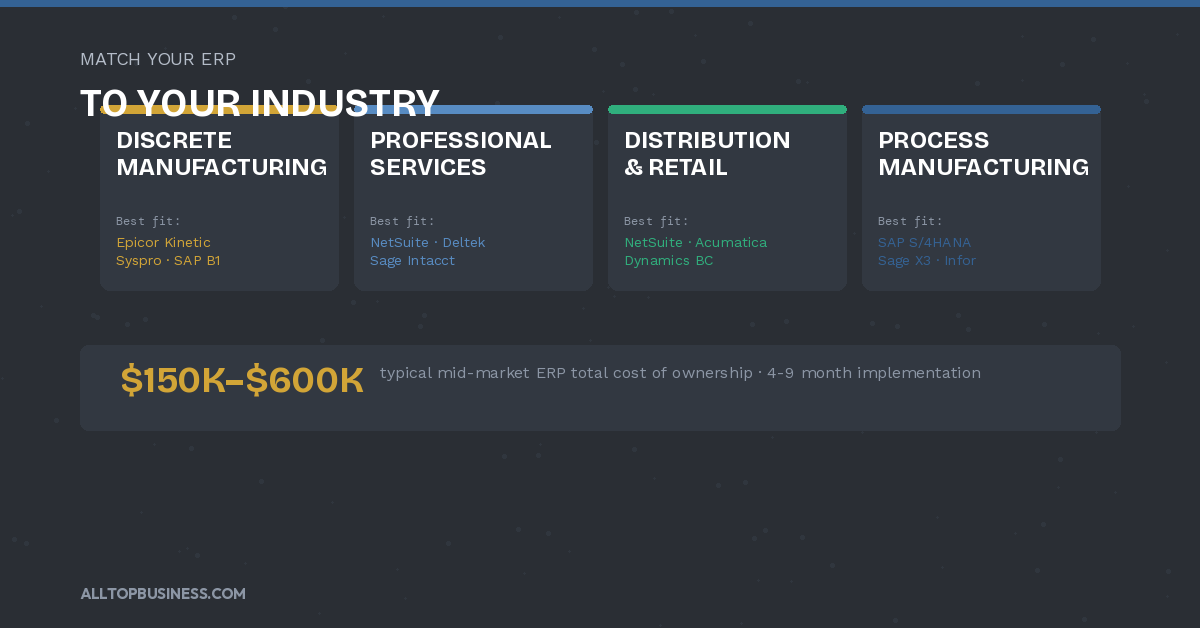
Product-based businesses — manufacturers, distributors, retailers — need inventory, production, and supply chain management. Epicor, Syspro, Sage X3, and SAP Business One are built for this. Services businesses — consultancies, SaaS, nonprofits, professional services — need project accounting and HR integration. NetSuite, Sage Intacct, Deltek, and Workday serve this better.
What does the realistic total cost of ownership look like?
Total cost of ownership for mid-market ERP implementations typically ranges from $150,000 to $600,000. This includes licensing, implementation, training, customization, and first-year support. Get a 5-year TCO model from every vendor before comparing headline prices — the gap between licensing cost and real cost can be 3x or more for complex platforms.
What is your Microsoft or Oracle ecosystem commitment?
Already deeply embedded in Microsoft 365 and Azure? Dynamics 365 Business Central reduces integration complexity and adoption friction. Already running Oracle infrastructure or databases? NetSuite or Oracle Fusion maintains ecosystem consistency. No strong ecosystem preference? Evaluate on functional fit alone.
What implementation capacity can you genuinely commit?
Business process re-engineering is typically part of the ERP project, and implementations run 4 to 9 months. Companies should plan for dedicated internal ERP team resources and budget for independent advisory support during vendor selection. If you cannot commit an internal project owner with 25 to 50% of their time, choose a faster-to-deploy platform over a functionally richer one that will stall in implementation.
Frequently Asked Questions
What is the best ERP software for mid-market companies overall?
Oracle NetSuite is the strongest all-around choice for most growing mid-market companies — it has the largest installed base, the most proven cloud architecture, and covers the widest range of business types from distribution to SaaS. For Microsoft-centric organizations, Dynamics 365 Business Central delivers comparable functionality with better Microsoft ecosystem integration. For manufacturers specifically, Epicor Kinetic or Syspro provides better production management at a lower cost.
How much does ERP software cost for a mid-market company?
ERP pricing for mid-market companies ranges from $100 per user per month to enterprise-level custom pricing. Typical total cost of ownership ranges from $150,000 to $600,000 in the first year, including licensing, implementation, and training. NetSuite at 50 users typically costs $75,000 to $150,000 per year in total. Acumatica’s consumption model can be significantly lower for companies with many occasional users. SAP S/4HANA implementations at mid-market scale typically exceed $300,000 in year one.
What is the difference between NetSuite and SAP for mid-market companies?
NetSuite is purpose-built for growing mid-market companies — faster to implement, cloud-native from day one, and covers most mid-market needs without enterprise-level complexity. SAP S/4HANA is designed for large enterprise operations and provides deeper functionality in manufacturing, procurement, and supply chain — but at significantly higher cost and implementation complexity. For most mid-market companies, NetSuite is the right starting point; SAP becomes relevant when operational complexity genuinely requires its depth.
How long does a mid-market ERP implementation take?
Implementation timelines for mid-market companies typically range from 3 to 6 months to 9 to 18 months, depending on scope and complexity. NetSuite with SuiteSuccess typically deploys in 3 to 6 months for straightforward implementations. Dynamics 365 Business Central runs for 3 to 5 months for standard deployments. Epicor and SAP S/4HANA at mid-market scale typically take 6 to 12 months. Complex multi-entity or multi-country implementations add 3 to 6 months regardless of platform.
What is the easiest ERP to implement for a mid-market company?
Acumatica and Dynamics 365 Business Central consistently have the fastest and least disruptive implementations in the mid-market category. Odoo is the fastest for technically capable teams willing to self-implement. NetSuite’s SuiteSuccess methodology reduces implementation time significantly compared to a custom NetSuite deployment. The fastest implementation is always achieved by limiting scope — going live with core modules before adding complexity.
Should a mid-market company use a full ERP or best-of-breed tools?
A full ERP makes sense when the cost of integrating separate best-of-breed tools — accounting, inventory, CRM, HR — exceeds the cost and complexity of a single integrated platform. Below 50 employees, a best-of-breed stack is usually more flexible and less expensive. Above 50 to 100 employees with genuine cross-functional data needs, a full ERP typically produces better outcomes. Sage Intacct is the right answer for finance-first companies that want ERP-quality financials without operational modules.
Final Verdict
For most growing mid-market companies starting a fresh ERP evaluation, Oracle NetSuite is the strongest default choice, proven at scale, genuinely cloud-native, and covering the broadest range of business types.
For Microsoft-ecosystem companies, Dynamics 365 Business Central at $70 per user per month delivers comparable functionality with better adoption and Copilot AI integration.
For mid-market manufacturers, Epicor Kinetic delivers production management depth that NetSuite and Dynamics 365 cannot match at a lower total cost than SAP.
For finance-first companies that need best-in-class accounting without manufacturing modules, Sage Intacct outperforms NetSuite at comparable pricing.
For budget-conscious SMBs evaluating ERP for the first time, Acumatica’s consumption pricing and Odoo’s free Community edition both provide genuine paths to ERP capability without committing to six-figure annual software costs.
The most expensive ERP mistake is not overpaying for a platform; it is underinvesting in implementation. Budget at least as much for implementation services as for the first year of licensing, and assign an internal project owner with real authority to make decisions.
For more B2B software reviews and comparisons, browse the AllTopBusiness blog. Have a specific ERP evaluation question? Contact our team directly.
External Sources:

I’m Adeyemi Adetilewa, a Content Marketing and SEO Specialist, Digital Strategist, Entrepreneur, and the Editor of AllTopBusiness.com. With over 13 years of experience helping businesses scale through content-driven growth, I’m happy to share all the top business tools I have discovered with you here.