Oracle ERP has been one of the most recognized names in enterprise software for decades. But recognizable does not always mean right for your business.
Oracle’s portfolio spans four distinct ERP platforms: Fusion Cloud ERP, NetSuite, JD Edwards, and E-Business Suite; each built for different company sizes, industries, and deployment preferences. If you are already in Oracle’s ecosystem, choosing between them is a genuine strategic decision. If you are evaluating Oracle against the broader ERP market, the choice is even more complex.
This guide covers all four Oracle ERP systems in detail, plus 13 of the strongest alternatives across mid-market and enterprise segments. Every entry is evaluated against the same criteria, so you can make a direct comparison rather than reading four different vendor websites.
We evaluated over 25 ERP platforms to arrive at this list of 17. Only tools with genuine, documented use cases and substantive user review data from G2, Gartner Peer Insights, and Capterra were included.
For context on how ERP treasury modules compare to standalone treasury systems, read our guide on the best treasury software solutions.
Oracle ERP Systems: Quick Picks
| Label | Pick |
|---|---|
| Best Overall Oracle ERP | Oracle Fusion Cloud ERP: the most complete suite for large enterprises |
| Best for Small Business | Oracle NetSuite: purpose-built cloud ERP for growing companies |
| Best for Enterprise | Oracle Fusion Cloud ERP: deep financials, AI, and global scale |
| Best Free or Low-Cost Option | Odoo: open-source ERP with a genuinely usable free tier |
| Best for Ease of Use | Microsoft Dynamics 365 Business Central: familiar interface, fast adoption |
| Best for Manufacturing Companies | Epicor Kinetic: purpose-built for industrial and manufacturing operations |
How We Selected These Tools
Every ERP system on this list was evaluated against six criteria:
- Functional depth across financials, supply chain, procurement, and HR
- Deployment flexibility: cloud, on-premise, and hybrid options
- Integration quality with third-party tools and existing business systems
- Implementation timeline and complexity for the target company size
- Total cost of ownership, including licensing, implementation, and support
- User review consensus from G2, Gartner Peer Insights, and Capterra
Oracle ERP Systems and Alternatives: Comparison Table
| Tool | Best For | Starting Price | Free Trial | G2 Rating | Key Integration |
|---|---|---|---|---|---|
| Oracle Fusion Cloud ERP | Large enterprise cloud ERP | Custom ($300K+ annually) | No | 3.9/5 | Oracle OCI, Salesforce |
| Oracle NetSuite | Growing mid-market companies | From ~$99/user/mo | No | 4.0/5 | Salesforce, Shopify |
| Oracle JD Edwards | Manufacturing and asset industries | Custom | No | 3.9/5 | Oracle DB, CAD tools |
| Oracle E-Business Suite | Legacy enterprise on-premise | Custom | No | 3.7/5 | Oracle DB, OBIEE |
| SAP S/4HANA | Global enterprise, manufacturing | Custom ($500K+) | No | 3.9/5 | SAP BTP, SuccessFactors |
| Microsoft Dynamics 365 | Microsoft ecosystem mid-market | From $70/user/mo | 30 days | 3.7/5 | Microsoft 365, Azure |
| SAP Business One | Manufacturing SMBs | From ~$94/user/mo | No | 4.3/5 | Salesforce, Stripe |
| Epicor Kinetic | Industrial mid-market | Custom | No | 3.9/5 | Salesforce, Power BI |
| Infor CloudSuite | Healthcare and manufacturing enterprise | Custom | No | 3.8/5 | Salesforce, AWS |
| Workday | Services and people-centric enterprises | Custom | No | 4.0/5 | Salesforce, Okta |
| Sage Intacct | Finance-first mid-market companies | From ~$400/mo | No | 4.3/5 | Salesforce, ADP |
| Acumatica | SMB and lower mid-market | From ~$10K/year | No | 4.5/5 | Shopify, Salesforce |
| Unit4 ERPx | Professional services and nonprofits | Custom | No | 3.8/5 | Microsoft 365, Power BI |
| Odoo | SMBs want a modular open-source ERP | Free tier / From $9.90/user/mo | Yes | 4.2/5 | Shopify, Stripe |
| Syspro | Mid-market manufacturing and distribution | Custom | No | 4.1/5 | Microsoft 365, Power BI |
| Priority Software | SMB to mid-market all-in-one | From ~$65/user/mo | No | 4.3/5 | WooCommerce, Salesforce |
| Deltek Vantagepoint | Project-based professional services | Custom | No | 4.2/5 | Salesforce, Microsoft 365 |
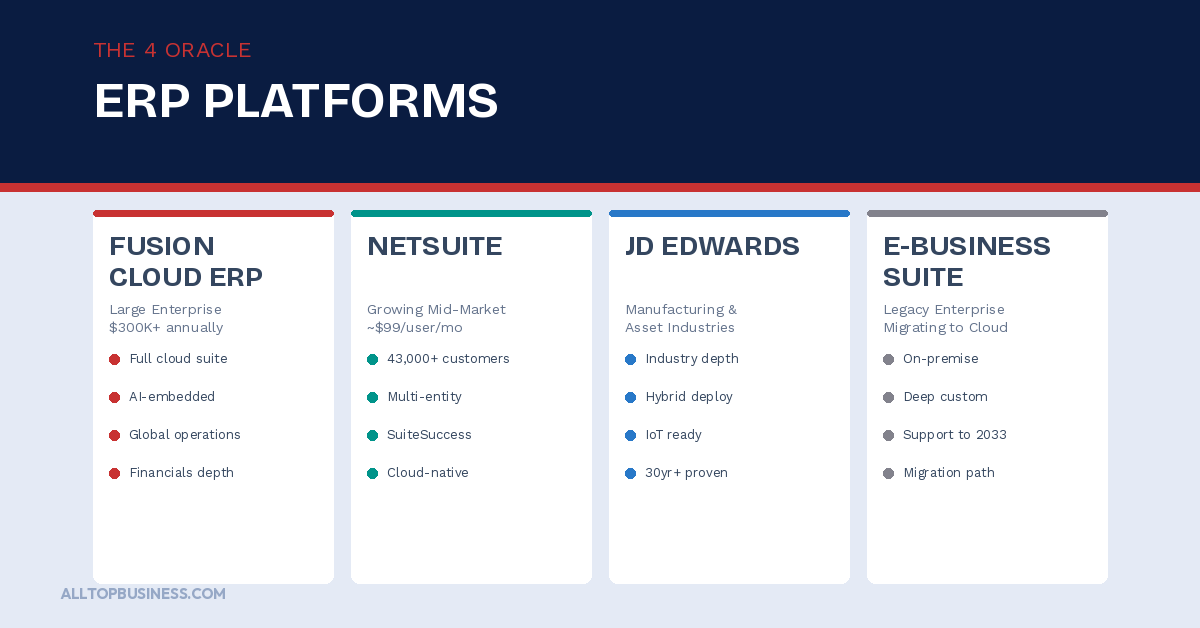
The 4 Oracle ERP Systems
1. Oracle Fusion Cloud ERP
The most comprehensive cloud ERP Oracle offers. Built for large enterprises managing global operations
Oracle Fusion Cloud ERP is Oracle’s flagship modern ERP platform. It is a cloud-native suite covering financials, procurement, project management, risk management, supply chain, and HR under one umbrella. Unlike Oracle’s legacy platforms, Fusion was purpose-built for the cloud and benefits from Oracle’s AI investment across every module.
The financials module is widely regarded as one of the strongest in the enterprise ERP market. Real-time close processes, automated intercompany reconciliation, and AI-driven anomaly detection give large finance teams capabilities that previously required significant manual effort or bolt-on tools.
Oracle has embedded AI extensively throughout Fusion, including automated invoice coding, predictive cash flow forecasting, smart supplier matching, and natural language querying across financial data. For enterprises that have already made the shift to AI-augmented finance operations, Fusion provides a coherent platform to build on rather than a fragmented stack.
Bank connectivity and treasury management are handled natively through Oracle Cash and Treasury Management, which integrates directly with Fusion Financials. For companies already running Oracle Cloud, this eliminates the need for a standalone TMS in many mid-market scenarios.
What it does well:
- Industry-leading financials module with real-time close and AI-driven automation
- Comprehensive AI integration across procurement, finance, and supply chain
- Strong compliance and audit trail functionality for regulated industries
- Native cloud architecture with automatic quarterly updates from Oracle
- Broad ERP coverage from financials through supply chain and HR in one suite
Where it falls short:
- Implementation timelines of 9 to 18 months for large deployments are significant
- Total cost of ownership is among the highest in the market
- Requires Oracle expertise to configure and maintain, internal capability, or a strong implementation partner is non-negotiable
- Some modules, particularly HR, are considered less mature than best-of-breed alternatives like Workday
Pricing: Custom enterprise pricing. Projects typically start at $300K or more annually, including licensing and implementation support.
Best for: Large enterprises with complex global financials, supply chain, and procurement operations that want a single-vendor cloud ERP strategy.
2. Oracle NetSuite
The gold standard cloud ERP for growing mid-market companies
NetSuite is the most widely deployed cloud ERP for growing businesses and holds a distinct position in Oracle’s portfolio. It is the entry point for companies that want serious ERP functionality without the complexity and cost of Oracle Fusion. More than 43,000 companies globally run NetSuite, making it one of the most proven cloud ERP platforms in the mid-market.
The platform covers financial management, CRM, inventory and order management, e-commerce, professional services automation, and HR in a single system. For product-based businesses, services companies, and SaaS operators in the $5M to $250M revenue range, NetSuite provides a level of integration that is genuinely difficult to replicate with a stack of point solutions.
NetSuite’s real strength is in multi-entity and multi-currency management. Growing companies with multiple subsidiaries, international operations, or acquisition-driven structures get genuine consolidation and intercompany accounting functionality that most SMB accounting tools cannot provide.
The platform’s SuiteSuccess methodology provides industry-specific configurations for manufacturing, wholesale distribution, SaaS, retail, and professional services, reducing implementation time and avoiding the blank-slate configuration problem that plagues generic ERP deployments.
What it does well:
- Purpose-built cloud ERP for growing mid-market companies
- Strong multi-entity and multi-currency consolidation
- Industry-specific SuiteSuccess configurations reduce implementation time
- Extensive SuiteApp marketplace for third-party integrations
- Continuous cloud updates with no on-premise upgrade cycles
Where it falls short:
- Customizations can become complex and costly to maintain over time
- Customer support receives mixed reviews, with longer resolution times for complex issues
- Reporting is powerful but has a steep learning curve for non-technical users
- Some users report that pricing increases significantly at renewal
Pricing: Starts at approximately $99 per user per month plus a platform license. Total annual cost for a 20-user company typically ranges from $25,000 to $75,000, depending on modules and customization.
Best for: Growing mid-market companies with $5M to $250M in revenue that need a scalable, cloud-native ERP with strong multi-entity and financial management capabilities.
3. Oracle JD Edwards EnterpriseOne
Deep industry-specific ERP for manufacturing, construction, and asset-intensive businesses
JD Edwards EnterpriseOne is Oracle’s hybrid ERP platform that combines on-premise deployment flexibility with cloud and hosted options. It is particularly well-regarded in manufacturing, construction, real estate, agriculture, and asset-intensive industries where industry-specific module depth matters more than cloud-native architecture.
JD Edwards has a strong installed base of companies that have run the platform for 10 to 20 years and continue to invest in it because of the depth of its industry functionality. Oracle has continued to develop JD Edwards in parallel with Fusion, adding tools-based orchestration, mobile capabilities, and AI features to keep the platform competitive.
The platform covers financials, procurement, manufacturing, distribution, project management, asset management, and real estate management with industry-specific workflows that go significantly deeper than generic ERP platforms in each vertical.
What it does well:
- Deep industry-specific functionality for manufacturing, construction, and distribution
- Flexible deployment: on-premise, hybrid, or Oracle cloud-hosted
- Proven stability with a large global installed base and strong user community
- Strong asset management and equipment maintenance capabilities
- Orchestration framework enables integration with IoT and modern systems without custom code
Where it falls short:
- Less modern cloud-native architecture compared to Oracle Fusion or NetSuite
- Implementation complexity is high and requires significant partner expertise
- The user interface is functional rather than modern compared to newer cloud ERP tools
- Less suitable for services-oriented businesses or fast-growing SaaS companies
Pricing: Custom pricing based on modules and deployment type. Typically requires a significant implementation investment with Oracle partners.
Best for: Mid-market and enterprise companies in manufacturing, construction, distribution, and asset-intensive industries that need deep vertical functionality and deployment flexibility.
4. Oracle E-Business Suite (EBS)
The legacy on-premise Oracle ERP for enterprises is not yet ready to migrate to the cloud
Oracle E-Business Suite is Oracle’s original enterprise ERP platform, built over decades to support large-scale on-premise deployments across financials, supply chain, HR, and customer management. It remains in active use at thousands of large enterprises globally, and Oracle continues to provide extended support.
E-Business Suite is no longer Oracle’s strategic growth platform. That role belongs to Fusion Cloud ERP. However, for enterprises with heavily customized EBS environments, the migration to Fusion is a significant undertaking that many organizations are managing carefully over multi-year timelines rather than rushing.
If you are evaluating ERP options fresh, E-Business Suite is not the right choice. It is most relevant for organizations already running it that are planning their cloud migration roadmap.
What it does well:
- Extremely deep functionality built over decades of enterprise use
- Highly customizable for complex, industry-specific requirements
- Large global consulting and support ecosystem
- Extended support available from Oracle through 2033
Where it falls short:
- On-premise architecture is increasingly expensive to maintain
- No modern cloud-native capabilities without the Fusion migration
- UI is outdated compared to every modern ERP alternative
- Oracle is actively steering customers toward Fusion Cloud ERP
Pricing: Custom pricing. On-premise licensing plus significant hardware, IT, and maintenance costs.
Best for: Enterprises already running E-Business Suite that are managing a phased migration to Oracle Fusion Cloud ERP over the next two to five years.
The Best Oracle ERP Alternatives
5. SAP S/4HANA
Best for: Global enterprises that need the deepest ERP functionality available anywhere in the market
SAP S/4HANA is Oracle Fusion’s most direct large-enterprise competitor and the only ERP platform that competes at the same scale and depth. Built on SAP’s in-memory HANA database, S/4HANA delivers real-time analytics across every module with no data replication or batch processing delays.
SAP dominates the manufacturing, automotive, consumer goods, and chemicals industries in a way that Oracle does not. For enterprises in these verticals considering a new ERP deployment, SAP S/4HANA is the default benchmark against which everything else is measured.
The platform covers every major enterprise function, including financials, procurement, supply chain, manufacturing, asset management, and HR, and integrates tightly with SAP SuccessFactors for HCM and SAP Ariba for procurement.
What it does well:
- Unmatched depth in manufacturing, supply chain, and procurement workflows
- Real-time analytics on the HANA database eliminates reporting lag
- Largest ERP ecosystem of consultants, partners, and integrations globally
- Strong regulatory compliance across 100+ countries
- Proven at the largest enterprise scale
Where it falls short:
- Among the most expensive ERP platforms to license, implement, and maintain
- Implementation timelines of 12 to 24 months for large global deployments
- Steep learning curve and significant change management requirements
- Less intuitive for non-technical finance users compared to newer cloud platforms
Pricing: Custom enterprise pricing. Projects typically start at $500,000 and frequently exceed $5M for large global implementations.
Best for: Global enterprises, particularly in manufacturing, consumer goods, and chemicals, that need the most functionally complete ERP available and have the resources to implement it.
6. Microsoft Dynamics 365
Best for: Mid-market and enterprise companies already embedded in the Microsoft ecosystem
Microsoft Dynamics 365 is Oracle’s strongest challenger in the mid-market and increasingly competitive at the enterprise level. Its core advantage is integration. No other ERP platform connects as naturally with Microsoft 365, Teams, Azure, Power BI, and Copilot AI as Dynamics 365.
For organizations where every employee already works in Teams, Outlook, and Excel, Dynamics 365 reduces the user adoption friction that kills many ERP implementations. Finance teams get familiar interfaces. Operations teams get data in tools they already use. And Microsoft’s Copilot AI features bring natural language querying and automated workflow suggestions into ERP functions in a way that feels genuinely usable rather than bolted on.
Dynamics 365 comes in two main flavors: Business Central for SMBs and lower mid-market, and Finance and Supply Chain Management for larger enterprises. The modular approach lets companies start with finance and add supply chain, manufacturing, or field service as needed.
What it does well:
- Native integration with Microsoft 365, Teams, Azure, and Power BI
- Microsoft Copilot AI features across finance and operations modules
- A modular approach lets companies start small and add functionality over time
- A familiar interface reduces training time and user resistance
- Competitive pricing compared to Oracle and SAP at enterprise scale
Where it falls short:
- Less depth in complex manufacturing and supply chain versus SAP and Oracle JDE
- Partner quality for implementation varies significantly. Choosing the wrong partner is a common failure mode
- Some modules feel less integrated than Oracle’s native suite
- Large-scale global deployments can be complex to manage across entities
Pricing: Dynamics 365 Business Central starts from $70 per user per month. Finance and Supply Chain Management starts from $180 per user per month.
Best for: Mid-market companies and enterprises already running Microsoft 365 that want a modern, AI-augmented ERP with lower adoption friction than Oracle or SAP.
7. SAP Business One
Best for: Small and mid-sized manufacturers and distributors that want SAP functionality at the SMB scale
SAP Business One is SAP’s purpose-built ERP for small and mid-sized businesses, particularly in manufacturing, distribution, and retail. It covers financials, inventory, sales, purchasing, and production in a single integrated system without the complexity or cost of SAP S/4HANA.
For businesses that have outgrown QuickBooks or Xero and need genuine inventory and production management alongside financials, SAP Business One provides a well-structured upgrade path. It is available on-premise, in the cloud, or as a hybrid deployment and has a strong ecosystem of certified implementation partners.
What it does well:
- Right-sized ERP for SMBs without the enterprise complexity
- Strong inventory, production, and distribution functionality
- Large global implementation partner network
- SAP’s brand credibility is useful for enterprise customers and investor relationships
- Available on-premise, cloud, or hybrid
Where it falls short:
- Customization can add high cost and complexity
- User interface feels dated compared to newer cloud-native SMB ERPs
- Reporting requires add-ons for advanced analytics
- Less suitable for services-oriented businesses
Pricing: Starts at approximately $94 per user per month for cloud deployment. On-premise licensing costs more upfront.
Best for: Small and mid-sized manufacturers, distributors, and retailers with $5M to $100M in revenue that need a structured ERP with genuine production and inventory management.
8. Epicor Kinetic
Best for: Mid-market manufacturers and industrial businesses that want purpose-built ERP without enterprise overhead
Epicor Kinetic is the cloud-native evolution of Epicor’s long-running manufacturing ERP platform. It is purpose-built for discrete manufacturing, distribution, automotive, and building supply businesses and delivers deeper industry-specific functionality in these verticals than most general-purpose ERP platforms can match.
The platform combines modular design with industry-tuned workflows, IoT connectivity, and AI-powered analytics. Epicor’s focus is narrow — it does not try to be a platform for every business type, which means the manufacturing and distribution functionality is genuinely deep rather than generic.
What it does well:
- Deep manufacturing, production planning, and shop floor management
- IoT integration for equipment monitoring and predictive maintenance
- Industry-specific workflows out of the box for manufacturing and distribution
- Faster deployment and lower TCO than Oracle JDE for mid-market manufacturers
- Modern, cloud-native architecture with a clean user interface
Where it falls short:
- Limited functionality outside manufacturing, distribution, and related industries
- Less suitable for services-oriented or SaaS businesses
- Partner ecosystem smaller than SAP or Oracle
- Financial management depth is lighter than Oracle Fusion or SAP S/4HANA
Pricing: Custom pricing based on modules and company size. Typically, more accessible than Oracle and SAP for mid-market manufacturers.
Best for: Mid-market manufacturers, distributors, and industrial businesses in the $50M to $500M revenue range that need deep vertical functionality without enterprise ERP complexity.
9. Infor CloudSuite
Best for: Enterprise companies in healthcare, manufacturing, and distribution that need industry-specific depth
Infor CloudSuite is an industry-focused enterprise ERP platform built on AWS infrastructure. Infor’s differentiation is its vertical depth. Each CloudSuite edition (healthcare, manufacturing, distribution, fashion, hospitality) comes pre-configured with workflows, terminology, and compliance frameworks specific to that industry.
For healthcare systems, manufacturers, and distributors evaluating alternatives to Oracle or SAP, Infor competes on industry depth and lower implementation complexity rather than breadth. The tradeoff is that Infor’s brand recognition and partner ecosystem are smaller than those of Oracle or SAP.
What it does well:
- Deep industry-specific pre-configurations across healthcare, manufacturing, and distribution
- Built on AWS infrastructure with strong security and scalability
- Industry-specific compliance frameworks reduce regulatory configuration burden
- Lower implementation complexity than Oracle Fusion or SAP S/4HANA for target verticals
Where it falls short:
- Smaller consulting ecosystem than Oracle or SAP
- Less suitable for companies outside Infor’s target verticals
- Brand recognition challenges when selling to enterprise customers familiar only with Oracle and SAP
Pricing: Custom enterprise pricing. Typical implementations range from $300K to $2M.
Best for: Enterprise companies in healthcare, manufacturing, or distribution that prioritize industry-specific depth over broad platform capabilities.
10. Workday
Best for: Mid-market and enterprise services companies that prioritize finance and people management
Workday is the strongest cloud-native alternative to Oracle for services-oriented organizations where human capital management is as important as financial management. It combines financial management, HR, payroll, and workforce planning in a single cloud platform built from the ground up rather than assembled through acquisitions.
Workday’s financial management module is particularly strong for services businesses like professional services firms, financial institutions, healthcare systems, and technology companies that do not have complex manufacturing or supply chain requirements.
The platform’s people-centric design philosophy means HR and finance share the same data model, which produces a level of workforce-to-financial integration that Oracle Fusion achieves but most other ERP platforms do not.
What it does well:
- Best-in-class HCM is tightly integrated with financial management
- Strong planning and analytics through Workday Adaptive Planning
- Modern, intuitive interface with high user adoption rates
- Real-time financial and workforce reporting without separate BI tools
- Continuous cloud innovation with a strong product roadmap
Where it falls short:
- Supply chain and manufacturing capabilities are limited. Not suitable for product-based businesses
- Implementation costs and timelines are significant
- Customization is more constrained than Oracle or SAP
- Pricing is at the enterprise tier
Pricing: Custom enterprise pricing. Typically starts at $100 to $150 per employee per year for core HCM, with financials adding significantly to that.
Best for: Mid-market and enterprise services companies like technology, professional services, healthcare, and financial services, where HR and finance integration is a primary requirement.
11. Sage Intacct
Best for: Finance-first mid-market companies that want best-in-class financial management without full ERP complexity
Sage Intacct is consistently recognized as one of the strongest cloud financial management platforms for mid-market companies. It is not a full ERP. It does not cover manufacturing or supply chain, but for finance-first organizations that need serious multi-entity accounting, project accounting, and revenue recognition, Sage Intacct provides depth that NetSuite struggles to match at comparable pricing.
The platform carries the AICPA preferred financial management software designation and is particularly strong in nonprofit, healthcare, SaaS, and financial services organizations where accounting complexity is high, but manufacturing is not relevant.
What it does well:
- Industry-leading multi-entity and multi-currency financial management
- Strong project accounting and revenue recognition for services businesses
- AICPA preferred software. Widely trusted by accounting teams
- Clean API and integration marketplace for connecting best-of-breed tools
- Competitive pricing relative to NetSuite for finance-only deployments
Where it falls short:
- Not a full ERP. No manufacturing, supply chain, or production management
- HR and CRM require third-party integrations
- Implementation can be complex for highly customized accounting structures
Pricing: Starts at approximately $400 per month for smaller deployments. Mid-market implementations typically range from $15,000 to $60,000 annually.
Best for: Mid-market companies in professional services, nonprofit, healthcare, and SaaS that need best-in-class financial management without full ERP complexity.
12. Acumatica
Best for: SMBs and lower mid-market companies that want flexible, consumption-based cloud ERP
Acumatica is a cloud ERP platform that covers financials, distribution, manufacturing, construction, and retail for SMBs and lower mid-market companies. Its most distinctive feature is its consumption-based pricing model. You pay based on computing resources used rather than per user, which makes it cost-effective for companies with large numbers of occasional ERP users.
The platform consistently receives some of the highest user satisfaction scores in the SMB ERP market on G2 and Capterra. Its modern UI, strong partner ecosystem in North America, and flexible deployment options make it a practical alternative to both Oracle NetSuite and Microsoft Dynamics 365 Business Central.
What it does well:
- Consumption-based pricing. No per-user fees, unlimited users
- High user satisfaction scores consistently on G2 and Capterra
- Modern, intuitive interface reduces training burden
- Strong construction, manufacturing, and distribution modules
- Active North American partner ecosystem
Where it falls short:
- Less global footprint and partner availability outside North America
- Less depth for very large or complex enterprise deployments
- Financial management is not as deep as Sage Intacct for complex multi-entity accounting
Pricing: From approximately $10,000 per year. Pricing scales based on transaction volume and resource consumption rather than users.
Best for: SMBs and lower mid-market companies with 10 to 200 employees that want flexible cloud ERP with consumption-based pricing and strong construction, distribution, or manufacturing functionality.
13. Unit4 ERPx
Best for: Professional services firms, nonprofits, and public sector organizations
Unit4 ERPx is a cloud ERP platform specifically designed for people-intensive service organizations. It covers finance, procurement, projects, HR, and planning in a unified cloud environment, with pre-built configurations for professional services, nonprofits, higher education, and public sector organizations.
Unit4’s people-centric design means workflows are built around how service organizations actually operate, projects, billable time, grant management, and workforce planning, rather than being adapted from manufacturing-focused ERP systems.
What it does well:
- Purpose-built for professional services, nonprofits, and the public sector
- Strong project management and professional services automation
- People-centric architecture aligns with how service businesses operate
- Modern cloud platform with regular feature releases
- A genuine alternative to Oracle for organizations that find Fusion oversized
Where it falls short:
- Not suitable for manufacturing, distribution, or product-based businesses
- Smaller brand recognition and partner ecosystem than Oracle or SAP
- Less depth in financial management than Sage Intacct or Oracle Fusion
Pricing: Custom pricing based on organization size and modules.
Best for: Professional services firms, nonprofits, higher education institutions, and public sector organizations that need an ERP designed around people and projects rather than manufacturing.
14. Odoo
Best for: SMBs that want a modular, open-source ERP they can start for free and scale affordably
Odoo is the most popular open-source ERP platform in the world and one of the few genuine alternatives for cost-sensitive SMBs evaluating Oracle NetSuite. The platform covers over 50 integrated modules, including accounting, inventory, manufacturing, CRM, e-commerce, HR, and project management.
The free Community edition is fully functional for single-company deployments and gives small businesses a genuine ERP capability with no software cost. The Enterprise edition adds advanced features, hosting, and support starting from $9.90 per user per month, which makes it one of the most accessible ERP platforms available.
The tradeoff is implementation support. Open-source flexibility cuts both ways. Odoo is highly customizable, but that customization requires technical resources, either internal or through an Odoo partner.
What it does well:
- Genuinely free Community edition for single-company deployments
- Extremely affordable Enterprise edition pricing
- 50+ integrated modules covering virtually every business function
- Active global community and partner ecosystem
- Modern interface that competes favorably with paid SMB ERP tools
Where it falls short:
- Implementation and customization require technical resources or a paid partner
- Enterprise support quality varies by partner
- Less suitable for complex multi-entity or heavily regulated environments
- Financial management depth is lighter than NetSuite or Sage Intacct
Pricing: Community edition is free. Enterprise starts at $9.90 per user per month.
Best for: SMBs and startups that want a modular, affordable ERP they can start small with and scale. Also suitable for technically capable teams comfortable with open-source software.
15. Syspro
Best for: Mid-market manufacturers and distributors that want ERP without enterprise complexity
Syspro is a mid-market ERP platform focused exclusively on manufacturing and distribution businesses. Like Epicor, its narrow vertical focus produces genuine depth in production planning, inventory management, and supply chain operations that general-purpose ERPs deliver less effectively at this price point.
Syspro is available on-premise, cloud-hosted, or as a hybrid deployment and has a strong presence in food and beverage, electronics, industrial equipment, and medical device manufacturing.
What it does well:
- Deep manufacturing and distribution functionality without enterprise pricing
- Flexible deployment options across on-premise, cloud, and hybrid
- Strong inventory and warehouse management capabilities
- Good fit for regulated manufacturing environments (FDA, ISO)
- Responsive customer support rated well by mid-market users
Where it falls short:
- Limited functionality outside manufacturing and distribution
- Less modern UI compared to Epicor Kinetic or Acumatica
- Smaller partner ecosystem and brand recognition outside its core verticals
Pricing: Custom pricing. Typically, more accessible than Oracle JD Edwards for mid-market manufacturers.
Best for: Mid-market manufacturers and distributors, particularly in food and beverage, electronics, and industrial equipment, that want focused ERP depth without enterprise overhead.
16. Priority Software
Best for: SMB to mid-market companies that want an all-in-one ERP with strong financials and CRM
Priority Software is a cloud ERP platform covering financials, CRM, manufacturing, distribution, procurement, and HR in a single system. It is particularly strong in Israel and growing across Europe, Asia, and North America as an alternative to both Oracle NetSuite and Microsoft Dynamics 365.
The platform’s strength is in breadth. It genuinely covers more business functions in a single platform than most SMB ERP tools, including a built-in CRM that is more capable than the basic CRM functionality most ERPs offer as an add-on.
What it does well:
- Broad functionality, including a strong built-in CRM
- Competitive pricing for the features offered
- Good mid-market fit for companies that want everything in one system
- Strong manufacturing and distribution modules alongside financials
Where it falls short:
- Less brand recognition in North America compared to NetSuite or Dynamics 365
- Partner ecosystem smaller in North America
- Advanced analytics require add-ons
Pricing: Starts at approximately $65 per user per month.
Best for: SMB to mid-market companies globally that want broad ERP coverage, including a built-in CRM at competitive pricing.
17. Deltek VantagePoint
Best for: Project-based professional services firms like consultancies, engineering, architecture, and government contractors
Deltek VantagePoint is the most purpose-built ERP available for project-based professional services businesses. It covers project management, financial management, resource planning, CRM, and business development in a platform specifically designed around how project-based businesses bill, manage resources, and recognize revenue.
For engineering firms, architecture practices, management consultancies, and government contractors, Deltek delivers depth that Oracle, SAP, and Workday simply do not provide natively. The platform has decades of experience serving these specific verticals, and the workflows reflect that.
What it does well:
- Unmatched depth for project-based professional services businesses
- Integrated project management, financial management, and resource planning
- Strong government contracting compliance (DCAA, FAR, CAS)
- Purpose-built CRM for business development in services firms
- High user satisfaction scores among professional services users
Where it falls short:
- Very limited outside its target verticals. Not suitable for manufacturing or product companies
- Smaller brand recognition outside professional services and government contracting
- Implementation requires Deltek-certified partners
Pricing: Custom pricing based on company size and modules.
Best for: Engineering firms, architecture practices, management consultancies, IT services companies, and government contractors that need a project-centric ERP designed specifically for their business model.
How to Choose Between Oracle ERP and Its Alternatives
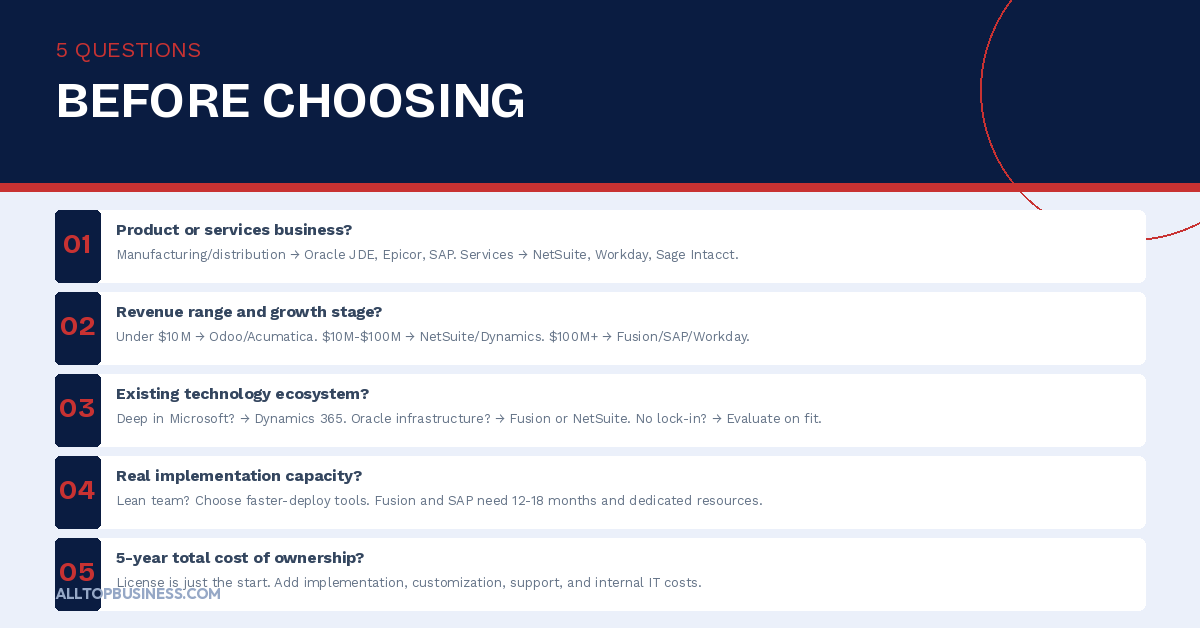
The ERP market in 2026 is more fragmented and more specialized than it has ever been. The right platform depends on five decisions made honestly before you talk to a single vendor.
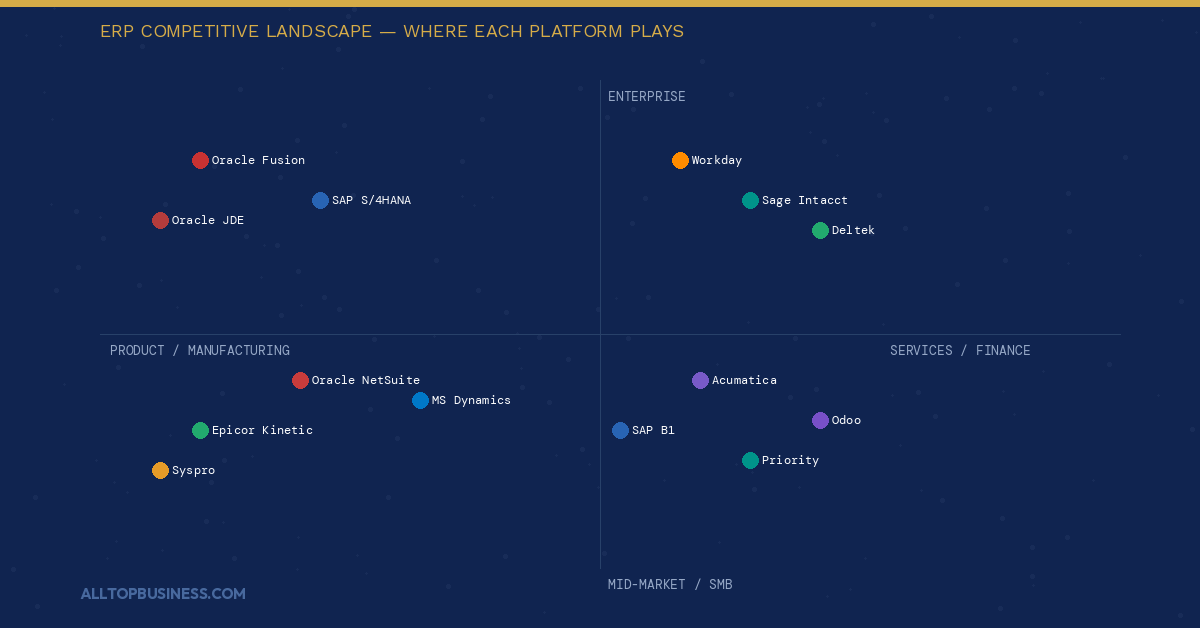
Are you product-based or services-based? Product-based businesses like manufacturers, distributors, and retailers need deep inventory, production, and supply chain management.
Oracle JDE, SAP S/4HANA, Epicor, and Syspro are built for this. Services businesses like consultancies, SaaS companies, and healthcare systems need strong financial management, project accounting, and HR. NetSuite, Workday, Sage Intacct, and Deltek serve this better.
What is your revenue range and growth trajectory? Below $10M: Odoo or Acumatica. $10M to $100M growing fast: Oracle NetSuite or Microsoft Dynamics 365 Business Central. $100M to $1B mid-market: Oracle Fusion, SAP S/4HANA, Workday, or Infor, depending on industry. Above $1B: Oracle Fusion or SAP S/4HANA.
Are you already in an ecosystem? Already on Microsoft 365 and Azure? Dynamics 365 is the path of least resistance and reduces integration complexity.
Already running an Oracle database or OCI infrastructure? Oracle Fusion or NetSuite maintains that consistency. No strong ecosystem loyalty? Evaluate on functional fit alone.
What is your actual implementation capacity? Oracle Fusion and SAP S/4HANA require significant internal resources, executive sponsorship, and 12 to 18 months of commitment.
If your team cannot genuinely resource a major implementation, a faster-to-deploy platform like NetSuite, Dynamics 365 Business Central, or Acumatica produces better outcomes even if it is slightly less functionally deep.
What is the total cost of ownership over 5 years? License costs are only the starting point. Implementation, customization, annual support, upgrades, and internal IT costs all compound significantly for complex ERP platforms. Get a 5-year TCO estimate from each shortlisted vendor before comparing sticker prices.
Frequently Asked Questions
What is the best Oracle ERP system for a mid-market company? Oracle NetSuite is the right choice for most mid-market companies. It is purpose-built for growing businesses in the $5M to $250M revenue range, deploys faster than Oracle Fusion, and provides genuine multi-entity and multi-currency management at a more accessible price point than Oracle’s enterprise platforms.
What is the difference between Oracle Fusion Cloud ERP and Oracle NetSuite? Oracle Fusion Cloud ERP is Oracle’s enterprise-tier platform built for large, complex organizations with global operations.
NetSuite is Oracle’s mid-market platform built for growing companies. Fusion has deeper financials, more sophisticated risk management, and handles greater organizational complexity. NetSuite deploys faster, costs less, and is better suited to companies that have not yet reached enterprise scale.
Is Oracle ERP better than SAP? Neither is universally better. The right choice depends on industry, company size, and existing technology ecosystem. Oracle has a stronger cloud-native architecture and is preferred in financial services, technology, and healthcare.
SAP dominates in manufacturing, consumer goods, and chemicals. For mid-market companies, both are often oversized, and alternatives like Microsoft Dynamics 365 or NetSuite deliver better value.
How long does Oracle ERP implementation take? Oracle NetSuite implementations typically take 3 to 6 months for mid-market companies. Oracle Fusion Cloud ERP implementations for large enterprises typically take 9 to 18 months. Oracle JD Edwards and E-Business Suite implementations vary widely depending on customization scope.
What is the cheapest Oracle ERP option? Oracle NetSuite is the most accessible Oracle ERP platform, starting at approximately $99 per user per month. For companies that want genuinely free ERP, Odoo’s Community edition is the strongest option in the market.
Can Oracle ERP integrate with Salesforce? Yes. Both Oracle Fusion Cloud ERP and Oracle NetSuite offer documented integrations with Salesforce.
NetSuite has a native Salesforce connector through its SuiteApp marketplace. Fusion Cloud ERP integrates with Salesforce through Oracle Integration Cloud or third-party middleware platforms.
Is Oracle ERP suitable for small businesses? Oracle Fusion Cloud ERP and JD Edwards are not designed for small businesses. Oracle NetSuite serves small businesses at the upper end, companies with $2M or more in revenue, and some operational complexity. For genuinely small businesses, Odoo, Acumatica, or SAP Business One are more appropriate starting points.
What are the main alternatives to Oracle ERP? The strongest alternatives depend on your company size and industry. For enterprise: SAP S/4HANA and Microsoft Dynamics 365. For mid-market: NetSuite, Sage Intacct, and Workday. For manufacturing: Epicor Kinetic and Syspro. For SMBs: Odoo and Acumatica. For professional services: Deltek VantagePoint and Unit4 ERPx.
Final Verdict
For most growing mid-market companies evaluating Oracle ERP for the first time, Oracle NetSuite is the right starting point. It delivers genuine ERP depth, scales well through the $250M revenue range, and deploys faster than any of Oracle’s other platforms.
For large enterprises with complex global operations, Oracle Fusion Cloud ERP is one of the two or three strongest platforms in the market alongside SAP S/4HANA and Workday.
If you are not already inside Oracle’s ecosystem, take the alternatives seriously before committing. Microsoft Dynamics 365 is a compelling choice for Microsoft-centric organizations. Epicor Kinetic serves mid-market manufacturers better than Oracle JDE at a lower cost and complexity. Sage Intacct outperforms NetSuite for finance-first mid-market companies that do not need manufacturing modules.
For more guides on ERP, treasury software, and B2B finance tools, browse the AllTopBusiness blog. For questions about your specific ERP evaluation, contact our team. And if you are evaluating treasury management alongside your ERP selection, read our guide on what treasury management is and how it connects to your ERP.
External Sources:
- Gartner Magic Quadrant for Cloud ERP for Product-Centric Enterprises
- G2 Enterprise Resource Planning Software Reviews

I’m Adeyemi Adetilewa, a Content Marketing and SEO Specialist, Digital Strategist, Entrepreneur, and the Editor of AllTopBusiness.com. With over 13 years of experience helping businesses scale through content-driven growth, I’m happy to share all the top business tools I have discovered with you here.