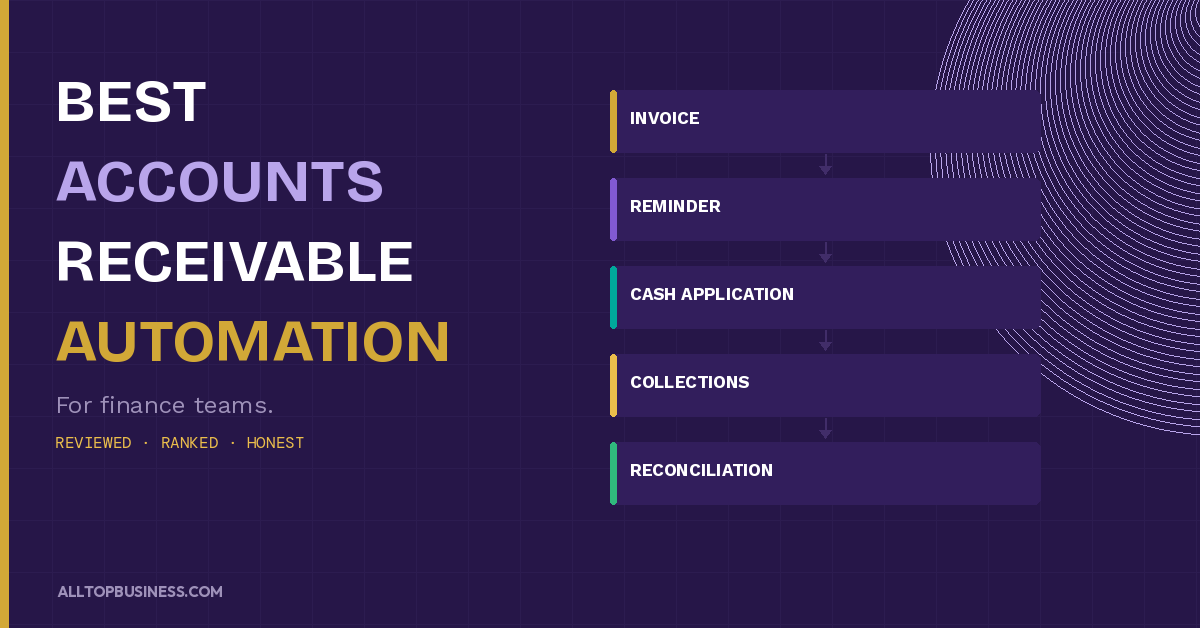
AR teams spend 70% of their time on repetitive tasks. Sending the same payment reminder for the third time. Manually matching a payment that arrived without a remittance. Chasing a dispute that has been sitting in someone’s inbox for two weeks. Rebuilding a cash forecast that was already out of date before it was finished.
That is not a staffing problem. It is a systems problem, and accounts receivable automation software is what fixes it.
The AR automation software market has matured significantly in 2026. What was once a category dominated by a single enterprise platform now spans a spectrum from plug-and-play SMB tools to AI-native enterprise suites handling complex multi-entity cash application. AR teams spend 70% of their time on repetitive tasks, and across 200+ verified G2 reviews, finance teams describe the same operational shifts after moving beyond ERP-only AR workflows: fewer exceptions falling through, clearer ownership between roles, and less time reconciling between systems.
This guide covers 15 AR automation platforms evaluated against the same criteria. We assessed over 30 platforms to arrive at this list. Every entry includes real 2026 pricing data where available, honest limitations, and a precise recommendation for who each tool actually fits.
For related reading on managing the broader finance operations stack, read our guide on treasury management KPIs every CFO should track and explore more B2B software reviews on the AllTopBusiness blog.
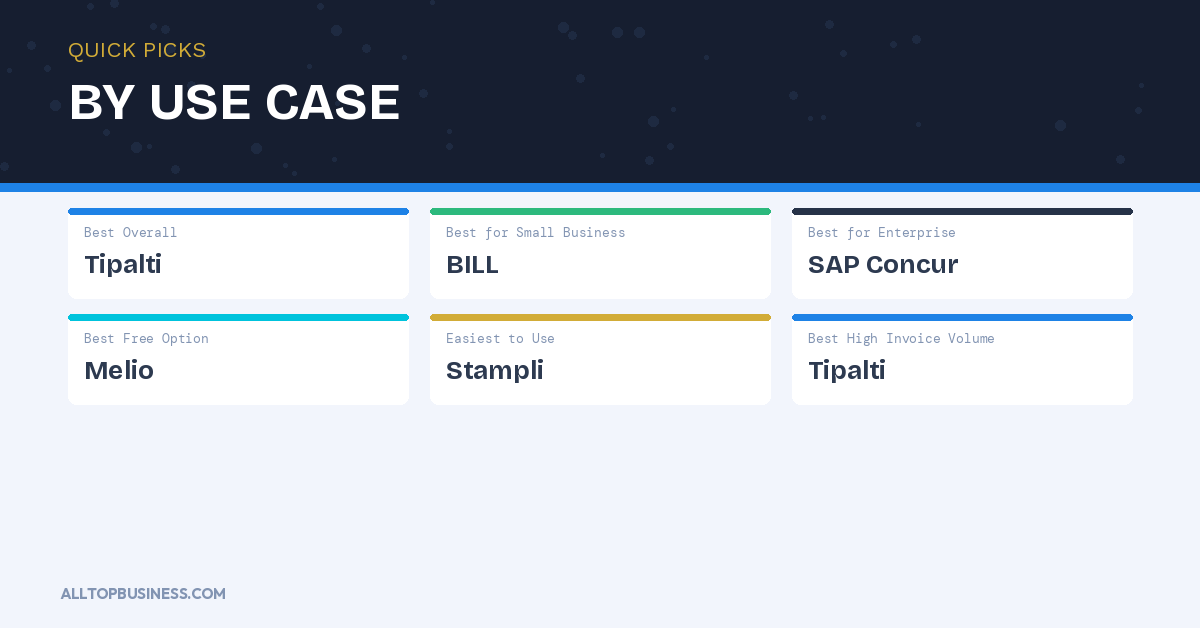
Quick Picks: Best AR Automation Software for Finance Teams
| Label | Pick |
|---|---|
| Best Overall | HighRadius — the most complete enterprise AR automation suite covering credit, billing, cash application, and collections |
| Best for Small Business | BILL — plug-and-play AR and AP automation for SMBs, starting at $45/user/month |
| Best for Enterprise | HighRadius — Agentic AI-powered order-to-cash with the deepest enterprise feature set in the category |
| Best Free or Low-Cost Option | Zoho Books — AR automation included in Zoho’s SMB accounting platform from $15/month |
| Best for Ease of Use | Upflow — the cleanest interface in the category with the fastest implementation for mid-market teams |
| Best for High Invoice Volume | Billtrust — purpose-built invoice delivery and cash application for high-volume B2B billing operations |
How We Selected These AR Automation Tools
Every platform on this list was evaluated against six criteria:
- AR workflow coverage — invoicing, collections, cash application, dispute management, and credit management
- AI and automation depth — machine learning for payment matching, collections prioritization, and forecasting
- ERP and accounting integration — connectivity with SAP, Oracle, NetSuite, QuickBooks, and major ERPs
- Implementation speed — realistic time from contract to productive use for the target company size
- Pricing transparency — actual cost data from public sources, Vendr, and industry benchmarks
- User review consensus — ratings and themes from G2, Capterra, and Gartner Peer Insights
Best AR Automation Software: Comparison Table
| Tool | Best For | Starting Price | Free Plan | G2 Rating | Key Integration |
|---|---|---|---|---|---|
| HighRadius | Enterprise order-to-cash automation | $50,000+/yr | No | 4.3/5 | SAP, Oracle, NetSuite |
| Billtrust | Invoice delivery and cash application | $20,000-$60,000/yr | No | 4.4/5 | SAP, Oracle, NetSuite |
| Versapay | Collaborative AR with buyer portals | $50,000-$150,000+/yr | No | 4.5/5 | NetSuite, Sage Intacct |
| Tesorio | Cash forecasting-led AR automation | Mid $5 to mid $6 figures Y1 | No | 4.6/5 | NetSuite, Salesforce |
| Esker | Unified AR and AP automation | Custom | No | 4.5/5 | SAP, Oracle, NetSuite |
| Quadient AR (YayPay) | Mid-market collections automation | $1,000-$5,000/mo | No | 4.5/5 | NetSuite, QuickBooks, Sage |
| Upflow | SMB and mid-market collections | From $400/mo | No | 4.7/5 | QuickBooks, Xero, NetSuite |
| BILL | SMB AR and AP automation | From $45/user/mo | No | 4.4/5 | QuickBooks, Xero, NetSuite |
| Gaviti | Collections-focused mid-market | Custom | No | 4.7/5 | NetSuite, QuickBooks, SAP |
| Chargebee | Subscription billing and AR | Free / from $299/mo | Yes | 4.4/5 | Salesforce, NetSuite, Xero |
| Zuora | Enterprise subscription billing and revenue recognition | Custom | No | 4.1/5 | Salesforce, NetSuite, SAP |
| Paystand | B2B payments and AR automation | Custom | No | 4.6/5 | NetSuite, Salesforce, SAP |
| Growfin | AI-powered collections for mid-market | Custom | No | 4.6/5 | QuickBooks, NetSuite, Salesforce |
| BlackLine | AR automation as part of the financial close | Custom | No | 4.3/5 | SAP, Oracle, NetSuite |
| Zoho Books | SMB accounting with built-in AR automation | Free / from $15/mo | Yes (1 user) | 4.5/5 | Zoho CRM, Stripe, PayPal |
1. HighRadius
The most complete enterprise AR automation suite — built for large finance teams managing complex order-to-cash workflows
HighRadius built the AR automation category and remains the benchmark enterprise platform against which everything else is measured. HighRadius is the premier global platform built specifically for teams looking to replace manual payment portals with end-to-end accounts receivable automation. Unlike point solutions that only handle single components, HighRadius unifies credit, collections, cash application, and deductions into a single, cohesive system.
The platform’s Agentic AI layer is the most developed in the category — autonomous agents handle collections outreach, payment matching, dispute routing, and cash flow forecasting without human intervention for routine cases. The AI cash application module achieves high match rates on straight-through processing, reducing the manual matching work that consumes AR team time at enterprise scale.
In 2026, HighRadius has doubled down on its agentic AI positioning — AI agents now handle payment prediction, proactive collections prioritization, and automated dispute resolution at a level of autonomy that competing platforms have not yet matched.
HighRadius’s implementation timelines are 3 to 6 months with significant professional services costs — which is the honest tradeoff for a platform this comprehensive. For teams that cannot commit to that timeline and budget, the mid-market alternatives below deliver strong results faster.
What it does well:
- Agentic AI across collections, cash application, deductions, and forecasting
- Highest straight-through processing rates for cash application in the enterprise category
- Unified credit, billing, collections, and cash application in one platform
- Deep SAP, Oracle, and NetSuite integration with bidirectional data sync
- Proven at Fortune 500 scale with large global customer deployments
Where it falls short:
- Implementation takes 3 to 6 months and requires significant professional services investment
- Pricing starts at $50,000+ annually — not accessible for companies under $100M in revenue
- Template-based document extraction requires manual configuration per remittance format — a known architectural constraint
- Complexity can overwhelm teams without dedicated AR operations resources
Pricing: $50,000+ year one per Lunos 2026. Enterprise deployments typically cost $75,000 to $300,000+ annually.
Best for: Large enterprises and upper mid-market companies with $500M+ in revenue that need end-to-end order-to-cash automation with the deepest AI capability available in the category.
2. Billtrust
The best AR platform for high-volume B2B invoice delivery and cash application
Billtrust excels at standardizing how invoices are delivered into complex customer procurement portals, automating the payment acceptance side of AR, and applying cash through machine learning-assisted matching.
Billtrust’s core strength is invoice delivery — it manages how invoices get to customers across channels including paper, email, EDI, and buyer portals, ensuring invoices land in the format each customer’s AP system requires. For companies that lose days of DSO because invoices sit in customer email queues or arrive in the wrong format, Billtrust solves this upstream invoicing problem directly.
The Business Payments Network connects buyers and suppliers for faster, more accurate payment exchange — reducing the friction that delays payment between trading partners. Billtrust is popular for improving the payment experience, but it focuses less on the collections strategy. Finance teams still have to handle follow-ups, dispute conversations, and payment promises manually.
What it does well:
- Industry-leading invoice delivery across paper, email, EDI, and customer portals
- Business Payments Network for faster buyer-supplier payment exchange
- Strong cash application with machine learning-assisted payment matching
- Good mid-market pricing at $20,000 to $60,000 annually
- Clean integration with SAP, Oracle, and NetSuite
Where it falls short:
- Collections automation is less developed than HighRadius or Tesorio
- Manual collections follow-up is still required for dispute-heavy accounts
- The implementation timeline of 8 to 16 weeks is longer than that of newer platforms
Pricing: $20,000 to $60,000 mid-market per Lunos 2026, depending on invoice volume and modules.
Best for: Mid-market and enterprise B2B companies with high invoice volumes that need to standardize invoice delivery across channels and improve cash application accuracy.
3. Versapay
The best AR platform for collaborative, dispute-driven accounts receivable management
Versapay uses branded buyer portals to allow customers to view, dispute, and pay invoices in a social-style interface, drastically reducing resolution times. For companies where DSO is driven primarily by disputes and customer communication delays rather than collection follow-up frequency, Versapay’s collaborative model addresses the root cause directly.
The platform is particularly strong for distribution businesses with high deduction volumes and CPG companies managing retail customer chargebacks. When a customer disputes an invoice, Versapay routes the dispute through a structured resolution workflow in the buyer portal — keeping communication centralized and resolution timelines visible to both sides.
Versapay pricing in 2026 typically runs $50,000 to $150,000+ annually for mid-market AR automation, with custom quotes based on volume, modules, and user count.
What it does well:
- Buyer portal eliminates email-based dispute resolution and speeds resolution cycles
- Strong collaborative AR model for distribution and CPG companies
- Accepts ACH, credit cards, and wire payments through the integrated payments platform
- Good NetSuite and Sage Intacct integration
- High user satisfaction — 4.5/5 on G2
Where it falls short:
- The implementation timeline is typically 8 to 16 weeks
- Less depth in AI-powered collections prioritization versus HighRadius or Tesorio
- Pricing is opaque and requires a sales conversation
Pricing: $50,000 to $150,000+ annually based on volume and modules.
Best for: Mid-market and enterprise companies in distribution, CPG, and wholesale where disputes and deductions are the primary driver of extended DSO.
4. Tesorio
The best AR automation platform for tech companies that prioritize cash flow forecasting alongside collections
Tesorio is highly popular with high-growth tech companies for its exceptional cash flow forecasting and real-time visibility into liquidity. Where most AR platforms treat forecasting as a reporting function, Tesorio treats it as the operational core — payment prediction models drive collections prioritization, and the forecast updates in real time as customer payment behavior changes.
Tesorio focuses more narrowly on AR automation and cash flow forecasting with stronger AI-driven predictive analytics. Tesorio offers a more accessible entry point for mid-market companies prioritizing AR automation and cash forecasting without the full HighRadius footprint.
The platform integrates natively with NetSuite and Salesforce and is particularly strong for SaaS companies, high-growth tech businesses, and subscription-based businesses where predicting when customers will pay matters as much as collecting the payment itself.
What it does well:
- Best-in-class cash flow forecasting powered by payment prediction AI
- Collections prioritization driven by payment likelihood scores
- Clean, modern interface that AR teams and CFOs both find intuitive
- Fast implementation relative to enterprise competitors
- Strong NetSuite and Salesforce integration
Where it falls short:
- Less depth in invoice delivery and cash application versus Billtrust or HighRadius
- Less suitable for companies where invoice format complexity is the primary AR challenge
- Mid-market pricing requires a sales conversation
Pricing: Mid-five to mid-six figures year one.
Best for: High-growth tech companies, SaaS businesses, and subscription-based companies that want AI-powered collections prioritization and real-time cash flow forecasting as the centerpiece of their AR automation.
5. Esker
The best unified AR and AP automation platform for companies that want one vendor for both
Esker is best suited for companies that want a unified AR and AP automation platform from a single vendor. Its AR module covers collections management, cash application, credit management, and customer self-service portals — all within the same platform as its AP automation module.
Esker’s collections management module is particularly strong. The system automates dunning workflows, prioritizes collection efforts based on risk scoring, and provides customer-facing portals for self-service payment and dispute resolution. The cash application module supports multi-channel payment ingestion and uses matching rules combined with machine learning to apply payments to invoices.
For companies that want to consolidate both sides of their payables and receivables automation under a single vendor relationship, Esker removes the integration complexity of maintaining separate AR and AP platforms.
What it does well:
- Unified AR and AP automation — single vendor for the full payables and receivables stack
- Strong collections management with risk-based prioritization
- Customer self-service portals for payment and dispute resolution
- Multi-channel cash application with machine learning matching
- Strong SAP, Oracle, and NetSuite integration
Where it falls short:
- If you already have an AP automation tool you are happy with and only need AR-side automation, Esker’s bundled approach may include more capability than you need at a price that reflects the full platform
- Implementation complexity is higher than that of point solutions
- Custom pricing requires a sales conversation
Pricing: Custom. Enterprise implementations typically range from $ 75,000 to $ 200,000+ annually.
Best for: Mid-market and enterprise companies that want to automate both AR and AP under a single platform from a single vendor.
6. Quadient AR (YayPay)
The best structured collections automation platform for upper mid-market B2B companies
Quadient AR — formerly YayPay — is a collections-focused AR automation platform that combines automated dunning, customer communication workflows, and payment portal access in a clean mid-market package. Quadient AR provides collaboration portals and structured collections playbooks that give AR teams a systematic approach to collections without the complexity of enterprise platforms.
The platform integrates with NetSuite, QuickBooks, Sage, and Microsoft Dynamics, making it accessible for mid-market companies running a range of ERP environments. Mid-market tools like Billtrust, Versapay, and Quadient use subscription pricing that generally ranges from $1,000 to $5,000 per month depending on volume and features.
What it does well:
- Structured collections playbooks with automated dunning sequences
- Customer payment portal for self-service invoice viewing and payment
- Broad ERP integration across NetSuite, QuickBooks, Sage, and Dynamics
- Predictable subscription pricing in the $1,000 to $5,000 per month range
- Good fit for mid-market companies with 1 to 5 AR team members
Where it falls short:
- AI capabilities are less advanced than HighRadius or Tesorio
- Cash application functionality is lighter than Billtrust or HighRadius
- Less suitable for companies with complex invoice delivery or deduction management needs
Pricing: $1,000 to $5,000 per month depending on volume and features.
Best for: Upper mid-market B2B companies with $25M to $250M in revenue that need structured collections automation with payment portals and broad ERP connectivity at predictable mid-market pricing.
7. Upflow
The best collections automation tool for SMB and lower mid-market teams that want fast implementation
Upflow helps mid-sized B2B companies modernize collections through a framework that balances aggressive cash collection with strong customer relationship health. It is the cleanest, fastest-to-implement AR automation tool in the category — most teams are operational within days rather than weeks, and the interface is noticeably more polished than most competitors at this price point.
Upflow earns a 4.7/5 on G2 and consistently receives strong reviews for ease of use and customer support responsiveness. It integrates with QuickBooks, Xero, and NetSuite, covering the most common accounting environments for SMB and lower mid-market companies.
What it does well:
- Fastest implementation in the category — most teams operational within days
- Cleanest interface with the lowest learning curve
- 4.7/5 on G2 — among the highest satisfaction scores in the AR automation category
- Good QuickBooks, Xero, and NetSuite integration
- Pricing accessible from $400/month — transparent and predictable
Where it falls short:
- Less depth in cash application and credit management versus enterprise platforms
- Less suitable for companies processing thousands of invoices per month
- Reporting depth is lighter than HighRadius or Tesorio at enterprise scale
Pricing: From $400/month. Full pricing depends on invoice volume and team size.
Best for: SMBs and lower mid-market B2B companies with $5M to $50M in revenue that want clean collections automation with fast implementation and transparent pricing.
8. BILL
The best AR and AP automation platform for small businesses
BILL provides a plug-and-play experience for basic invoicing, automated reminders, and simple ACH payments — making it the most accessible AR automation tool for small businesses and the natural starting point for teams that have never used dedicated AR software before.
The platform covers invoice creation and delivery, automated payment reminders, ACH and card payment acceptance, and basic AP automation in a single interface. For small businesses that need to get off manual invoicing and email reminders quickly without a complex implementation, BILL removes virtually all the friction.
SMB tools like BILL start at $45 per user per month.
What it does well:
- The most beginner-friendly AR platform — operational within hours
- Covers both AR and AP in one tool — reduces vendor count for small finance teams
- Automatic payment reminders with customizable timing and messaging
- ACH and card payment acceptance with fast settlement
- Strong QuickBooks and Xero integration
Where it falls short:
- Not suitable for companies with complex invoice delivery, deductions, or high-volume cash application
- Limited reporting and analytics versus dedicated mid-market AR platforms
- Collections strategy automation is basic compared to Upflow or Quadient AR
Pricing: From $45 per user per month.
Best for: Small businesses with fewer than 50 employees and straightforward B2B invoicing and collections needs that want plug-and-play AR automation without implementation complexity.
9. Gaviti
The best collections-first AR automation tool for mid-market B2B companies
Gaviti is a collections-focused AR automation platform with a 4.7/5 on G2 and strong user reviews for collections workflow depth and customer support responsiveness. Gaviti strengthens follow-ups and aging visibility with automated dunning sequences, customizable collection workflows, and a customer payment portal.
The platform integrates with NetSuite, QuickBooks, SAP, and other major accounting systems, and its collections analytics give AR managers clear visibility into aging exposure, collector performance, and promise-to-pay tracking.
What it does well:
- Deep collections workflow automation with highly customizable dunning sequences
- 4.7/5 on G2 — tied for the highest satisfaction score in the mid-market AR category
- Strong collector performance analytics and aging exposure dashboards
- Promise-to-pay tracking and dispute management built into collections workflows
- Good NetSuite and QuickBooks integration
Where it falls short:
- Less depth in cash application and invoice delivery versus full-suite platforms
- Custom pricing requires a sales conversation
- Less suitable for companies whose primary AR challenge is invoice format complexity
Pricing: Custom pricing based on company size and invoice volume.
Best for: Mid-market B2B companies with $25M to $300M in revenue where collections follow-up and aging management are the primary AR pain points.
10. Chargebee
The best AR automation platform for subscription and SaaS businesses
Chargebee is a subscription billing and revenue management platform that handles the full billing lifecycle for SaaS and subscription businesses — from plan configuration and proration through dunning, churn recovery, and revenue recognition. Its AR automation is built specifically around the recurring billing model rather than the transactional invoice model of most AR platforms.
The platform covers subscription management, automated billing, dunning sequences for failed payments, customer self-service portals, and ASC 606 revenue recognition. The free plan is available for businesses under $100K in annual recurring revenue, making it accessible for early-stage SaaS companies.
What it does well:
- Purpose-built for subscription billing — handles proration, upgrades, downgrades, and trials natively
- Automated dunning for failed payments with smart retry logic
- ASC 606 and IFRS 15 revenue recognition automation
- Free plan for businesses under $100K ARR
- Strong Salesforce and NetSuite integration for quote-to-cash workflows
Where it falls short:
- Not designed for transactional B2B invoice-based billing
- Less suitable for companies without a subscription or recurring revenue model
- Revenue recognition requires the higher-tier plans
Pricing: Free under $100K ARR. Growth from $299/month. Scale and Enterprise custom pricing.
Best for: SaaS companies, subscription businesses, and any organization with a recurring revenue model that needs subscription billing, dunning automation, and revenue recognition in a single platform.
11. Zuora
The best enterprise subscription billing and revenue recognition platform for complex subscription models
Zuora has the deepest feature set for enterprise subscription billing and AR on this list — purpose-built for the subscription economy. It has strong Salesforce CPQ integration for end-to-end quote-to-cash automation and ASC 606/IFRS 15 automation that can close the books up to 50% faster. It handles extremely high subscriber volumes and transaction complexity that mid-market tools cannot support.
For enterprise SaaS companies, media businesses, and any organization managing complex subscription portfolios across multiple products, currencies, and pricing models, Zuora provides a depth of billing engine capability that Chargebee and most mid-market platforms cannot match at scale.
What it does well:
- Deepest subscription billing engine in the category — handles complex pricing models natively
- ASC 606/IFRS 15 automation accelerates financial close significantly
- Salesforce CPQ integration for seamless quote-to-cash
- Handles extremely high transaction volumes at enterprise scale
- Strong multi-currency and multi-entity support
Where it falls short:
- Enterprise pricing and implementation complexity not suited for companies under $50M ARR
- Implementation requires significant professional services investment
- Interface complexity requires training investment for new users
Pricing: Custom enterprise pricing.
Best for: Enterprise SaaS companies, media businesses, and subscription-based enterprises managing complex multi-product billing, high transaction volumes, and multi-entity revenue recognition requirements.
12. Paystand
The best AR automation platform for companies that want to eliminate payment fees through bank-to-bank payments
Paystand is a B2B payments and AR automation platform that differentiates itself on its zero-fee bank-to-bank payment model. Rather than charging per-transaction fees on credit card payments, Paystand charges a flat subscription fee and processes payments directly bank-to-bank — which can produce meaningful fee savings for companies processing high volumes of B2B payments.
The platform covers automated invoicing, digital payment acceptance, cash application, and collections — with a payments-first architecture that most AR automation platforms do not offer natively.
What it does well:
- Zero-fee bank-to-bank payment model — eliminates per-transaction charges for a flat fee
- Meaningful payment cost savings for high-volume B2B payment environments
- Strong NetSuite and Salesforce integration
- Cash application and collections automation alongside the payments layer
- Clean customer payment portal
Where it falls short:
- The zero-fee model requires customers to pay via bank transfer rather than credit card — not suitable for all buyer bases
- Less depth in collections AI and forecasting versus Tesorio or HighRadius
- Custom pricing requires a sales conversation
Pricing: Custom pricing based on payment volume and modules.
Best for: Mid-market and enterprise B2B companies with high payment volumes who want to reduce transaction fee costs by shifting customers to bank-to-bank payment workflows.
13. Growfin
The best AI-powered collections platform for mid-market companies wanting modern, fast-deploy AR automation
Growfin is a newer AR automation platform that has grown quickly in the mid-market segment on the back of strong AI-powered collections automation and consistently high user satisfaction reviews. It earns a 4.6/5 on G2 and is particularly well-regarded for the speed of its implementation and the quality of its customer success support.
The platform covers collections automation, customer communication workflows, dispute management, and AR analytics — with AI that prioritizes accounts by payment likelihood and recommends the next best action for each collector.
What it does well:
- AI-powered collections prioritization with next-best-action recommendations
- Fast implementation relative to enterprise competitors
- 4.6/5 on G2 with strong customer success ratings
- Clean, modern interface with high AR team adoption rates
- Strong QuickBooks, NetSuite, and Salesforce integration
Where it falls short:
- Less depth in cash application and invoice delivery than Billtrust or HighRadius
- Newer platform with a smaller track record than established category leaders
- Custom pricing requires a sales conversation
Pricing: Custom pricing based on company size.
Best for: Mid-market B2B companies with $20M to $250M in revenue that want modern AI-powered collections automation with fast implementation and strong customer success support.
14. BlackLine
The best AR automation platform for companies that want AR integrated with their financial close process
BlackLine is primarily known as a financial close automation platform, and its AR automation module sits within that broader financial close context. For companies already using BlackLine for reconciliations and close management, adding the AR module creates a tightly integrated order-to-cash and close workflow that eliminates the manual handoffs between AR operations and accounting.
The AR module covers invoice-to-cash automation, cash application, collections, and dispute management — all connected to BlackLine’s reconciliation and close workflows so that AR data flows directly into the close process without manual consolidation.
What it does well:
- Tight integration between AR automation and financial close workflows
- Strong for companies already running BlackLine for reconciliations and close
- Enterprise-grade security and audit trail for regulated industries
- Cash application with machine learning-assisted matching
- Deep SAP and Oracle integration
Where it falls short:
- Best value only for companies already using BlackLine for financial close
- Standalone AR automation value is limited compared to purpose-built AR platforms
- Custom enterprise pricing
Pricing: Custom enterprise pricing.
Best for: Enterprise companies already running BlackLine for financial close management that want AR automation integrated directly into their close process under a single vendor relationship.
15. Zoho Books
The best AR automation option for small businesses already in the Zoho ecosystem
Zoho Books includes solid AR automation functionality — automated payment reminders, customer payment portals, invoice tracking, and bank reconciliation — as part of its broader SMB accounting platform. For small businesses already using Zoho CRM, Zoho Books delivers AR automation without adding a separate vendor, and the free plan covers one user with unlimited invoices.
For businesses that have outgrown BILL or basic accounting AR features but do not yet need a dedicated mid-market AR platform, Zoho Books provides a practical middle ground at a significantly lower cost.
What it does well:
- AR automation is included in Zoho’s SMB accounting platform — no separate tool required
- Automated payment reminders with customizable sequences
- Customer payment portal for online invoice viewing and payment
- Native integration with Zoho CRM for sales-to-collections visibility
- Free plan for one user — the most affordable entry point on this list
Where it falls short:
- Less depth in collections AI and cash application versus dedicated AR platforms
- Best value for businesses already in the Zoho ecosystem
- Not suitable for companies with complex deduction or dispute management needs
Pricing: Free for 1 user. Standard from $15/month. Professional from $40/month. Premium from $60/month.
Best for: Small businesses with $1M to $10M in revenue already using Zoho CRM or other Zoho products that want AR automation without adding a separate platform.
How to Choose the Right AR Automation Software
The order still matters: agree on outcomes first — collection speed, overdue exposure, severe aging — shortlist by category fit, run demos on your real edge cases, and compare pricing by total cost drivers rather than headline numbers. Four decisions cut through the rest.
What is your primary AR bottleneck?
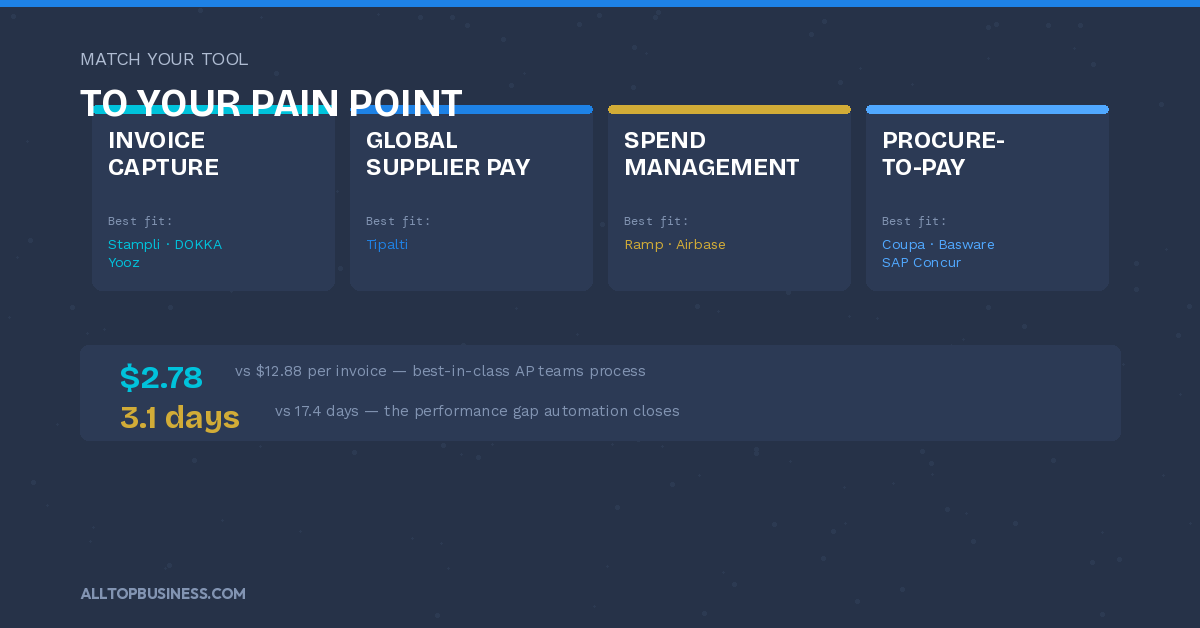
Invoice delivery and format complexity? Billtrust or Esker. Collections follow-up and aging management? Upflow, Gaviti, or Quadient AR. Cash application matching? HighRadius or Billtrust. Cash flow forecasting alongside collections? Tesorio. Disputes and deductions? Versapay. Subscription billing? Chargebee or Zuora. Matching the tool to your actual bottleneck delivers faster ROI than buying the broadest platform.
What is your company size and ERP environment?
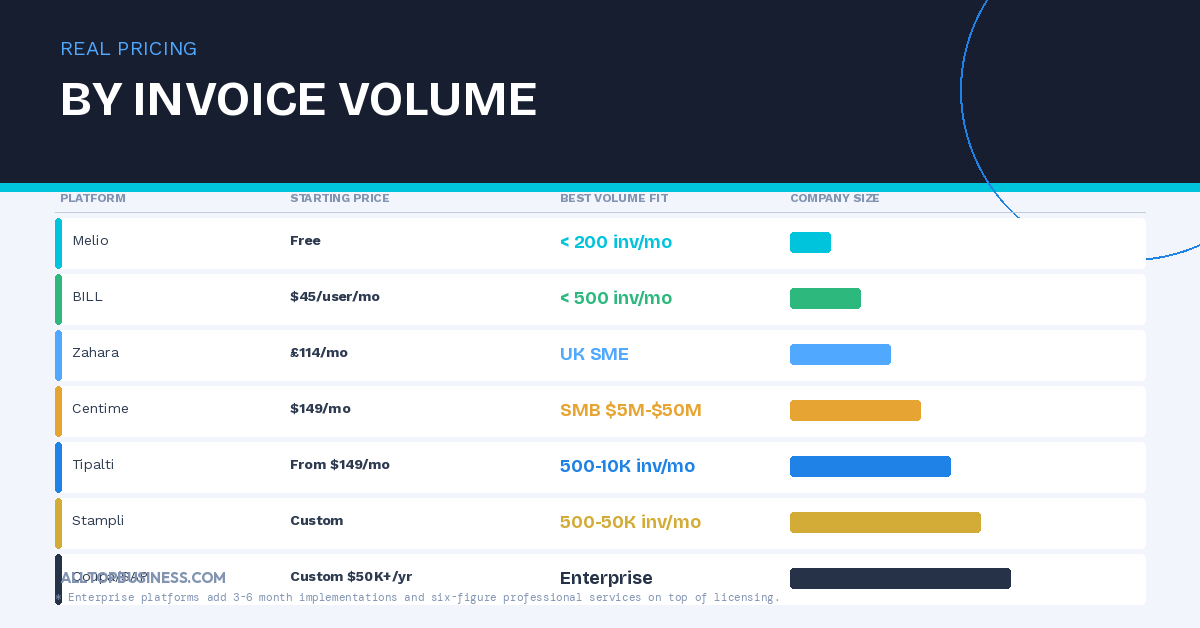
Mid-market organizations with 20 to 100 staff invest $15,000 to $35,000 annually. Enterprise platforms run $35,000 to $100,000+, while SMB tools like BILL start at $45 per user per month. NetSuite users are well-served by Tesorio, Versapay, or Quadient AR. SAP and Oracle users should evaluate HighRadius, Billtrust, or Esker first. QuickBooks and Xero users are best served by Upflow, BILL, or Zoho Books.
What does the total cost of ownership look like over 24 months?
Enterprise platforms like HighRadius and Esker carry implementation fees in the six-figure range plus annual licensing. Mid-market platforms like Billtrust, Versapay, and Quadient AR run $1,000 to $5,000 per month. SMB tools like BILL and Upflow offer transparent monthly pricing. Always model implementation cost alongside licensing — for enterprise platforms, implementation often equals or exceeds year-one licensing.
How fast do you need to see results?
Upflow and BILL will deploy in days. Gaviti and Growfin typically deploy in 4 to 8 weeks. Versapay runs 8 to 16 weeks. HighRadius implementations run 3 to 6 months with significant professional services costs. If you need to show DSO improvement within a quarter, the enterprise platforms will not get you there in time.
Frequently Asked Questions
What is accounts receivable automation software?
AR automation software digitizes and automates the order-to-cash cycle — from invoice generation through payment collection and reconciliation. It replaces manual tasks like sending payment reminders, matching incoming payments to open invoices, managing disputes, and chasing overdue accounts with automated workflows, AI-powered prioritization, and customer self-service portals.
What is the best AR automation software for small businesses?
BILL and Upflow are the strongest options for small businesses. BILL provides the most plug-and-play AR and AP automation experience starting at $45 per user per month. Upflow offers a cleaner interface and faster implementation for B2B collections starting at $400 per month. Zoho Books includes solid AR automation as part of its SMB accounting platform from $15 per month.
How much does AR automation software cost?
Mid-market organizations with 20 to 100 staff invest $15,000 to $35,000 annually. Enterprise platforms run $35,000 to $100,000+, while SMB tools like BILL start at $45 per user per month. Always factor implementation costs into year-one budgets — enterprise platforms typically require six-figure professional services investments on top of licensing.
What is the difference between AR automation and collections software?
AR automation covers the full order-to-cash workflow — invoicing, cash application, credit management, collections, and dispute resolution. Collections software focuses specifically on recovering overdue payments through automated follow-up sequences and aging management. Most modern AR platforms include collection features, making standalone collection tools less necessary unless your only pain point is follow-up automation.
What is cash application in AR automation?
Cash application is the process of matching incoming customer payments to the correct open invoices in your accounting system. Manual cash application is one of the most time-consuming AR tasks — especially when customers pay multiple invoices in one payment, remittances arrive in inconsistent formats, or payments arrive without any reference information. AI-powered cash application in platforms like HighRadius and Billtrust automates this matching at high accuracy rates.
How does AR automation reduce DSO?
AR automation reduces DSO by eliminating the delays that extend payment cycles: invoices that never arrived in the right format, reminders that were not sent consistently, disputes that sat unresolved in email threads, and cash that was collected but not applied for days. Faster invoice delivery, automated follow-up, structured dispute resolution, and immediate cash application each shave days off DSO — companies that implement AR automation typically report DSO reductions of 5 to 20 days within the first year.
What ERP integrations should I look for in AR automation software?
The most important integration is with your ERP or accounting system — this is where invoice data originates and where cash application results must land. For SAP and Oracle users, HighRadius, Billtrust, and Esker have the deepest native integrations. For NetSuite users, Tesorio, Versapay, and Quadient AR integrate well. For QuickBooks and Xero users, Upflow, BILL, and Zoho Books cover the most common integration needs.
Final Verdict
For most enterprise finance teams, HighRadius is the strongest end-to-end AR automation platform, but only if you can commit to the 3 to 6-month implementation and the six-figure budget.
For mid-market companies, the choice comes down to your primary pain point: Billtrust for invoice delivery and cash application, Versapay for dispute-driven DSO problems, Tesorio for forecasting-led collections, Quadient AR for structured collections at predictable pricing, or Upflow if speed of implementation is the priority.
For small businesses, BILL is the most accessible starting point, and Upflow is the strongest upgrade once collections complexity grows.
For subscription businesses, Chargebee handles mid-market needs, and Zuora handles enterprise billing complexity.
The most important first step is not choosing the right software; it is identifying the specific bottleneck that is extending your DSO. Match the tool to that problem, and you will see results. Buy the broadest platform without that diagnosis, and you will have expensive software your team works around.
For more B2B finance and software reviews, browse the AllTopBusiness blog. Have a specific AR automation question? Contact our team directly.
External Sources:
- G2 — Accounts Receivable Software Reviews
- Gartner — Accounts Receivable Automation Technology Reviews

I’m Adeyemi Adetilewa, a Content Marketing and SEO Specialist, Digital Strategist, Entrepreneur, and the Editor of AllTopBusiness.com. With over 13 years of experience helping businesses scale through content-driven growth, I’m happy to share all the top business tools I have discovered with you here.